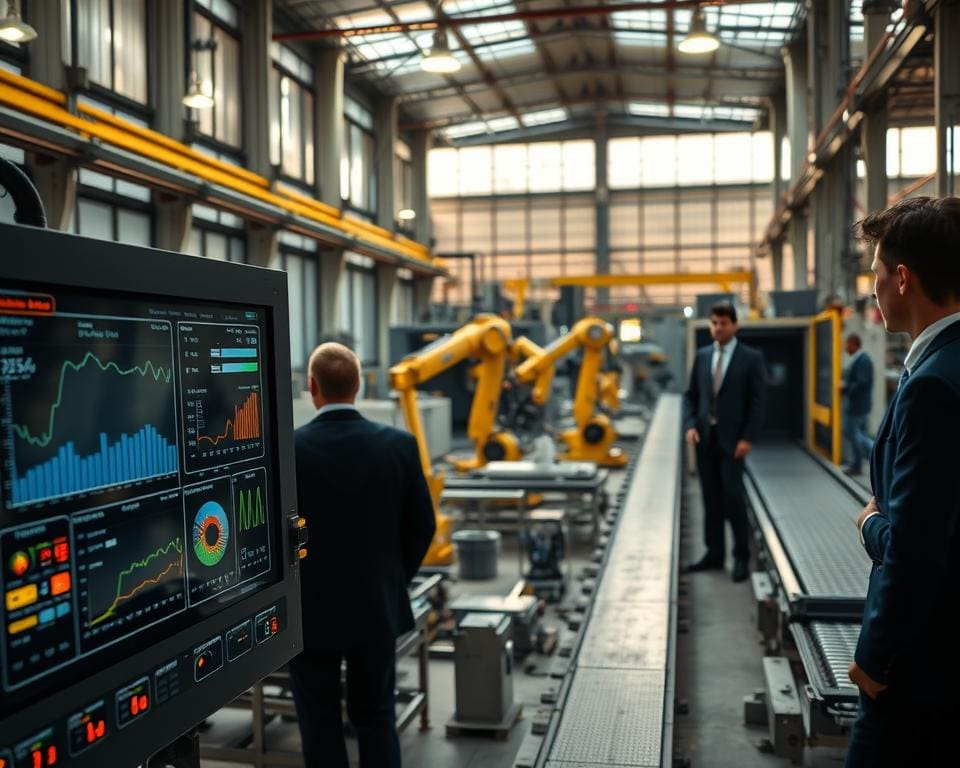
Across British manufacturing, machine monitoring has become central to reducing downtime and raising quality. This short section sets out the purpose and scope of a product-review style guide that compares factory monitoring systems and vendor offerings relevant to the industrial monitoring UK market.
Factory managers, maintenance engineers and procurement teams will find a clear map of the stack: sensor hardware at the edge, wired and wireless data paths, SCADA and MES software, and cloud platforms that enable predictive maintenance. The focus is practical adoption and measurable outcomes such as lower mean time to repair and improved yield.
Subsequent sections examine objectives and KPIs, the sensor technologies you can deploy, analytics and machine‑learning approaches, and the integration, cybersecurity and standards that matter in the United Kingdom. The aim is to blend factual descriptions with persuasive, case-ready recommendations so readers can choose monitoring solutions that deliver strong ROI.
How are machines monitored in factories?
Manufacturers seek clarity on equipment health, production quality and energy use. Clear machine monitoring objectives guide investment, choosing between reactive fixes, scheduled upkeep and predictive condition-based strategies. Leading vendors such as Siemens, ABB and Schneider Electric supply full solutions while SKF and Fluke focus on specialist sensing and diagnostics.
Overview of machine monitoring objectives
Primary aims include preventing unplanned downtime, extending asset life and protecting product quality. Effective programmes also reduce energy consumption and support traceability for audits.
Predictive maintenance is now widespread because it avoids needless interventions and stops failures before they occur. That approach yields lower mean time to repair and improved overall equipment effectiveness.
Key performance indicators tracked on the factory floor
Factory KPIs combine equipment, process and safety metrics to give a full picture. On individual machines, teams monitor vibration, bearing temperature, motor current and cycle times.
At plant level, operators watch OEE elements, throughput, rejection rates and energy per unit. Data comes from sensors, PLC counters and MES or ERP integrations to give context to readings.
Why continuous monitoring matters for uptime and quality
Continuous monitoring benefits show in early anomaly detection. Rising vibration or current spikes surface before catastrophic failure, so planned repairs replace urgent stoppages.
Ongoing data allows baselining and machine learning model training, improving detection accuracy and cutting false alarms. Quality assurance sensors flag small process drifts so teams correct issues before off-spec product is made.
Regulatory audits grow simpler with persistent records, helping firms meet standards for food and pharmaceuticals while enabling robust root-cause analysis after incidents.
Sensor technologies and data acquisition systems for industrial monitoring
Smart factories rely on a mix of proven hardware and local intelligence to keep machines safe and productive. A well‑designed layer of industrial sensors feeds crisp signals to nearby processors, enabling early fault detection and clearer decision making.
Types of sensors used: vibration, temperature, pressure and current
Vibration sensors such as accelerometers and velocity units spot bearing wear, imbalance and misalignment before damage spreads. Brands like SKF and Brüel & Kjær supply units that output FFT spectra and time‑domain metrics such as RMS and kurtosis.
Temperature monitoring uses thermocouples, RTDs and infrared spot sensors to track bearing, motor and process temperatures. Fluke and Omega Engineering make rugged probes suited to rotating parts and hard‑to‑reach locations.
Pressure transducers and differential sensors measure hydraulics, pneumatics and steam systems. Established suppliers Wika and Rosemount provide reliable transducers for process plants. Current and power sensors, from Siemens and Schneider Electric, monitor motor current, power factor and inrush events to reveal electrical faults and load shifts.
Specialised devices add depth: acoustic emission sensors for crack detection, ultrasonic leak detectors, encoders and environmental sensors for humidity and gas. These expand visibility across complex assets.
Edge data acquisition and local preprocessing
Edge data acquisition places computation near the machine to reduce latency and bandwidth use. Gateways and edge servers from Advantech and HPE perform signal conditioning, FFT and feature extraction before data leaves the plant.
Local preprocessing can include anomaly scoring, compression and short‑term storage. This approach keeps sensitive data onsite, lowers transmission costs and enables rapid, local alarms that do not depend on cloud links.
A typical flow looks like: sensor → edge DAQ/gateway → local historian → cloud for long‑term analysis. Edge processing supports resilient operation when central connectivity is intermittent.
Wired and wireless connectivity options: pros and cons
Wired networks such as Profinet, EtherNet/IP and Modbus deliver determinism, high bandwidth and strong reliability for control loops. The trade‑off is higher installation cost and less flexibility for mobile equipment.
Wireless choices include Wi‑Fi, BLE, LoRaWAN and NB‑IoT. These enable rapid deployment and lower cabling expense, making retrofits simpler and assets like forklifts easier to monitor. Consider the wireless sensors pros and cons in metal‑dense environments where interference and limited determinism can be challenges.
Hybrid architectures combine a wired backbone with wireless endpoints or use 4G/5G for remote sites. Strong security practices—network segmentation, VPNs and certificate‑based authentication—are essential whether you choose wired or wireless to protect IIoT connectivity.
Practical deployments that pair the right sensors with edge data acquisition and robust IIoT connectivity deliver clearer situational awareness. For insights on real‑time monitoring systems and safety benefits, see this discussion on safer machine operation: safer machine operation.
Software platforms and analytics powering predictive maintenance
Industrial teams rely on a layered software approach to turn sensor streams into timely actions. SCADA systems gather telemetry and present live control points. MES integration ties those machine events to production orders so maintenance work matches business priorities.
Leading suppliers such as AVEVA (Wonderware), Siemens WinCC and Rockwell FactoryTalk supply the supervisory functions and historian storage many plants use. MES vendors like Siemens Opcenter and Dassault Systèmes DELMIA handle scheduling, traceability and quality data. OPC-UA, MQTT and RESTful APIs are common bridges between PLCs, SCADA, MES and cloud analytics.
The analytics layer embeds predictive maintenance software that looks for early signs of failure. Anomaly detection ranges from straightforward threshold rules to advanced models such as autoencoders and isolation forests. These tools cut false alarms and surface subtle drifts before they become outages.
Estimating remaining useful life demands diverse modelling philosophies. Teams use physics-based models where mechanisms are understood and data-driven approaches like random forests or LSTM networks where plentiful historical patterns exist. Combining methods with transfer learning or synthetic data helps when labelled failures are scarce.
Commercial platforms from IBM Maximo and Microsoft Azure IoT to specialist vendors provide packaged ML pipelines and evaluation metrics. Precision and recall guide alert tuning. Mean absolute error measures RUL accuracy. Business KPIs focus on downtime avoided and maintenance cost saved.
Visualisation dashboards translate analytics into operator actions. Effective dashboards show real-time KPIs, trend charts and asset health scores. Tools such as Grafana, Microsoft Power BI and vendor GUIs let operators drill down from a plant map into root causes.
Alerting must be tiered and contextual to prevent alarm fatigue. Integrations with CMMS products such as IFS and Infor automate work orders and ensure a clear escalation path. Role-based views give operators instant tasks while engineers access deeper forensic data.
Integration, cybersecurity and standards for reliable monitoring
Bringing machine data into a modern platform needs careful planning. IIoT integration must balance real-time control with the desire for cloud analytics. A pragmatic approach uses edge gateways and protocol converters to mirror telemetry without changing PLC logic. This keeps deterministic control intact while enabling data-driven insights.
Consider a legacy equipment retrofit that begins with non‑invasive sensors. Clamp‑on current probes, magnetic‑mount accelerometers and IR thermography deliver immediate condition signals. IO‑Link devices add smart connectivity. Vendors such as HMS Networks and Moxa offer protocol gateways to translate Modbus or Profibus into OPC‑UA or MQTT for higher‑level systems.
Architecture matters when adding monitoring to active production lines. Use read‑only data taps and duplicate telemetry to an IIoT network rather than altering control paths. This reduces risk during retrofit projects common in automotive tier suppliers and food processors that want predictive maintenance benefits without full PLC replacement.
Protecting machine data starts with strong industrial cybersecurity. Segment IT and OT networks and place a controlled DMZ between them. Enforce strict access control and multifactor authentication for remote access. Edge devices should support secure boot and firmware signing to limit tampering.
Encryption and device identity are central. Use TLS for MQTT and HTTPS, deploy VPN tunnels when remote access is required and adopt certificate‑based device authentication. Hardware security modules or TPM chips on edge gateways raise the bar against credential compromise.
Operational monitoring and response reduce dwell time for threats. Deploy OT‑focused intrusion detection and anomaly monitoring from specialist vendors. Prepare incident response plans that unite IT, OT and third‑party suppliers to speed recovery and preserve production traceability.
Follow established standards to show due diligence. ISA/IEC 62443 provides a practical framework for industrial control system security. Aligning with ISO 27001 and industry‑specific norms supports audit readiness and helps meet UK compliance standards for regulated sectors.
Data protection has a role in industrial programmes. Sensor streams that reveal worker locations or personal identifiers must comply with GDPR industrial data obligations. Define retention policies, pseudonymise where possible and record audit trails in SCADA or MES historians for inspection.
Certification and audit readiness depend on traceable records. Timestamped historians, access logs and signed firmware manifest a mature control environment. These elements support compliance with MHRA, Food Standards Agency rules and broader UK compliance standards when manufacturers face audits.
Practical considerations, product comparison and return on investment
Begin by defining use-cases and success metrics before engaging suppliers. Decide which failure modes you must catch, the acceptable false‑positive rate and target reductions in downtime or maintenance cost. A focused brief makes pilot design clearer and helps estimate predictive maintenance ROI from the outset.
Factor scalability and total cost of ownership into procurement decisions. Include sensor kit cost, gateways, edge devices, software licences, cloud fees, integration, training and ongoing support. Phased rollouts—pilot to line to plant—reduce risk and provide real data to refine TCO and retrofit solutions UK plans.
Prioritise ease of installation, local support and open interoperability. Solutions with quick‑connect sensors, pre‑configured analytics and UK channel partners such as Siemens, ABB and Schneider often speed deployment. Insist on OPC‑UA or MQTT, exportable data and APIs to avoid vendor lock‑in and preserve analytics portability.
Compare product families pragmatically: full‑stack incumbents like Siemens SIMATIC/MindSphere, Rockwell FactoryTalk and Schneider EcoStruxure suit integrated automation needs. Specialist vendors such as SKF, Fluke and Brüel & Kjær excel at high‑fidelity sensing. Cloud‑first platforms — Microsoft Azure IoT, PTC ThingWorx and AWS IoT — are strong for agile retrofits and rapid ML experiments. Edge providers such as Advantech and HPE Edgeline offer low‑latency processing for bandwidth‑constrained sites. For maintenance workflows, IBM Maximo, Infor EAM and IFS close the loop.
Build the business case on measurable gains: reduced unplanned downtime, lower spare‑parts inventory, extended asset life and energy savings. Typical payback for targeted pilots ranges from 6–24 months. Use conservative sensitivity analyses, track KPIs during pilot phases and consider financing options, SaaS or hardware‑as‑a‑service to spread capital. Seek UK innovation funding where relevant.
For UK manufacturers, adopt a hybrid approach: high‑quality sensors and edge analytics for immediate detection, integrated with SCADA and MES for context, plus cloud platforms for longer‑term RUL models. Choose suppliers with strong local service, open protocols and clear escalation paths, and measure predictive maintenance ROI against defined KPIs as you scale.