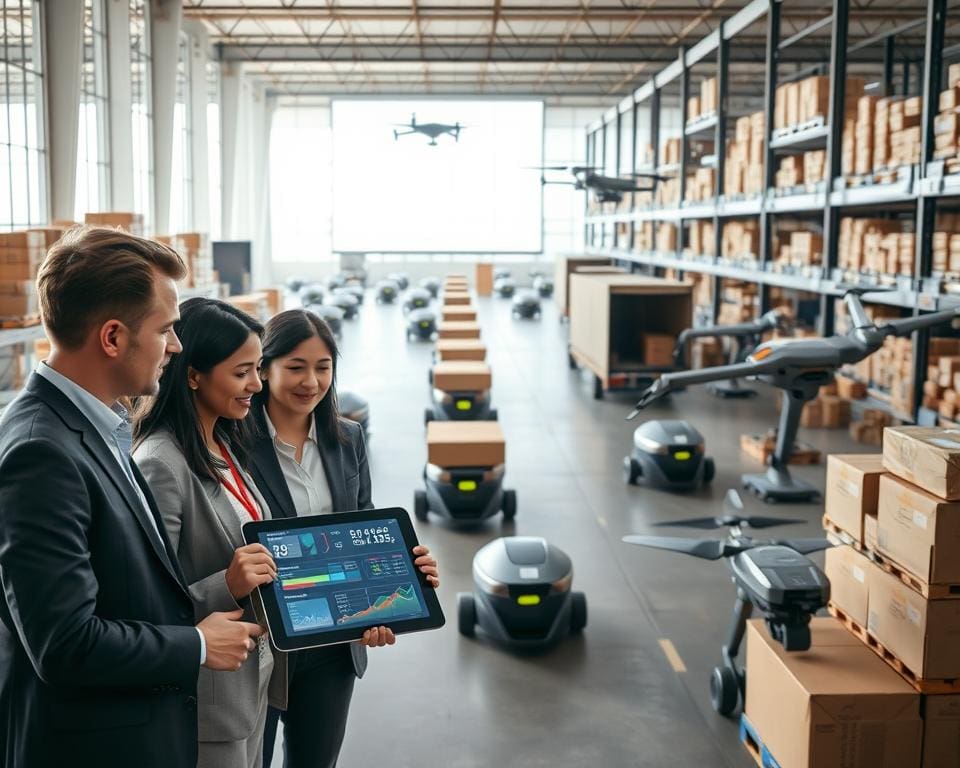
Technology in logistics has reshaped everyday work across warehouses, depots and delivery fleets in the United Kingdom. This short introduction explains how is technology used in logistics jobs and why it matters for logistics careers UK, from frontline pickers to senior supply chain leaders.
Driven by e-commerce growth, labour shortages and net-zero targets, firms such as Amazon, Tesco, DHL and Wincanton are investing in a mix of warehouse automation, inventory systems, transport management, IoT and AI. Supply chain technology now aims to boost efficiency, accuracy and safety while reducing costs and emissions.
The practical angle in this review treats tech as tools that empower people. Vendors like Zebra Technologies, Honeywell, Blue Yonder, Manhattan Associates, Siemens and Samsara supply hardware and platforms that change daily tasks without erasing the human role.
Readers will learn what logistics job tech can deliver for frontline staff, middle managers and senior leaders, plus the skills and training needed to adopt these systems successfully. The following sections assess categories and real UK use-cases to make the benefits tangible and actionable.
How is technology used in logistics jobs?
Technology shapes everyday work in UK warehouses and transport hubs. Rapid growth in UK logistics technology adoption answers demand from e-commerce, seasonal peaks and tight labour markets. Many operators favour a hybrid model that pairs manual skills with selective automation to keep agility and control.
Overview of technology adoption in UK logistics
Investment focuses on cloud platforms, automation and data tools from vendors such as Microsoft, IBM and specialist logistics suppliers. Connectivity and planning permission for automated buildings can affect roll-out speed across regions. Industry reports point to steady funding in fulfilment tech and systems that integrate via APIs for faster decision-making. Read more about the technology mix here.
Key benefits for frontline logistics roles
Frontline staff see clear gains in productivity and safety. Goods-to-person systems and pick-to-light reduce walking and speed cycles, lifting throughput. Barcode and RFID scanning cut mispicks and returns while voice-directed picking improves accuracy and pace.
Safety improves with collision-detection sensors and wearable supports that lower strain and injuries. Jobs shift toward supervision, exception handling and quality control, giving staff new skills and responsibilities. These frontline logistics benefits are felt across warehouses and last-mile teams.
Examples of technology in everyday tasks: picking, packing and shipping
Picking uses voice systems from Honeywell and pick-to-light racks to accelerate fulfilment. Robotic trolleys and arm assistants handle high-volume SKUs to keep human workers focused on complex orders.
Packing relies on automated weigh and dimension stations plus packing optimisation software to cut material use and processing time. Parcel sortation solutions from Vanderlande and Siemens speed throughput at peak times.
Shipping is driven by transport management systems such as Blue Yonder and Descartes that automate manifesting, label creation and carrier selection. Handheld scanners from Zebra confirm dispatch and capture proof of delivery, tying into the wider logistics digital transformation UK landscape.
Warehouse automation and robotics transforming operations
The rise of warehouse automation UK is reshaping how goods move from shelf to dispatch. Facilities are combining dense storage, smart software and robotic workcells to lift throughput while using space more efficiently.
Automated storage and retrieval systems bring high-density shelving served by cranes or shuttles. Names such as AutoStore and SSI Schäfer are common in large fulfilment centres. These AS/RS systems cut retrieval times, reduce shrinkage and keep throughput steady at peak demand.
Adopters must weigh capital outlay, facility redesign and maintenance contracts. Major retailers and manufacturers often lead the investment, guided by planning permissions and long-term ROI modelling.
Robotic picking uses articulated arms from ABB, Fanuc and KUKA alongside mobile robots from Amazon Robotics and Locus. Machine vision and adaptable grippers handle varied SKUs. Cobots work beside people in mixed-SKU lines to combine speed with flexibility.
Conveyor integration links robotic cells to sorters and continuous flows. Solutions from Vanderlande and Beumer illustrate how conveyors and robots reduce idle time, speed packing and support sustained dispatch rates.
Job roles evolve as automation grows. Purely manual picking for high-volume SKUs declines while demand rises for technicians, robotics operators and system integrators.
Logistics workforce skills shift toward PLC basics, robotics troubleshooting and vendor-specific software. Mechanical maintenance, systems monitoring and data interpretation become everyday requirements.
Practical workforce strategies include cross-skilling existing staff, using temporary workers for seasonal surges and partnering with colleges and City & Guilds for technician certification. These steps help companies harness robotic picking, conveyor integration and AS/RS systems while keeping teams motivated and capable.
Inventory management systems and real-time tracking
Modern logistics teams in the UK rely on real-time stock visibility to keep shelves full and costs down. Cloud platforms link warehouses, online stores and transport partners so teams can act fast when demand shifts.
Cloud-based platforms and centralised control
Platforms from Manhattan Associates, Oracle NetSuite and Blue Yonder run on cloud infrastructure to give a single view of inventory across sites. This centralised control keeps SKU master data consistent and speeds up software updates.
APIs connect WMS to ERP, Shopify and Magento, which supports omnichannel fulfilment and scales during seasonal peaks. Using cloud inventory systems reduces on-premise IT overheads and helps teams respond to sudden surges in demand.
RFID and barcode scanning for accuracy
Handheld scanners from Zebra and Honeywell still deliver excellent barcode scanning accuracy for line-level picking and dispatch. Scanning 1D and 2D barcodes remains a cheap, reliable method for day-to-day operations.
RFID logistics offers a different step-change. Passive and active tags allow quick bulk reads at pallet level, speed up cycle counts and improve receiving accuracy. The trade-off is higher upfront tag and reader costs, but many retailers and cold-chain operators find the time savings outweigh the investment.
How real-time data helps reduce stockouts and overstocks
Live telemetry shows current stock, backorders and replenishment needs. Automated triggers can create purchase orders or transfer requests when thresholds are met, which helps reduce stockouts overstocks and lowers emergency deliveries.
Predictive signals cut lead times and improve fill rates. UK case studies report better on-shelf availability for retailers and fewer excess inventory holds for manufacturers when systems use real-time data to guide replenishment.
Transport management systems and route optimisation
Transport management systems UK are reshaping how fleets plan and execute trips across cities and regions. Cloud-based TMS platforms from vendors such as SAP Transportation Management and Transporeon centralise carrier networks, enable dynamic pricing and simplify freight auditing. This creates a single control point for planners who must balance service levels with cost and sustainability targets.
Planners and operators face tight urban constraints: congestion, low-emission zones and narrow streets demand smarter approaches. Effective route optimisation cuts miles driven and reduces failed deliveries by clustering stops and matching vehicle type to load. Micro-hubs, parcel lockers and click-and-collect schemes make deliveries more resilient while keeping customer windows intact.
Integrating telematics integration with a TMS adds live vehicle location, driver behaviour and engine diagnostics to planning tools. Providers like Samsara and Verizon Connect feed real-time data to predict ETAs, trigger dynamic rerouting and monitor compliance with driver hours. That link between software and hardware turns static plans into adaptive movements on the road.
Last-mile delivery UK is where outcomes become visible to customers. Using electric vans, cargo bikes and cycle couriers for inner-city drops lowers street-level emissions and speeds up delivery in dense areas. Crowd-sourced models and time-window optimisation further squeeze inefficiency out of the final leg.
Cost savings come from fewer wasted miles, improved first-time delivery rates and better asset utilisation. Route optimisation reduces fuel and labour spend by tightening schedules and cutting idle time. At the same time, logistics carbon reduction is achieved through modal shifts, EV adoption and consolidated loads, supporting corporate Net Zero aims and UK clean air measures.
Practical steps for teams include adopting a cloud TMS that supports parcel carrier APIs, pairing it with robust telematics and piloting micro-hub networks in congested boroughs. Small trials of consolidated routing and locker pick-ups deliver quick wins and build momentum for broader change.
IoT and sensors improving visibility across the supply chain
Connected sensors reshape how goods move from factory to customer. In the UK, teams rely on a mesh of devices to track condition, location and performance in real time. That visibility helps operations stay agile and protect high-value cargo.
Temperature and condition monitoring for sensitive goods
Pharmaceuticals, fresh food and certain chemicals demand constant temperature, humidity and shock checks. Solutions from Sensitech and Emerson feed cloud alerts and audit trails that satisfy MHRA and Food Standards Agency reporting.
Such temperature monitoring cold chain systems reduce spoilage and lower recall risk. Buyers gain confidence when shipments carry verifiable, time-stamped condition records that back quality claims.
Asset tracking and predictive maintenance
GPS and Bluetooth tags give clear asset visibility for trailers, containers and equipment. That visibility cuts loss and raises utilisation for fleets and warehouses.
Sensors on forklifts and conveyors capture vibration, heat and run hours. Platforms from SKF, Siemens MindSphere and Caterpillar telematics turn those feeds into predictive maintenance plans, trimming unplanned downtime and servicing costs.
Data streams and actionable insights for dispatch teams
Real-time dashboards merge IoT feeds with WMS and TMS to present ETA estimates, condition flags and exception alerts. Dispatchers use dispatch insights to re-route time-sensitive loads or switch carriers before a problem escalates.
- Prioritise orders by sensor-derived risk scores.
- Trigger alternate carriers for at-risk consignments.
- Schedule preventative work to keep fleets running.
These workflows strengthen SLAs, cut shrinkage and speed decision-making across the network. As more operators adopt IoT logistics UK approaches, resilience and service quality improve for customers and suppliers alike.
Data analytics, AI and machine learning in logistics
Data and machine learning are changing how UK operators plan and act. Small teams can use large datasets to spot patterns in sales, weather and promotions. That leads to smarter decisions on stock levels and routing, lifting service without bloating costs.
Demand forecasting logistics
Machine learning models from vendors such as Blue Yonder, SAP IBP and RELEX Solutions blend sales history with external signals. These systems forecast demand more accurately than older statistical methods. The result is lower safety stock, fewer stockouts and reduced markdowns.
Inventory optimisation AI
AI-driven replenishment and dynamic slotting shrink excess inventory while keeping shelves full. Planners receive ranked options with confidence scores so they can accept or adjust suggestions. Systems explain which drivers—promotions, seasonality or local events—shape recommendations.
AI-driven decision support for planners and managers
Use cases include automated load building, exception detection and suggested corrective actions. AI augments human judgment by presenting clear trade-offs and predicted outcomes. This helps managers make faster, more transparent choices under pressure.
case studies UK logistics efficiency
- Supermarket chains report fewer out-of-stocks during promotions when using AI forecasting, improving customer satisfaction and sales.
- Third-party logistics providers increase vehicle fill rates through optimisation algorithms, cutting cost-per-delivery and emissions.
Reported gains often fall in ranges such as 10–30% faster order fulfilment and 5–20% inventory reduction. Results vary by baseline performance and implementation scope, but real-world examples show clear uplift.
Mobile apps and handheld devices empowering staff
Mobile solutions have rewritten the frontline playbook in UK distribution centres. Rugged handhelds from Zebra and Honeywell sit alongside tablet devices running bespoke WMS mobile applications. These tools turn task lists into clear, real-time actions that speed picking, capture signatures and log photo evidence for quality control.
Handheld scanners remain essential for accuracy at the shelf. Their rapid reads reduce errors and shorten cycle times during peaks. Consumer-grade tablets give managers flexible views of progress and exceptions, while enterprise apps keep records centralised and auditable.
The next wave of ergonomics comes from wearable tech and hands-free systems. Wrist-mounted scanners and smart glasses let teams work with both hands free. Voice headsets pair with warehouse software to guide speech-driven workflows.
Wearable tech picking devices increase comfort and speed, which helps night shifts and short-term hires maintain pace. Systems such as Honeywell’s Vocollect are proven to raise throughput and reduce mistakes through clear voice prompts.
User-friendly design is vital for permanent staff and seasonal recruits. Interfaces need large buttons, clear prompts and support for multiple local languages. Simplified modes cut onboarding time for temporary workers and reduce mental load in busy operations.
Training and rollout shape long-term success. Phased pilots, on-the-job mentoring and blended learning models—combining e-learning with practice—help teams adopt new devices with confidence. Involving unions and staff representatives early eases change and builds trust.
- Phased roll-outs and pilot programmes speed realistic adoption.
- Peer mentoring and certifications reward digital competence.
- Measured metrics show faster ramp-up and higher retention.
Strong planning ties technology to people outcomes. Thoughtful user interfaces, reliable handheld scanners and supportive training drive acceptance. When staff see devices as enablers, productivity and morale rise in tandem with system capability.
Safety, compliance and sustainability through technology
Modern logistics safety technology UK delivers clear, measurable benefits on the warehouse floor and in transit. Proximity sensors, smart cameras and autonomous guided vehicles reduce collisions, while exoskeletons and powered lifting aids cut the risk of musculoskeletal injuries. Mobile incident-reporting apps and digital checklists make near-miss logging simple, driving a stronger safety culture and faster corrective action.
Compliance logistics is strengthened by connected systems that record and retain vital data. Warehouse management systems, transport management platforms and IoT sensors produce audit-ready trails with timestamps, GPS logs and sensor readouts. That digital evidence supports regulatory compliance UK obligations such as ADR for dangerous goods, food safety standards and cold-chain rules for pharmaceuticals.
Sustainable logistics technology plays a central role in reducing the carbon footprint of operations. Route optimisation, fleet electrification and load consolidation cut CO2 per parcel, and telematics provide the telemetry needed for accurate Scope 1 reporting. Packaging optimisation software trims material use and waste, helping teams meet carbon reduction supply chain goals while lowering costs.
Technology delivers best results when chosen to solve defined problems and paired with people-centred deployment. Start with pilots, favour modular solutions that integrate with existing WMS/TMS, and work with reputable vendors such as Blue Yonder, Manhattan Associates, Zebra, Honeywell, Siemens and Vanderlande. Invest in training to turn tools into lasting gains in safety, compliance logistics and sustainable logistics technology for board-level impact.