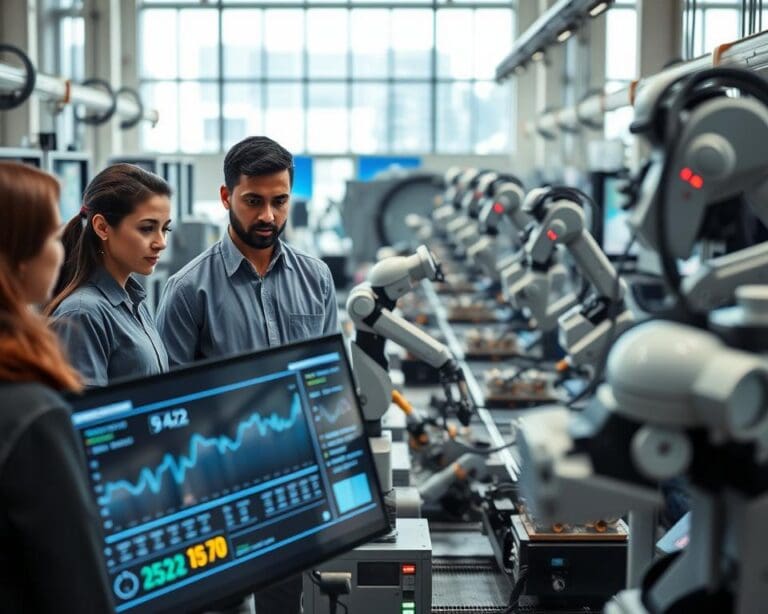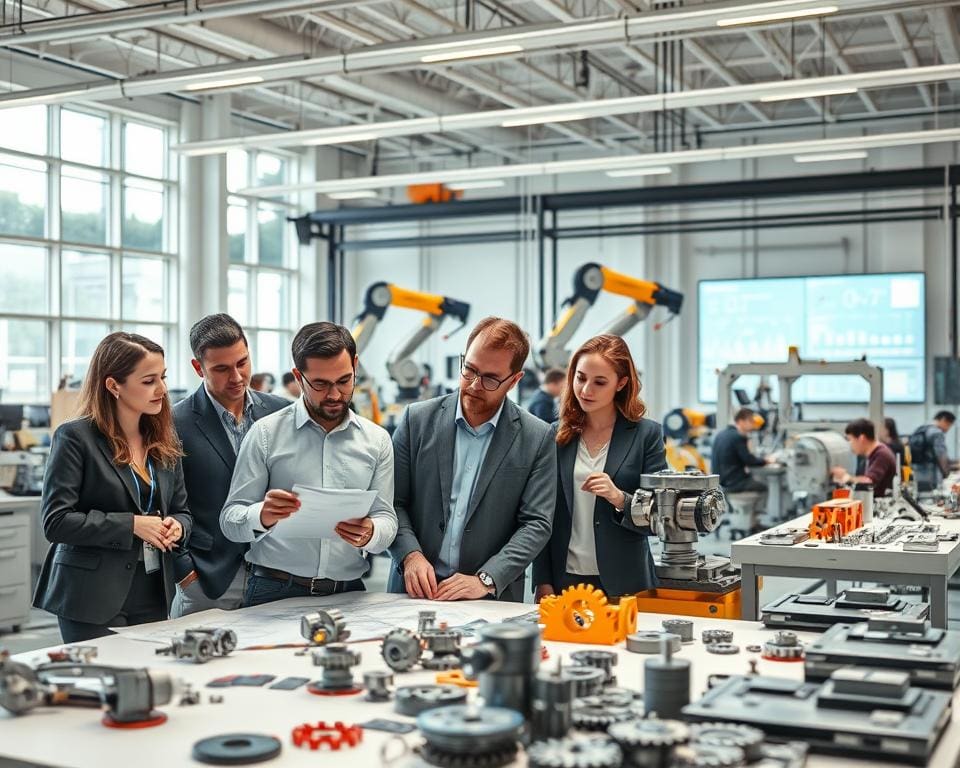
Engineers across the United Kingdom are tackling complex manufacturing problems with creativity and rigour. This piece explains how engineering solutions manufacturing now blend materials science, digital tools and human factors to meet rising demand for bespoke products and faster delivery.
Drivers of complexity include greater product customisation, continued miniaturisation, shorter lifecycles and tighter safety rules such as MHRA and UKCA conformity. Supply‑chain volatility since Brexit and the push towards UK Net Zero also force cross‑disciplinary approaches rather than single‑issue fixes.
The outcomes sought are clear: higher throughput and flexibility, consistent quality at scale, lower lifecycle emissions, resilient supply chains and faster time‑to‑market. Successful strategies balance technical performance with compliance, safety and commercial viability.
Manufacturing innovation UK is visible in aerospace with Rolls‑Royce and BAE Systems, in automotive with Jaguar Land Rover and Nissan Sunderland, and in pharma and medtech with AstraZeneca and Smith & Nephew. Programmes from UK Research and Innovation, the High Value Manufacturing Catapult and Innovate UK help translate industrial engineering advances into practical solutions.
This article first explores technological innovations such as advanced materials, digital twins and AI, then moves to collaborative technologies and workforce upskilling, and finally examines process innovation, sustainability and regulatory compliance. Together these sections show how engineers are solving complex manufacturing challenges through integrated, real‑world action.
How are engineers solving complex manufacturing challenges?
Engineers combine material science, simulation and artificial intelligence to meet rising performance and sustainability targets. Teams in the UK and beyond pair rapid materials testing with manufacturing workflows to move innovations from lab benches to shop floors. This blend of practical research and industrial scale-up drives progress in advanced materials manufacturing and design innovation.
Novel materials such as carbon‑fibre composites, high‑temperature alloys, additive manufacturing powders and biocompatible polymers let designers cut weight and increase life. Aerospace firms adopt carbon‑fibre to lower fuel use. Automotive engineers select aluminium and magnesium alloys for light‑weighting. Rolls‑Royce uses advanced alloys and additive routes for turbine components while GE Aviation prints complex parts to reduce assemblies.
Design for additive manufacturing (DfAM) unlocks topology optimisation and part consolidation. Engineers reduce assembly steps and failure points by creating shapes impossible with traditional methods. Faster mechanical testing, improved microstructural imaging and in‑situ monitoring shrink the time from discovery to factory readiness.
Standards bodies such as BSI and ISO help qualify new materials and ensure interoperability. Their guidance supports exportable practice and gives manufacturers the confidence to adopt materials engineering UK programmes.
Digital twins and simulation for process optimisation
Digital twin simulation creates a virtual replica of machines, lines or whole plants to run scenarios without halting production. Siemens and Dassault Systèmes provide platforms used in planning and validation. Nissan and Jaguar Land Rover apply simulations to shorten validation cycles and improve assembly ergonomics.
Simulated testing reduces commissioning time and cuts the need for physical prototypes. Multi‑physics tools — CFD and FEA — coupled with real‑time IIoT sensor feeds keep twins synchronised with reality. That speeds root‑cause analysis and supports better layout decisions.
Data integration and cybersecurity are common barriers. Edge computing and pilot support from Catapult centres help overcome latency and deployment risks for UK manufacturers.
AI‑driven predictive maintenance and quality control
AI predictive maintenance uses machine learning on vibration, temperature and acoustic data to forecast failures and schedule repairs before breakdowns. Solutions from Siemens, IBM Maximo and PTC help companies reduce unplanned downtime and lower costs.
Quality control automation applies computer vision and deep learning to spot surface defects, dimensional variances and assembly errors faster than manual inspection. Manufacturers report improved first‑pass yield and less scrap after integrating vision systems into production lines.
Engineers embed AI into MES and SCADA to create closed‑loop feedback that tightens process control. Emphasis on explainable AI improves operator trust and meets regulatory needs in sectors such as pharmaceuticals, where traceability and interpretability are essential.
Collaborative technologies and workforce upskilling to tackle manufacturing complexity
Manufacturers in the United Kingdom are blending people, machines and networks to meet rising complexity. This shift puts emphasis on smart shop floors, resilient supply lines and a culture that values learning. The result is more adaptable factories and a workforce ready for change.
Human–machine collaboration and cobots
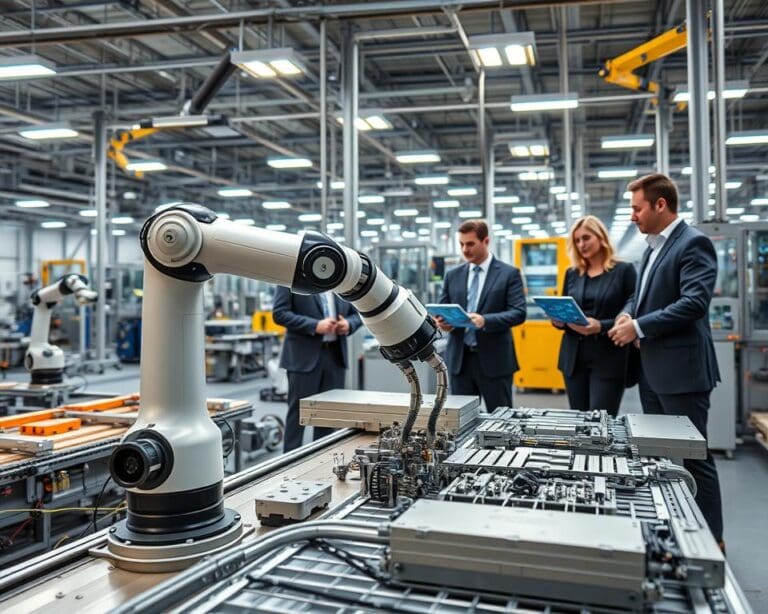
Collaborative robots can work safely alongside operators, taking on machine tending, inspection and light assembly. Brands such as Universal Robots, Fanuc and ABB have collaborative models deployed across UK plants.
Cobots UK help firms move to high‑mix, low‑volume production by offering flexible deployment and rapid redeployment between tasks. Small and medium enterprises use them to scale automation without losing skilled staff, since cobots augment craftspeople rather than replace them.
Engineers follow ISO 10218 and ISO/TS 15066 for risk assessment when integrating cobots. Human factors engineering shapes intuitive interfaces and ergonomic workstations to reduce cognitive load and improve safety.
Upskilling and digital training for engineers and technicians
Reskilling is essential. Engineers and technicians must master CAD, CAM, simulation tools, data analytics, AI basics and cyber‑physical systems. Programmes such as apprenticeships, T‑Levels, ECITB pathways and Catapult training support this drive in the UK.
Digital training engineers benefit from VR and AR for hands‑on practice and remote expert guidance. Solutions from PTC Vuforia and Microsoft Dynamics 365 Guides demonstrate how simulation cuts risk and speeds competency acquisition.
Organisations adopt competency matrices and promote lifelong learning. Blending technical courses with problem solving and systems thinking creates multidisciplinary teams capable of maintaining complex assets.
Cloud platforms and connected supply chains
Cloud supply chain platforms unify data from plants, suppliers and design teams to give real‑time visibility and improved demand forecasting. Siemens Xcelerator, PTC, AWS IoT and Microsoft Azure IoT are examples supporting UK manufacturers.
Connected manufacturing extends to supplier portals, distributed‑ledger proofs for provenance and digital procurement. These tools boost resilience, reduce lead times and aid regulated sectors such as aerospace and pharmaceuticals.
Engineers design secure architectures with segmentation and encryption while following NCSC guidance for industrial control systems. Cloud connectivity enables remote commissioning, over‑the‑air updates and centralised analytics, which accelerates roll‑out of innovations across multi‑site operations.
Process innovation, sustainability and regulatory compliance
Process innovation manufacturing means rethinking production flows to cut waste and speed delivery. In the UK, engineers apply lean manufacturing, Six Sigma and flexible manufacturing systems to reshape shop floors. Cell-based manufacturing and single-piece flow have reduced work-in-progress and lead times in automotive and electronics plants, while modular tooling and line reconfiguration let businesses switch models fast without losing quality.
Continuous improvement tools such as Kaizen, value‑stream mapping and design of experiments help teams refine processes step by step. Projects that combine design for additive manufacturing, automation and precise process control compress product development cycles. Manufacturing execution systems and product lifecycle management link design to the shop floor, creating digital audit trails that support regulatory compliance engineering and traceability.
Engineers also lead efforts in sustainable manufacturing UK by electrifying processes, recovering heat, reusing water and closing material loops. Remanufacturing programmes in aerospace and battery recycling in the automotive sector show how circular economy manufacturing can be practical. Lifecycle assessment gives teams clear data on environmental impact, guiding choices that lower emissions and resource use—examples include additive manufacturing to reduce scrap and optimised heat treatment to save energy.
Regulatory compliance engineering sits alongside efficiency and green goals. Teams follow MHRA rules for medical products, CAA and EASA (and UKCA/CE) requirements for aerospace parts, and HSE standards for workplace safety. Risk management tools such as FMEA, hazard analysis and IQ/OQ/PQ validation underpin consistent control. By uniting process innovation, sustainability and compliance, engineers create resilient, efficient systems that meet legal obligations and market demands across the UK and beyond.