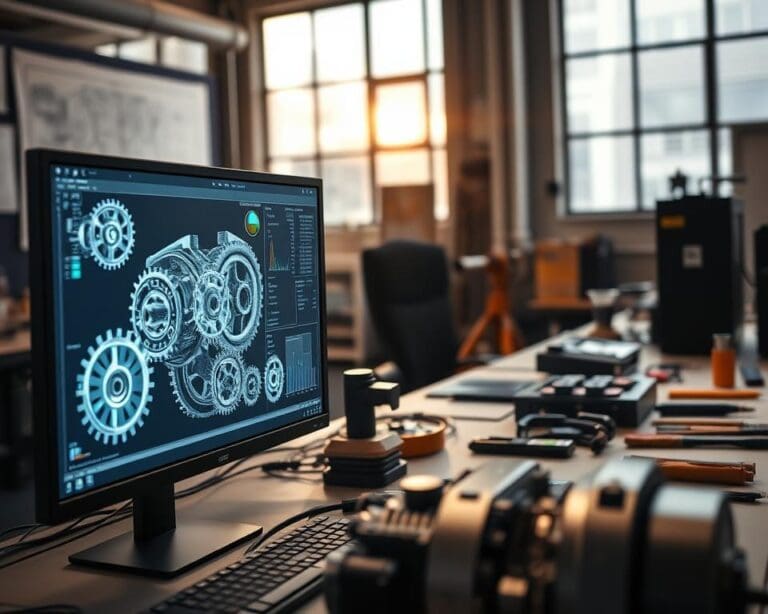
Engineers face a clear challenge: lift output while cutting waste. At its heart, productivity in machine design means output per unit time — throughput — together with measures such as overall equipment effectiveness (OEE), quality rate and yield, and resource efficiency for energy, material and labour. These metrics drive decisions from concept to commissioning.
Why does this matter in the UK? The UK Industrial Strategy and trends like reshoring push firms to favour high-value manufacturing. Companies such as Rolls‑Royce, JCB and GKN Aerospace depend on machine design for productivity to stay competitive against lower-cost markets. Strong engineering productivity UK improves margins and secures skilled jobs.
This article explores how do engineers design machines for higher productivity, starting with the metrics and sector case studies that show where gains are possible. We then move to practical principles and methodologies, and on to enabling technologies such as automation, IIoT and digital twins. The final section focuses on human factors, ergonomics and process optimisation.
Typical targets are tangible: engineers commonly aim for 10–30% higher throughput, 20–50% less unplanned downtime through predictive maintenance, and notable energy savings from efficient drives and controls. The emphasis is on sustainable productivity — increasing production while reducing waste and environmental impact — a key part of long-term industrial efficiency and production optimisation.
How do engineers design machines for higher productivity?
Engineers blend data, practical trade-offs and sector knowledge to lift machine performance. They use measurable targets to shape choices on components, layouts and control systems. This short guide outlines the metrics, design balances and UK examples that steer those decisions.
Understanding productivity metrics in engineering design
Design teams rely on clear indicators to guide decisions. Key measures include overall equipment effectiveness, cycle time, takt time and first-pass yield. Reliability figures such as mean time between failures and mean time to repair inform choices about spares, redundancy and maintenance access. Energy intensity (kWh per unit) is growing in importance for carbon and cost reasons.
These metrics translate into concrete design actions. Selecting reliable bearings and simple conveyance systems lifts availability. Sizing actuators to meet takt time prevents bottlenecks. Tooling designed for quick changeovers cuts downtime and protects yield.
Measurement and benchmarking support continuous improvement. Time studies, process capability indices (Cp, Cpk) and statistical process control show where variation harms throughput. Standards from ISO and BSI set common methods for measuring and reporting performance.
Balancing throughput, uptime and quality
Design involves trade-offs. Pushing for higher speed can reduce quality or accelerate wear. Over-engineering for durability can raise costs and slow upgrades. Skilled engineers aim for the best compromise for a given product mix.
Practical strategies include modular design to scale speed as demand grows and redundant critical components to enable uptime improvement without a full stop. In-line inspection using machine vision protects first-pass yield while keeping lines moving.
- Servo-driven indexed stations for precise high-speed motion.
- Quick-change tooling to shorten format switches and maintenance.
- Condition-monitoring sensors to flag faults before they become failures.
Case studies from UK manufacturing sectors
Automotive suppliers and OEMs in the UK apply automation and precision tooling to meet volume and quality demands. Operations linked to Jaguar Land Rover and historical Nissan plants show how tight integration of line design, robotics and inspection can improve overall equipment effectiveness.
The food and beverage sector emphasises hygienic design and flexible filling lines. Companies such as AB InBev and Kerry Group use rapid clean-in-place systems and multi-format lines to reduce downtime and support a wide SKU range.
Aerospace and high-value manufacturers such as Rolls‑Royce and GKN focus on machining accuracy and repeatability. Design that considers life-cycle maintenance helps sustain high OEE for expensive, low-volume parts.
Across these UK manufacturing case studies the common lessons are clear: design for flexibility, design for robustness and align engineering choices with maintenance planning to protect throughput vs quality balances.
Principles and methodologies that boost machine performance
Engineers blend practical tactics with proven methods to lift machine performance across a plant. Clear goals on uptime, throughput and cost guide choices from initial concept to long-term support. The right mix of design rules and operational thinking reduces waste and keeps assets productive.
Design for manufacturability and design for maintainability shape how a product is broken down, assembled and supported. Reducing part count and using standardised components cut assembly time. Modular subassemblies and captive fasteners speed line throughput and simplify spares planning.
Practical measures include snap-fit joints, common fastener sizes and fitted access panels for inspection. Kitting spare parts and designing clear visual indicators shorten mean time to repair. Suppliers using cell-based modular production report faster ramp-up and lower inventory holding.
Lean engineering adapts factory principles into the machine itself to remove non-value steps. Designers map internal flows to eliminate excess motion, waiting and over-processing. Simple error-proofing features such as guided feeds and interlocks reduce defects in use.
Tools like value-stream mapping reveal bottlenecks inside a machine’s cycle. A 5S layout inside service areas helps operators respond quickly. Where feasible, single-piece flow and poka-yoke devices cut rework and improve operator productivity, reflecting the influence of the Toyota Production System on many UK shops.
Reliability-centred maintenance and life-cycle thinking make long-term costs visible during design. Techniques such as FMEA and fault-tree analysis highlight critical failure modes early. Accelerated life testing validates material choices and mean-time-to-failure targets.
Life-cycle cost analysis examines energy use, spare parts, scheduled labour and downtime alongside capital spend. Total cost of ownership models justify using robust alloys, redundancy for key functions and modular replaceable units. Rolls‑Royce’s emphasis on life-cycle support in aerospace offers a strong model for high-value equipment.
- Design tactics: modular replaceable units, accessible service points, common spares.
- Lean methods: value-stream mapping, 5S, single-piece flow, poka-yoke.
- Reliability tools: FMEA, fault-tree analysis, accelerated testing and TCO modelling.
When teams combine design for manufacturability with maintainability, apply lean engineering and adopt reliability-centred maintenance, machines last longer and cost less to run. Small design choices compound into measurable gains for operators and owners.
Applying advanced technologies to increase efficiency
Modern factories gain momentum when digital tools meet sound engineering. Careful integration of automation, sensing and simulation creates systems that run faster, longer and with fewer surprises. The right blend of technologies transforms individual machines into resilient production cells that boost overall throughput while keeping operators safe.
Role of automation and robotics in productivity gains
Automation and robotics deliver consistent repeatability, higher operating speeds and extended operating hours. Fixed automation excels at high-volume, low-variation tasks. Flexible automation adapts to product changes with reprogrammable cells. Collaborative robots, or cobots, work alongside people to cut manual handling and improve ergonomics.
Designers must consider cell layout, vision-system placement and end-of-arm tooling to meet cycle-time targets. Human–robot interaction protocols follow UK safety standards such as BS EN ISO 10218 and ISO/TS 15066 to protect staff. Robotic palletising, machine tending, pick-and-place and metrology robots enable 24/7 operation for routine work while freeing skilled technicians for complex tasks.
Integrating sensors, IIoT and predictive maintenance
Industrial sensors such as vibration, temperature, current, acoustic emission and torque units feed condition-monitoring systems. Edge computing filters and preprocesses data on-site. Cloud platforms aggregate datasets for long-term analytics and team-wide visibility.
IIoT predictive maintenance uses machine-learning models on time-series sensor streams to forecast faults and plan interventions before failures occur. Systems from Siemens MindSphere, PTC ThingWorx and GE Predix are commonly deployed, with UK integrators implementing tailored solutions for manufacturers.
Benefits are measurable: higher MTBF, reduced unplanned downtime and optimised spare-parts inventories. Reports often show downtime cuts in the 20–50% range when condition monitoring and predictive maintenance are properly applied.
Use of simulation, digital twins and virtual commissioning
A digital twin is a live, data-driven model of equipment that supports performance tuning, scenario testing and predictive analysis. Engineers use kinematic and dynamic simulation for motion systems, discrete-event simulation for throughput analysis and finite-element analysis for structural stresses.
Virtual commissioning lets teams test control logic, HMI screens and safety interlocks in a simulated environment. This practice reduces on-site commissioning time, lowers risk during ramp-up and helps catch integration errors before hardware is installed.
Manufacturers use digital twin models to optimise machining parameters, reduce tool wear and rehearse changeovers. Virtual commissioning shortens time-to-production and smooths handovers between integrators and plant teams.
Human factors, ergonomics and process optimisation
Human operators remain central to safe, high-performing factories. Human factors engineering and ergonomics in manufacturing lower fatigue, reduce mistakes and cut injury risk. Simple changes — clear human–machine interface layouts, optimal control-panel height and readable displays — make complex tasks easier and faster for staff.
Operator-centred design uses adjustable workstations, tool balancers and lift-assist devices to reduce repetitive strain and speed changeovers. Quick-change fixtures and on-screen guided procedures, including augmented reality for maintenance, shorten repair times and keep quality consistent. These measures align with ISO 9241 and UK Health and Safety Executive guidance on manual handling and workplace ergonomics.
Process optimisation ties machine design into the wider workflow. Line balancing, process mapping and real-time dashboards turn isolated equipment into coordinated cells. Continuous improvement cycles, such as Kaizen, are driven by operator feedback and cross-functional teams from design, production and maintenance.
The outcome is tangible: higher throughput with consistent quality, lower absenteeism and improved morale. By combining sound engineering, enabling technologies and human-centred design, UK industry can field machines that are faster, more reliable and more sustainable while empowering the workforce. This approach sets a clear blueprint for boosting productivity across British manufacturing.