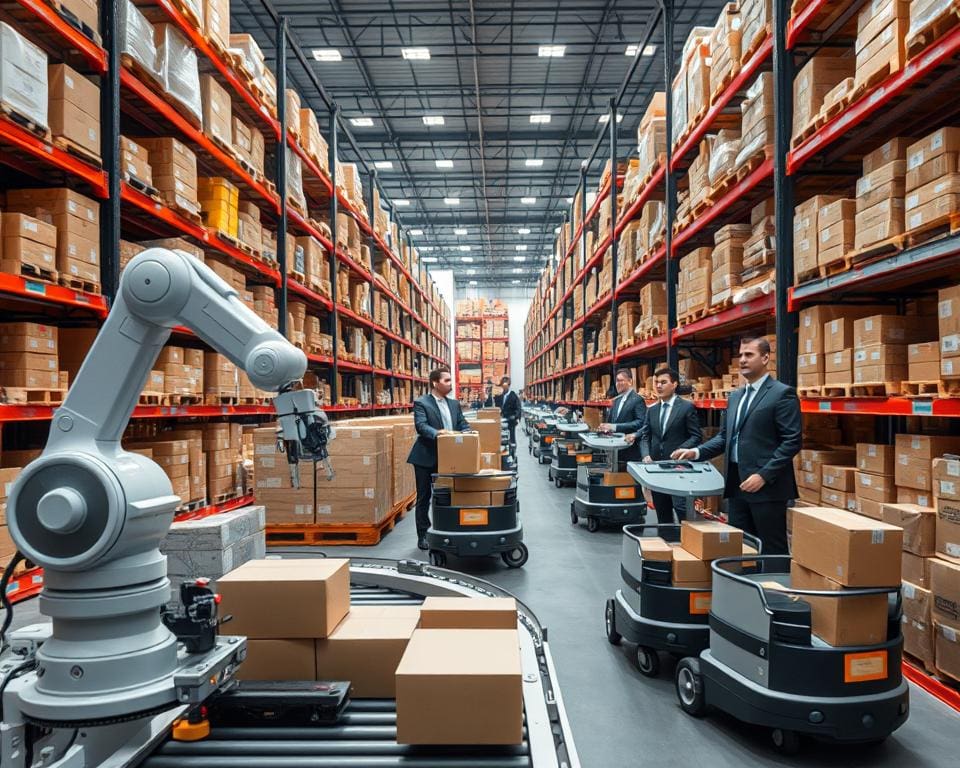
The question “How is automation applied in warehouses?” frames the shift from manual, paper‑based picking and static racking to networked, software‑driven operations. In the UK market, warehouse automation UK increasingly blends robotics, conveyors, AGVs and AMRs, AS/RS and integrated software like Warehouse Management Systems and Warehouse Control Systems to create seamless fulfilment flows.
Drivers for logistics automation in Britain are clear: rapid growth of e‑commerce, tighter delivery windows from consumers, persistent labour shortages and rising wage costs. Urban fulfilment centres and multistorey sites face space constraints that favour compact solutions such as AutoStore and vertical AS/RS, while sustainability targets push operators towards energy‑efficient automation choices.
This article aims to review technologies, systems and suppliers—naming leaders such as Ocado Technology, Amazon Robotics, Dematic, KNAPP, SSI Schaefer, Vanderlande and Blue Yonder—evaluate operational and financial impacts, and give practical procurement guidance for operations directors and supply‑chain decision‑makers across the UK.
Each following section walks readers from high‑level rationale to hands‑on selection criteria: an overview of warehouse automation technologies, detailed equipment types, software integration, strategy and workforce implications, financing and real‑world product review insights tailored to distribution centre automation and automated warehouses UK.
How is automation applied in warehouses?
Warehouse automation technologies are reshaping how goods move from intake to dispatch. Operators combine hardware and software to speed processes, cut errors and make better use of space. The effect is visible in modern distribution centres across the UK.
Overview of warehouse automation technologies
Automated Storage and Retrieval Systems, such as AutoStore and SSI Schaefer, stack inventory densely and deliver goods on demand. Conveyor and sortation equipment from Vanderlande and Dematic keeps parcels flowing through peak volumes. AGVs and AMRs from MiR, Fetch Robotics and Honeywell move pallets and totes without fixed guides.
Robotic picking arms and collaborative robots from Universal Robots, ABB and FANUC use vision systems to pick varied items. The software layer ties these components together. Blue Yonder and Manhattan Associates supply WMS and orchestration platforms. IoT sensors and machine vision provide inventory visibility and predictive maintenance.
Typical automation use-cases in UK distribution centres
E‑commerce fulfilment relies on high-speed picking, fast sortation and parcel consolidation to meet next-day promises. Grocery and chilled logistics deploy chilled AS/RS and goods‑to‑person stations to reduce spoilage.
Third-party logistics providers use modular automation to scale for seasonality and multi‑tenant operations. Returns hubs employ automated inspection and grading systems to speed refurbishment. Secure automated storage is common for pharmaceuticals and high-value electronics.
Benefits for throughput, accuracy and cost-efficiency
The benefits of warehouse automation include marked throughput gains through parallel processing and reduced travel time. Many sites report two to five times higher output after targeted upgrades.
Accuracy improves when goods‑to‑person systems, vision‑guided robots and barcode or RFID verification handle picks. That cuts returns and customer complaints. Labour costs fall as repetitive tasks are automated and staff move to exception handling and value‑added work.
Distribution centre automation benefits extend to space use and energy. Vertical AS/RS boosts capacity in a smaller footprint. Energy-efficient motors and smarter routing for AMRs lower energy per pick, which supports sustainability goals.
Types of warehouse automation systems and equipment
Warehouse automation blends tall racks, moving belts and smart machines to lift throughput and cut error rates. Below we map core systems that shape modern UK distribution centres and show how each one links into operations and software.
Automated storage and retrieval systems
Automated storage and retrieval systems use unit‑load cranes, mini‑load shuttles, vertical lift modules (VLMs) and grid cube layouts such as AutoStore to move pallets and totes. Lifts or shuttles travel to locations, pick items and deliver them to picking stations or conveyors.
Benefits include rapid putaway and retrieval, dense storage and improved inventory accuracy. Typical vendors in the UK market include SSI Schaefer, Dematic, Vanderlande and Autostore. Project planning must consider capital intensity, floor‑load limits, mezzanine design and cold‑store suitability. Integration with a Warehouse Management System keeps stock locations and tasks synchronised, while planned maintenance windows preserve uptime.
Conveyor systems and sortation
Conveyor sortation systems cover continuous conveyors, roller and belt types plus sorters such as cross‑belt, sliding‑shoe and tilt‑tray. These systems move goods at speed and divert items to lanes for packing or dispatch.
Typical applications are high‑speed parcel sortation, order consolidation and inline scanning with label application. Vendors such as BEUMER Group, Vanderlande and Dematic publish throughput ratings and modular layouts that influence facility design. Planners must assess flow, footprint and how conveyors interface with picking zones and AS/RS modules.
Automated guided vehicles and autonomous mobile robots
When teams evaluate AGV vs AMR they compare guided paths against dynamic navigation. AGVs follow fixed tracks, magnetic tape or wires for point‑to‑point transport. AMRs use SLAM and onboard sensors to map environments and adapt routes in real time.
Both handle replenishment, pallet moves and tote transport. AMRs tend to need fewer infrastructure changes and offer higher routing flexibility. Market players include Fetch Robotics, MiR, JBT and Seegrid, which supply fleet management platforms for coordination. Limitations to factor in are battery life, charging strategies, payload capacity and floor surface quality.
Robotic picking arms and collaborative robots
Robotic picking covers high‑speed industrial arms for packing and depalletising and collaborative robots that work beside people. Vision systems and grippers drive performance; options include vacuum end‑effectors, adaptive grippers and soft robotics for fragile items from companies such as Soft Robotics and OnRobot.
Robotic picking extends operating hours, improves consistency and reduces error rates. Success depends on product variability, bin orientation and training data for vision models. Quick end‑of‑arm tool changeover helps switch tasks without long downtime. Cobots in warehouses deliver a human‑friendly layer of automation for mixed SKU lines and light‑touch piece picking.
Integrating warehouse management software and control systems
A connected warehouse depends on clear roles for software and control layers. WMS integration keeps inventory records accurate, drives order allocation, manages slotting and plans labour. Mainstream vendors include Blue Yonder (formerly JDA), Manhattan Associates and SAP EWM, each providing core functions that reserve locations, trigger replenishment and expose inventory state for customer orders.
Warehouse Management Systems role
The WMS is the strategic brain that schedules waves, allocates stock and hands work down the chain. It decides which SKU moves where and when, while reporting precise stock levels for fulfilment. Good WMS integration ensures handoffs to automated equipment are timed and constrained by live inventory data.
Warehouse Control Systems and real‑time orchestration
WCS orchestration sits between the WMS and the hardware, translating work orders into real‑time commands for conveyors, AS/RS, robots and sorters. It handles traffic control, prioritisation and exception handling to keep throughput steady. WES platforms blur the line by adding execution logic and dynamic slotting on top of low‑latency control.
Design must favour deterministic performance and fault tolerance for high‑throughput centres. Low latency and resilient failover reduce stoppages and protect throughput during peak periods.
API integration, IoT and data flows
Typical architectures follow ERP ↔ WMS ↔ WES/WCS ↔ PLCs and robot controllers ↔ hardware. API warehouse integration uses REST or SOAP to exchange orders and confirmations. MQTT carries telemetry from sensors and AMR fleets, while OPC UA links industrial controllers for consistent command and status exchange.
Real‑time warehouse data from IoT in warehouses powers predictive maintenance, route optimisation and KPI dashboards. That telemetry lets teams spot wear, reroute fleets and reduce downtime before faults arise.
Security and governance must be part of any rollout. Network segmentation, device hardening, timely vendor patching and GDPR compliance protect customer data and system integrity. For practical guidance on rollout and staff impact, see this automation productivity guide.
- Key integrations: ERP, WMS, WCS/WES, PLCs and robotics controllers.
- Protocols: REST/SOAP for APIs, MQTT for telemetry, OPC UA for control.
- Outcomes: faster decision loops, richer real‑time warehouse data and lower error rates.
Designing an automation strategy for UK warehouses
Creating a practical warehouse automation strategy UK starts with a clear diagnosis of today’s operation and a vision for growth. A focused plan balances immediate fixes with long-term aims so investments deliver faster throughput and better accuracy.
Assessing current processes and pain points
Begin with an automation assessment that uses time‑motion studies, SKU velocity analysis and seasonal demand profiling. Calculate cost‑to‑pick and benchmark picks per hour against industry norms to show where gains are realistic.
Map inbound screening, picking travel, sortation choke points and packing throughput to reveal true bottlenecks. Check building height, floor loading, dock capacity and electrical supply so proposed changes fit the site.
Choosing the right mix of automation and human labour
Adopt a hybrid approach where machines handle repetitive, high‑volume work and people manage complex decisions. Use goods‑to‑person systems, sortation and pallet handling for bulk tasks while humans oversee quality checks and exception handling.
Decide on the human automation mix by evaluating SKU variability, order profiles and returns flows. Set cost‑per‑pick thresholds that trigger automation, then create clear upskilling routes so staff see new roles as progression rather than displacement.
Scalability, modularity and future‑proofing
Design for phased roll‑out with pilot cells, plug‑and‑play AMR fleets and modular AS/RS additions to control CAPEX and limit disruption. Select open architectures and standard APIs from vendors with strong UK service networks to ease upgrades.
Plan power, network and mezzanine adaptability early. Use data‑driven capacity forecasting so the site adopts innovations such as AI vision, better batteries and 5G without costly reworks. That way the operation stays flexible and supports scalable warehouse automation.
Operational impacts and workforce considerations
Automation reshapes daily operations and the roles of people on the floor. Firms that plan for workforce impacts automation see smoother transitions and stronger long‑term performance.
Reskilling and training warehouse staff
Staff need practical skills for robot supervision, fleet management and basic PLC troubleshooting. Training should include data‑driven process improvement and quality control to turn operators into technical custodians.
Offer blended learning: classroom sessions, VR simulators and on‑the‑job coaching. City & Guilds qualifications, local further education colleges and vendor certification for WMS and WCS platforms supply recognised routes for progression.
Communicate career pathways early to reduce anxiety and improve retention. Track time saved on repetitive tasks as a KPI to show how warehouse reskilling yields higher‑value work.
Health, safety and ergonomic improvements
Mechanised pallet handling and goods‑to‑person ergonomics cut manual lifting and repetitive strain injuries. Collaborative robots can reduce slips and improve output quality when integrated with proper safeguards.
Follow HSE guidance on machinery safety and collaborative robot risk assessment. New hazards require controls: robot exclusion zones, fleet traffic management, sensor reliability and robust emergency stop protocols.
Documented risk assessments, safe systems of work and ongoing safety audits sustain benefits from health and safety automation while keeping teams safe.
Change management and stakeholder buy‑in
Engage unions, works councils and staff representatives from the start. Use pilot projects and clear KPIs to build trust and show measurable gains in downtime reduction and order‑fulfilment SLA improvements.
Present a phased rollout, feedback loops and operational champions among staff. Transparent metrics reporting helps align managers and employees during change management warehouse automation.
Measure impact with KPIs such as reduction in errors and time saved on repetitive tasks. Share results and iterate; small wins accelerate adoption and demonstrate the value of investment. Boost productivity with automation
Cost, ROI and financing options for automation projects
Investing in warehouse automation calls for clear financial planning and realistic metrics. Use models that compare upfront costs with longer-term cashflow, then test assumptions for seasonality and utilisation. Aim to quantify benefits in terms of throughput, accuracy and service levels so that automation ROI sits at the heart of decision making.
Capital expenditure vs operating expenditure models
Capital expenditure automation means buying equipment outright and claiming it as an asset. Owning assets can bring tax allowances and stronger balance‑sheet control. That path suits firms with available capital and a long‑term horizon.
Operating expenditure models convert capital into service. Robotics‑as‑a‑service, pay‑per‑pick and leasing reduce initial cash outlay. Vendor subscriptions from firms such as Dematic and managed service packages from integrators deliver maintenance and upgrades as part of ongoing fees. OPEX improves cashflow and shifts some performance risk to the provider.
Calculating return on investment and payback period
Start with baseline metrics: current cost per pick, annual labour spend, throughput and error rates. Estimate savings from reduced labour, higher throughput and fewer returns. Add running costs for energy, maintenance and software licences to produce a net benefit figure.
Calculate net present value and a simple payback period. Typical payback often falls between two and five years, depending on scale and application. Run sensitivity analyses for peak seasons, variable utilisation and wage changes to understand downside risk.
- Key metrics: cost per pick, on‑time delivery, error rate, inventory holding costs.
- Include scenarios: high utilisation, low utilisation, labour scarcity.
- Model revenue uplift from faster throughput where appropriate.
Leasing, vendor financing and government support available in the UK
Financing options include equipment leasing, hire‑purchase and vendor finance with staged payments. Operational leases keep payments off the balance sheet, while hire‑purchase transfers ownership at term end. Leasing automation equipment can be an efficient way to scale without exhausting capital reserves.
Public support remains relevant. Innovate UK grants can back pilot projects and R&D work. Businesses may access R&D tax relief for qualifying development, and regional incentives such as Enterprise Zones can change site economics. Local growth funds and business rates relief have supported projects in the past.
Early engagement with financial advisers and systems integrators helps align deal structure with risk appetite and cashflow. That combination improves planning for capital expenditure automation and maximises chances of achieving the expected automation ROI.
Real‑world examples and product review insights
Four concise case studies show how automation lifts warehouse performance. Ocado Technology’s grocery fulfilment demonstrates integrated robotics, machine vision and WMS orchestration that power high‑density, rapid fulfilment for online supermarkets. AutoStore deployments in multi‑tenant 3PL sites illustrate goods‑to‑person cube storage delivering high storage density and fast SKU access, though initial capital and layout rigidity are trade‑offs noted in many AutoStore review reports.
AMR fleet projects from Fetch Robotics and Mobile Industrial Robots (MiR) are often cited in AMR review UK pieces for delivering quick pilot‑to‑scale timelines and measurable ROI with minimal fixed infrastructure. Parcel operators using Vanderlande or Dematic conveyor and sortation systems show how throughput and low per‑parcel handling costs scale, a common theme in warehouse automation case studies focused on high‑volume operations.
Robotic picking and cobot solutions from Universal Robots paired with OnRobot grippers receive positive product review automation coverage for ease of programming, strong safety features and adaptability to small‑item picking. Reviewers consistently flag that vision systems and end‑effector maturity determine success, and that AS/RS review comparisons often hinge on reliability and mean time between failure metrics.
When evaluating vendors, prioritise reliability, local service and spare‑parts availability in the UK, total cost of ownership, integration complexity with existing WMS, and vendor roadmaps for software updates. Insist on open APIs and standards such as OPC UA and MQTT, run measurable pilots with KPIs for throughput, accuracy and cost per pick, then stage rollouts with clear SLAs. With modular deployments and people‑centred change management, these warehouse automation case studies and product review automation insights show how automation becomes a strategic enabler for sustainable growth.