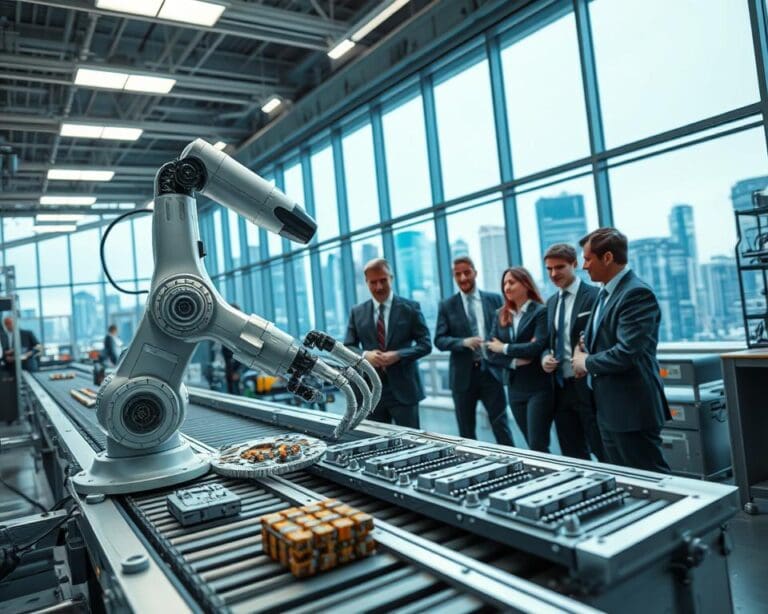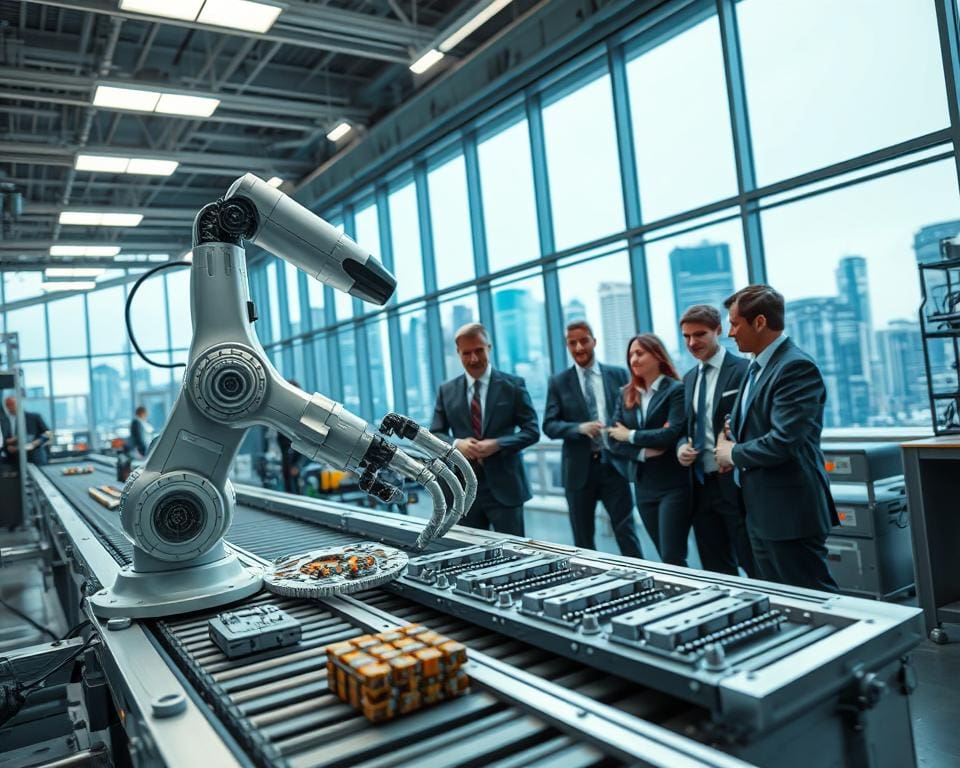
Robotics in industry UK has reshaped how factories and warehouses operate, lifting productivity and tightening quality control. The impact of robotics on industry shows in higher throughput, fewer defects and safer workplaces across sectors from automotive and aerospace to food processing, pharmaceuticals and logistics.
Major manufacturers such as Jaguar Land Rover, Rolls‑Royce and Unilever are increasing capital investment in automation, mirroring global trends reported by the International Federation of Robotics on robot density and growth. These investments underline the industrial automation impact that drives competitiveness and scale.
Technology advances are a core driver: precision actuators, force sensors, vision systems and smarter motion planning now work with IIoT, 5G and cloud platforms to make deployment more modular and affordable. Falling costs and accessible tools mean even mid‑sized firms can access manufacturing robotics benefits without prohibitive upfront barriers.
The measurable outcomes are clear — greater product consistency, lower error rates and improved safety as machines take on repetitive or hazardous tasks. Faster time‑to‑market and tighter process control also reduce waste and improve environmental performance, a key element of the broader robotics economic effects.
Understanding this shift matters for policymakers, business leaders and the workforce because the industrial automation impact frames choices on investment, skills and regulation. Practical guides on digital productivity and integration, such as the tools described by topvivo, help firms plan pilots, governance and KPI dashboards as they scale automation across operations. Digital productivity guidance
How robotics is transforming manufacturing processes and productivity
Robotics transforming manufacturing is reshaping shop floors across the UK. Modern cells lower risk and raise output by taking on dull, dangerous and highly repetitive work. That shift frees people for skilled roles in quality, maintenance and process improvement while raising overall productivity.
Automation of repetitive and hazardous tasks
Manufacturers commonly automate spot welding, palletising, machine tending, high-volume assembly and inspection in confined spaces. Robots handle hazardous chemical dosing and repetitive lifting with steady accuracy.
Adoption of collaborative robots lets operators keep close to the line for tasks that need dexterity or judgement. Cobots reduce exposure to harm and make mixed human–robot teams practical for SMEs.
Health and Safety Executive trends show lower injury rates in heavily automated facilities, which supports the case that automation repetitive tasks improves worker safety and reduces incident-related costs.
Improvements in throughput and operational efficiency
Robotic cells cut cycle times and scrap. High-speed delta and SCARA systems can multiply parts-per-hour compared with manual handling. Many manufacturers report manufacturing throughput improvements of 20–40% after targeted automation projects.
Predictive maintenance backed by sensors raises mean time between failures and reduces unplanned stops. Continuous, multi‑shift operation delivers consistent quality and better OEE.
Integration with MES and ERP systems unlocks tighter scheduling and lower inventory. That just-in-time flow reduces lead times and supports rapid response to demand swings.
Case studies from UK manufacturing sectors
Automotive plants from Nissan and Jaguar Land Rover use articulated robot cells for welding and painting to ensure repeatable fits and high line speed. Those deployments highlight how factory automation benefits consistency and throughput.
Food and beverage firms such as Warburtons and Müller apply robots in packing and sorting to meet hygiene standards and cope with seasonal peaks. Automation helps maintain food-safety compliance while scaling output.
Aerospace and precision engineering users, including Airbus operations and Rolls‑Royce, deploy robots for composite layup, drilling and automated inspection to achieve repeatable precision at scale.
UK SMEs adopt modular cobot cells and compact SCARA units to expand capacity without proportionate headcount increases. These UK manufacturing robotics case studies show that automation is viable beyond large multinationals.
For a deeper technical overview and practical examples of how robotic systems raise efficiency, see this practical resource on robotic impact and implementation here.
Why is consistency key in fitness?
Consistency is the engine behind lasting change. Small, steady actions in exercise and nutrition compound over weeks and months to create measurable gains. This idea answers the question: Why is consistency key in fitness by showing that regular practice outperforms sporadic intensity.
Look at the fitness consistency benefits: better technique, fewer injuries and steady strength or endurance increases. Tracking sessions, using a simple log or a smartwatch, creates feedback loops that keep people accountable and motivated.
Parallels between consistent fitness habits and industrial automation
Scheduled workouts mirror scheduled maintenance and standard operating procedures on a factory floor. Progressive overload in training reads like continuous process optimisation in manufacturing. Rest days match planned downtime and maintenance windows to protect systems and people.
How repeatable, reliable processes drive long-term performance
Repeatable habits performance reduces variance. In the gym, consistent technique and progressive plans lower injury risk and produce predictable gains in VO2 max and strength. On the production line, consistent process control cuts defects and raises yield, seen in metrics such as reduced defects per million opportunities.
Data shows adherence and steady progression matter more than occasional extremes. Small improvements, applied consistently, deliver compound benefits across months and years.
Lessons industry can borrow from disciplined, consistent training routines
Adopt periodised programmes for production planning. Set measurable milestones and schedule recovery cycles for equipment and teams. Use coaching principles: supervisors and continuous improvement facilitators act like trainers, giving timely feedback and adjusting plans.
- Design clear routines that employees can follow day after day.
- Use dashboards and KPIs as training logs to reinforce good habits.
- Celebrate adherence to standards to build a culture of small gains.
Industry leaders such as Rolls-Royce and Jaguar Land Rover already blend disciplined process control with continuous improvement. Embracing consistency in training and process control helps teams scale quality, reduce waste and unlock sustained performance.
Economic and workforce impacts of robotics adoption
Robotics adoption reshapes markets and labour in complex ways. Evidence shows automation can remove routine, predictable tasks while creating roles in maintenance, programming and systems engineering. Transitional periods often follow productivity gains as workers move between roles.
Job displacement versus job transformation
Certain manual jobs that follow fixed, repetitive steps face the highest risk. Roles that rely on creativity, complex judgement and interpersonal skill remain resilient. Labour analyses from the Office for National Statistics and OECD indicate net employment effects vary by sector and country, with some regions seeing short‑term displacement and long‑term reallocation.
Skills, retraining and opportunities in the UK labour market
Demand is rising for robotics technicians, controls engineers, data analysts, software developers and mechatronics specialists. Apprenticeships, T‑levels, university programmes and short courses from institutions such as the Institution of Engineering and Technology offer direct pathways. Further Education colleges and private providers run vocational options suited to employers.
Employer-led reskilling works best when combined with local partnerships. On-site training, collaborations with colleges and government incentive schemes for apprenticeships reduce barriers. Targeted retraining for robotics helps displaced workers move into higher-value positions.
Economic productivity gains and implications for SMEs
Where firms invest wisely, automation can lift output per worker, tighten quality control and sharpen competitiveness. Small and medium enterprises can see notable gains in robotics and SMEs productivity, yet many face high capital costs and limited in-house expertise.
Practical solutions lower the entry threshold. Leasing models and robot-as-a-service reduce upfront spend. Innovate UK grants, shared automation hubs and collaborative maker spaces provide access to equipment and skills. These approaches make reshoring and stronger regional supply chains more attainable.
- Balance risks and opportunities by planning phased adoption.
- Prioritise retraining for robotics to capture new roles.
- Use shared services to boost robotics and SMEs productivity.
Future trends: AI, collaborative robots and sustainable industry
Machine learning, computer vision and reinforcement learning are pushing the future of robotics AI into everyday factory floors. Deep‑learning visual inspection systems now spot tiny defects that humans miss, while reinforcement‑learning motion planners shave seconds from cycle times. These advances let robots cope with variability and perform complex inspections, widening use beyond tightly structured lines.
The rise of collaborative robots cobots from firms such as Universal Robots and FANUC is changing shopfloor dynamics. Lightweight, easily programmable cobots work safely alongside staff, lowering safety barriers and cutting integration costs. For UK SMEs and mixed‑model production, that means faster redeployment, greater flexibility and a gentler capital entry point to automation.
Sustainable manufacturing robotics is becoming central to circular economy goals. Robots reduce waste through precision assembly, enable remanufacturing and power robotic sorting in recycling centres. Energy‑efficient actuator designs and smart energy management further reduce carbon intensity, aligning automation with net‑zero ambitions across Britain.
Integration trends unite IIoT, cloud analytics, digital twins and augmented reality to simplify fleet monitoring and maintenance. Open platforms and standards will speed interoperability and reduce vendor lock‑in, amplifying the benefits of AI in industry UK. Policymakers and business leaders should prioritise R&D partnerships, workforce upskilling and SME access to automation. With sustained investment, training and policy support, these robotics future trends offer a pathway to stronger competitiveness and a skilled workforce for the UK.