Industry 4.0 is the convergence of digital, physical and biological systems that creates smart factories and data-driven value chains. In the UK this shift matters for competitiveness, sustainability and workforce transformation. Manufacturers that embrace Industry 4.0 technologies can boost productivity, cut downtime, raise quality, offer greater customisation and lower environmental impact.
Core technology families underpinning smart manufacturing UK include artificial intelligence and machine learning, the Industrial Internet of Things and connected systems, edge and cloud computing, advanced robotics and collaborative robots, additive manufacturing, digital twins and cybersecurity. These tools work together: AI turns sensor data from IIoT into insight, cloud and edge platforms provide the compute backbone, while robots and 3D printers act on those insights to change production in real time.
UK-specific drivers push adoption. Programmes such as Made Smarter, pressure to meet net zero targets and a desire to reshore strategic production are all incentives. At the same time, many SMEs face digital adoption hurdles and skills shortages. Industry 4.0 UK offers a path to modernise supply chains, create higher-skilled jobs and unlock new revenue streams.
This article sets out a clear roadmap. We will take deep dives into AI and machine learning, IIoT and connected systems, and advanced automation. Each section will include practical use cases, implementation considerations, and guidance on interoperability and security to help British manufacturers navigate the digital manufacturing trends ahead.
What technologies are driving Industry 4.0 forward?
The modern factory is a tapestry of connected tools and platforms that boost productivity and cut waste. This overview highlights the core Industry 4.0 technologies shaping today’s plants and points to how digital transformation manufacturing changes workflows, skills and business models.
Overview of core Industry 4.0 technologies
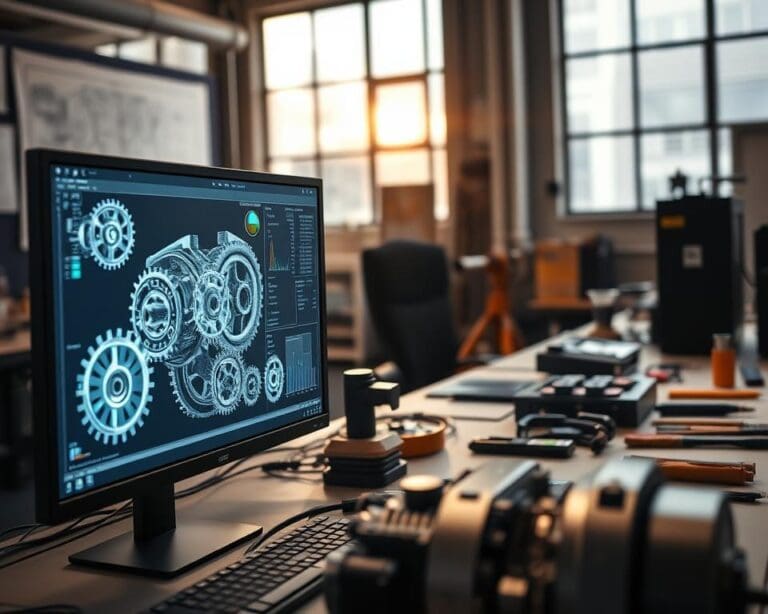
Digital twins act as virtual replicas of machines, lines and whole plants. Siemens Digital Industries and Dassault Systèmes supply industrial digital twin platforms that let engineers simulate performance, test changes and manage asset lifecycles without halting production.
Cloud computing platforms from Microsoft Azure, AWS and Google Cloud provide scalable storage, analytics and AI services. They host large datasets and model training that underpin an effective Industry 4.0 technology stack.
The Industrial Internet of Things (IIoT) links sensors, actuators and gateways across the shopfloor. Protocols such as OPC UA and MQTT create reliable data flows so monitoring and control systems can act on real-time signals.
Artificial intelligence and machine learning deliver pattern recognition, anomaly detection and optimisation. Frameworks like TensorFlow and PyTorch support developers and established industrial AI providers tailor models for manufacturing use.
Advanced robotics and collaborative robots from ABB, KUKA and Universal Robots speed repetitive tasks and enable safe human–robot collaboration. Additive manufacturing systems from Stratasys and EOS offer rapid prototyping and low-volume production options.
Enabling technologies include 5G and private cellular networks for low-latency connectivity, augmented reality for maintenance and training, and advanced vision and vibration sensors that feed richer data into analytics.
How digital transformation reshapes manufacturing processes
Digitisation spans the entire product lifecycle. Design starts in CAD, moves through simulation and production planning, then into execution with manufacturing execution systems and in-line quality assurance.
Digital planning shortens lead times. In-line inspection improves first-pass yield. Flexible automation reduces changeover time and supports varied product runs without heavy retooling.
Cultural change is essential. Organisations must adopt data-driven decision-making, form cross-functional teams and invest in reskilling. The Made Smarter review and UK programmes help small and medium enterprises navigate this shift.
Interplay between technologies for maximum impact
Manufacturing tech convergence makes single technologies more powerful when combined. IIoT devices stream data; edge computing filters and pre-processes it for low-latency needs; cloud analytics and AI extract insights; digital twins simulate responses and robots carry out optimised tasks.
- Asset health management: sensors + edge analytics + cloud AI + maintenance scheduling.
- Flexible assembly: cobots + vision systems + AI-driven sequencing + a running digital twin.
Standards and interoperability such as OPC UA and MTConnect are vital to integrate multi-vendor equipment and avoid vendor lock-in. An open Industry 4.0 technology stack helps manufacturers scale innovation while protecting investments.
Artificial intelligence and machine learning in smart manufacturing
AI and ML are reshaping factories across the UK and worldwide. These technologies turn sensor data, production logs and visual feeds into timely decisions. Manufacturers use supervised, unsupervised and reinforcement learning to detect patterns, predict faults and optimise flows. Platforms such as Siemens MindSphere, GE Predix and Microsoft Azure IoT with Azure Machine Learning supply prebuilt models and MLOps tools to speed deployment in industrial settings.
Predictive maintenance and anomaly detection
Time-series inputs from vibration, temperature and current sensors feed models that forecast bearing wear, motor faults or process drift. Techniques range from ARIMA and LSTM forecasting to autoencoders and isolation forest anomaly detection. Where domain knowledge exists, physics-informed hybrids improve early-warning accuracy. The result is less unplanned downtime, longer asset life and a shift from time-based to condition-based servicing.
Deployment depends on data quality and labelled failure events. Edge inference helps when latency matters. Integration with CMMS and EAM systems, such as SAP and IBM Maximo, closes the loop so maintenance tickets trigger automatically. Industry studies show strong ROI from reduced stoppages and lower repair costs, supporting investment in machine learning predictive maintenance programmes.
Optimising production with AI-driven scheduling
AI scheduling balances machine availability, workforce shifts, material arrivals and delivery windows. Reinforcement learning agents and optimisation solvers produce dynamic timetables and reschedule in real time after disruptions. Commercial APS tools now embed these algorithms to handle complexity at scale.
Practical gains include higher throughput, shorter lead times and better on-time delivery. Improved utilisation of capital equipment frees capacity for new orders. In UK plants, adoption of AI scheduling has helped manufacturers respond swiftly to demand swings while keeping costs under control.
Quality control through computer vision and deep learning
Computer vision quality control uses convolutional neural networks and transfer learning to spot defects, check dimensions and inspect surfaces faster than manual methods. Automotive and electronics lines rely on high-speed cameras with tailored lighting to detect micro-cracks, soldering faults and misalignments.
Building robust datasets and labelling examples are essential. Practitioners favour edge deployment for in-line inspection and link models to SPC and MES to trigger corrective actions. Explaining model decisions increases trust on the shop floor, encouraging wider adoption of ML in factories UK. Together, these techniques raise yield, reduce rework and support higher product quality across production lines.
Industrial Internet of Things and connected systems
The Industrial Internet of Things acts as the backbone for data-driven manufacturing. Sensors, PLCs and gateways create a live link between operational technology and information systems. This connection unlocks measurable gains in energy monitoring, asset tracking, process transparency and remote supervision.
Deciding where to process data shapes system behaviour. Edge computing places intelligence close to machines for low-latency control and fast anomaly detection. Cloud platforms offer scalable analytics, long-term storage and heavy model training.
Use edge for safety-critical closed-loop control. Use cloud for cross-site trend analysis and model development. Hybrid architectures such as Azure IoT Edge and AWS Greengrass push trained models and updates from cloud to edge, giving the best of both worlds in edge vs cloud manufacturing.
Sensor networks industrial commonly include temperature, pressure, vibration, current and vision devices. Protocols such as Modbus, PROFIBUS and EtherCAT remain widespread. Modern interoperability leans on OPC UA and MQTT to harmonise data across systems.
Good data practice saves time and cost. Apply time synchronisation, edge pre-processing like filtering and compression, and consistent metadata. Adopt common data models, for example the Asset Administration Shell, to simplify integration.
Wireless options such as 5G and private LTE enable flexible deployments for AGVs and mobile robotics. They reduce cabling and speed commissioning while supporting higher device counts in packed factory floors.
Threats to connected plants vary from unauthorised OT access to ransomware and supply-chain compromise. Organisations must treat IIoT security as a design requirement, not an afterthought.
Mitigations include network segmentation, zero-trust architecture and device identity using X.509 certificates. Secure boot, regular patching, industrial firewalls and intrusion detection further reduce exposure. Compliance with IEC 62443 and guidance from the NCSC helps UK manufacturers meet regulatory expectations.
Advanced automation: robotics, cobots and additive manufacturing
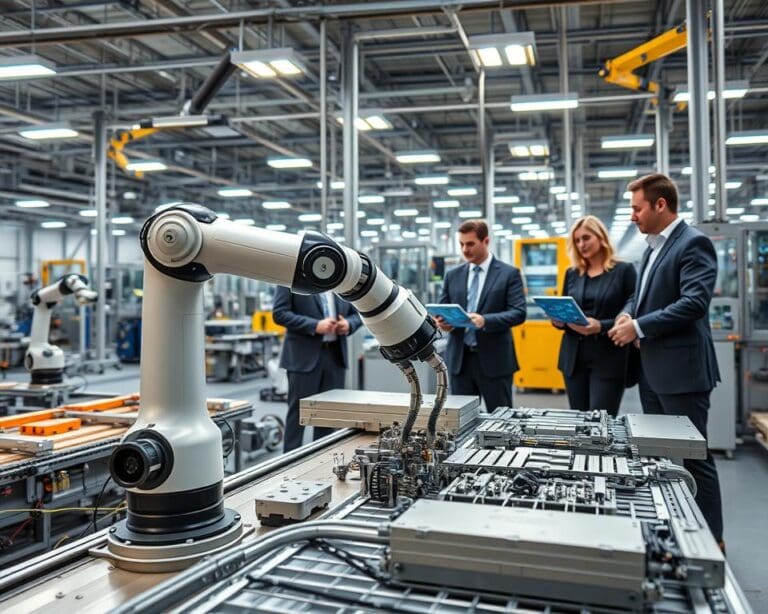
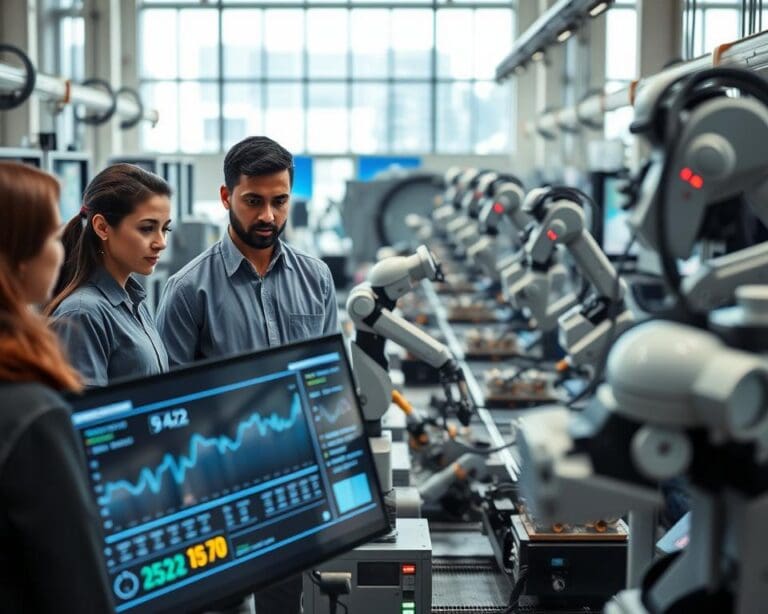
Advanced automation in Industry 4.0 blends high-speed industrial robots, safety-focussed collaborative robots and flexible additive manufacturing to reshape factory floors. Industrial arms from ABB, KUKA and FANUC handle heavy-duty, high-volume tasks like palletising and machine tending, while collaborative robots from Universal Robots work side-by-side with operators for pick-and-place and human-augmenting tasks. This mix lets manufacturers balance throughput with safety and agility.
Cobots UK adopters find lower entry costs and faster return on investment, making small-batch and mixed-model production viable for SMEs. Safety standards such as ISO 10218 for industrial robots and ISO/TS 15066 for collaborative robots guide deployments, and integration with vision systems, force–torque sensors and AI enables adaptive behaviour and greater autonomy on the line.
Additive manufacturing complements robotics by enabling rapid prototyping, serial customised production and on-demand spare parts. Processes such as SLA, SLS, DMLS (metal powder bed fusion) and FDM support applications from motorsport to aerospace suppliers and medical devices. 3D printing in industry reduces waste, shortens supply chains and offers design freedom, though material properties, post-processing and part qualification remain important considerations.
Looking ahead, digital twins, AI-driven optimisation and generative design will link robotics Industry 4.0 workflows with additive manufacturing for closed-loop improvement. That convergence will drive new, higher-value roles in programming, maintenance and data analysis and support a more sustainable, competitive manufacturing base across the United Kingdom.