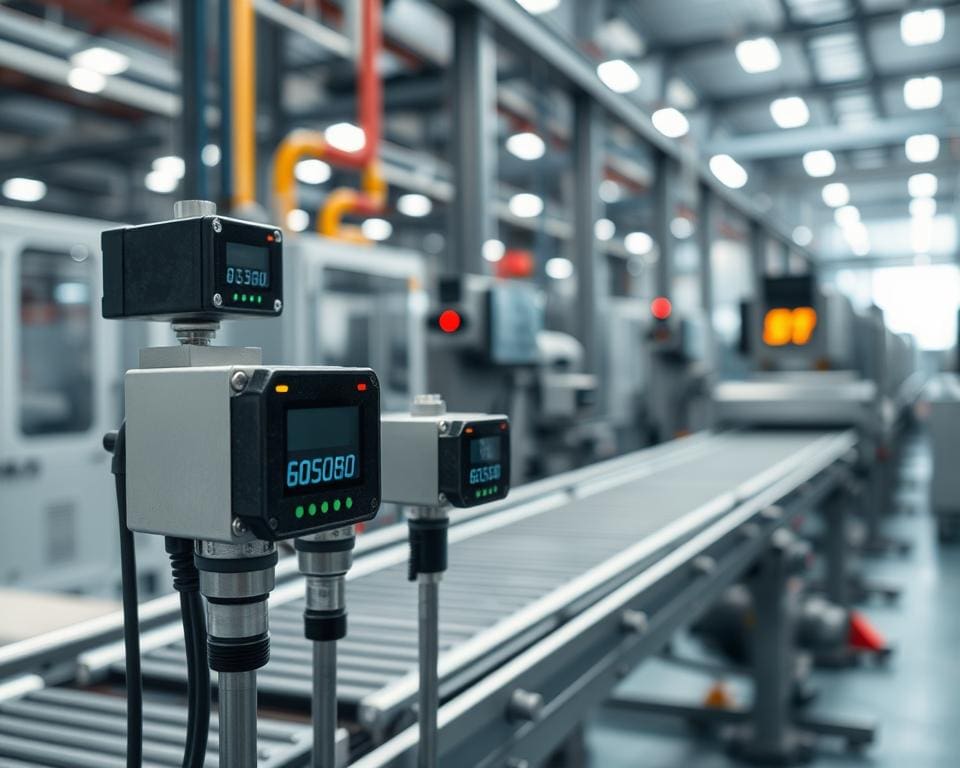
You already know margins matter. Industrial sensors sit at the heart of your move from inspection and instinct to data-led control. In manufacturing, process plants, logistics and facility management across the United Kingdom, sensor-enabled efficiency shifts how you run daily operations.
These devices are a cornerstone of Industry 4.0 and the IIoT. Major vendors such as Siemens, ABB, Honeywell, Rockwell Automation and Schneider Electric supply manufacturing sensors and systems that many automotive, food and beverage, pharmaceutical, oil and gas, and utilities sites now rely on.
By measuring temperature, pressure, vibration and other physical variables, sensors turn signals into action. You reduce manual checks, enable predictive maintenance, cut energy use, improve yield and shorten downtime. That is the promise of production optimisation through industrial sensors.
Expect tangible changes in KPIs you monitor: overall equipment effectiveness (OEE), mean time between failures (MTBF), mean time to repair (MTTR), energy consumption per unit produced, scrap rates and throughput. These metrics quantify the business case for sensor adoption and help you demonstrate return on investment.
This introduction sets the scene. The following sections will explain what manufacturing sensors measure, how to integrate them into your workflows, connectivity and security choices, and the measurable benefits you can expect from sensor-enabled efficiency.
industrial sensors and the fundamentals of efficiency improvement
You rely on accurate sensor measurement to understand what is happening in your plant. Industrial sensors convert physical, chemical or positional variables into electrical signals. That raw data gives you visibility of processes that would otherwise be hidden.
What industrial sensors measure and why it matters
Sensors detect temperature, pressure, flow, level, position, vibration, humidity, gas concentration and acceleration. Each measurement links directly to efficiency. For example, temperature sensors and pressure sensors help control process quality and reduce wasted energy. Flow sensors and level instruments optimise throughput and prevent overfilling or bottlenecks.
Position and proximity sensors speed up automation and cut cycle times on conveyors and robotic cells. Vibration monitoring identifies incipient faults in motors, pumps and bearings so you can avoid unplanned downtime. You must weigh accuracy, precision, resolution, response time and calibration when choosing a device.
Environmental ratings such as IP and ATEX determine where a sensor can be safely deployed. Manufacturers like Emerson, Honeywell, Endress+Hauser and ABB offer industrial-grade options that meet these standards.
Types of sensors commonly used in industry (temperature, pressure, flow, proximity, vibration)
- Temperature sensors: thermocouples, RTDs (Pt100), thermistors and infrared non-contact units for ovens, furnaces and product quality checks.
- Pressure sensors: gauge, absolute and differential transducers for compressors, steam lines and hydraulic systems.
- Flow sensors: electromagnetic, ultrasonic, turbine and Coriolis flowmeters for liquids and gases used in batching and energy control.
- Proximity and position sensors: inductive, capacitive, photoelectric and encoders for material handling, pick-and-place and safety interlocks.
- Vibration sensors: accelerometers and velocity sensors for condition monitoring of gearboxes, bearings and rotating equipment.
You will also find level sensors, gas detectors and humidity sensors where process specifics demand them. Choose sensor types that match measurement range, ruggedness and certification needs.
How real-time data collection supports faster decision-making
Streaming real-time data lets you spot deviations from setpoints and take swift action. Closed-loop control, such as PID systems, uses instant feedback to keep variables within tight tolerances.
Automated alarms and shutdowns protect equipment and product quality. Condition-based maintenance informed by vibration monitoring and other metrics reduces unnecessary work and prevents failures.
For reliable analysis you need good timestamps, appropriate sampling rates and standardised protocols like OPC UA and Modbus. High-quality real-time data feeds decision support tools that guide operators and engineers to faster, better choices.
Integrating sensors into your operational workflows
When you add sensors to plant equipment, you must plan how they will connect, where data will be processed and how control systems will act on insights. Good sensor integration starts with choosing the right mix of wired sensors and wireless sensors, then mapping data flows through gateways, edge devices and cloud platforms. Early design choices cut integration costs, reduce downtime and protect data integrity.
Wiring, wireless and IIoT connectivity options
For deterministic performance in critical loops, wired sensors remain the norm. Choose from 4–20 mA loops, HART, FOUNDATION Fieldbus, Profibus and Ethernet-based industrial networks such as EtherNet/IP or PROFINET for low latency and proven robustness in harsh sites.
Wireless sensors bring lower cabling costs and faster deployment. Common choices include Wi‑Fi, Bluetooth Low Energy, LoRaWAN, ISA100 and WirelessHART. Expect trade-offs: easier installation versus potential interference and battery maintenance.
IIoT connectivity links field data to enterprise systems. Many modern devices offer native IP/Ethernet or gateways that translate field protocols into MQTT or AMQP. Match connectivity to your latency, bandwidth and reliability needs when you design network topology.
Data aggregation, edge computing and cloud platforms
Your data pipeline usually runs: sensors → gateways/edge devices → on‑premise servers or cloud platforms. Edge computing filters and pre‑processes data close to the source, lowering latency and cutting upstream bandwidth.
Industry cloud platforms you can consider include Microsoft Azure IoT, Amazon Web Services IoT, Google Cloud IoT, Siemens MindSphere and PTC ThingWorx. These provide device management, telemetry ingestion, time‑series databases and visualisation tools for operators.
Store historical records for trending and analytics. That storage underpins machine learning, predictive maintenance and dashboards that help you spot performance shifts quickly.
Interfacing with SCADA, PLCs and MES for automated control
Sensor feeds must integrate into control layers. PLCs and DCS execute real‑time control loops, while SCADA integration covers supervisory monitoring and alarms. MES consumes sensor status and quality signals to manage schedules and traceability.
As an example, an accelerometer’s vibration alert routed via PLC and SCADA can trigger a maintenance job in MES, avoiding unplanned shutdowns. Use open standards such as OPC UA, IEC 61131 and ISA‑95 to ease interoperability and reduce future integration costs.
Security and data integrity considerations for sensor networks
Each new sensor increases attack surface area, so you must treat cybersecurity as core design work. Implement device authentication, TLS for MQTT, network segmentation between OT and IT, secure boot and a patching regime.
Protect data integrity with time synchronisation (NTP or PTP), checksums, tamper detection and redundant sensing where measurements are critical. Follow UK rules on personal data and safety certifications, including GDPR and standards such as ATEX/IECEx where applicable.
Measurable benefits of sensor-driven optimisation
When you deploy industrial sensors, the benefits of industrial sensors become tangible in months, not years. You can reduce downtime by 20–50% through predictive maintenance that spots wear before failure. Typical OEE improvement ranges 5–15%, and condition-based strategies often cut maintenance costs by 20–30%. These outcomes stem from clearer visibility into asset health, such as vibration, temperature and motor current trends.
Practical examples show how process optimisation delivers energy savings and quality gains. Vibration monitoring that detects bearing wear prevents catastrophic pump failure and costly stoppages. Flow and temperature sensors that steady heat-exchanger setpoints lower fuel and electricity use and reduce scrap. Better control reduces rejection rates and improves first-pass yield, so you waste less material and rework fewer products.
To justify investment and calculate ROI, quantify your current cost of downtime, maintenance, energy and scrap, then compare projected savings against system and integration costs plus any subscription fees. Many mid-sized plants see payback within 12–24 months; targeted pilots can return value in 6–24 months depending on scope and asset criticality. Track KPIs such as MTBF, MTTR, energy per unit and OEE to validate gains and drive further improvements.
Use pilots and analytics to scale confidently. Continuous monitoring builds baselines and improves detection with machine learning, reducing false alarms and supporting better scheduling. Review vendor case studies — for example, Siemens MindSphere or projects from Emerson and Endress+Hauser — and consult independent reports as you plan. For more on monitoring methods and tracking, see this primer on how machines are monitored in factories: machine monitoring explained. With careful selection, integration and governance, sensor-driven optimisation delivers measurable operational gains that sharpen your competitive edge in UK manufacturing.