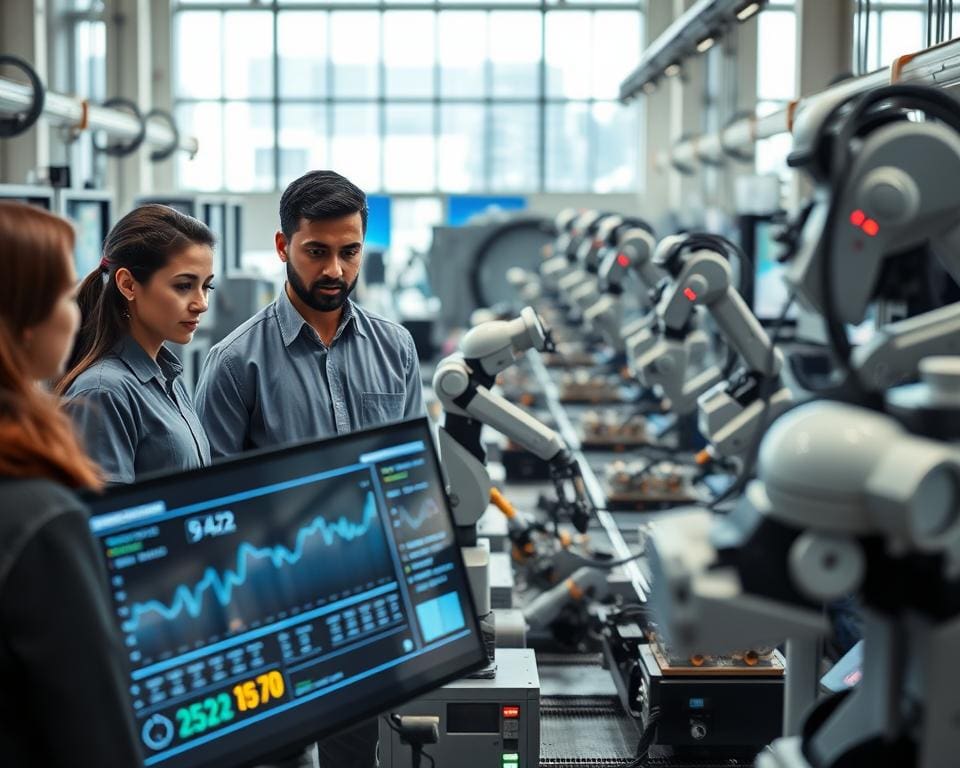
Smart factories are redefining how British industry competes and grows. At their core, smart manufacturing and digital manufacturing combine automation, robotics, IoT sensors, cloud platforms, edge devices and AI to create responsive production environments. This shift matters for competitiveness, regional employment and the United Kingdom’s Net Zero ambitions.
Seen in historical context, smart factories extend mechanisation, electrification and lean practice into the digital era. Industry 4.0 UK links those advances to real‑time data and system-wide connectivity, moving beyond isolated machines to integrated cyber–physical systems. For industrial engineering transformation, this means a move from tune‑and‑fix mechanical optimisation to continuous, data‑driven orchestration of software, hardware and human factors.
The strategic benefits are persuasive. Early adopters report higher productivity and asset utilisation, improved product quality and greater customisation, lower waste and energy use, safer workplaces and quicker time‑to‑market. Smart manufacturing also strengthens supply‑chain resilience, a crucial advantage for UK manufacturers of all sizes.
This article will unpack the technologies, workforce changes and data practices that underpin these gains. Subsequent sections explore core technologies, the evolving role of engineers, digital twins and predictive maintenance, and how supply‑chain integration and sustainability help future‑proof British industry.
How are smart factories changing industrial engineering?
Smart factories are reshaping industrial engineering by linking design, control and operations with data-driven tools. Engineers now blend traditional disciplines with digital systems to build production that is flexible, measurable and resilient.
Defining smart factories and their core technologies
At their heart, smart factories rely on a defined technology stack that connects hardware and software. Sensors and IoT devices gather condition and process data. PLCs and industrial PCs run control logic while edge computing handles low-latency processing on-site before cloud analytics take over for long-term storage and complex models.
Open standards such as OPC UA and ISA-95 ensure systems interoperate across suppliers. Industrial cybersecurity frameworks like IEC 62443 protect the OT–IT bridge. Widely used platforms from Siemens, Rockwell Automation, PTC and Microsoft provide automation, digital twin and PLM capabilities found in the UK market.
Transformations in design, process engineering and plant layout
Design practice has shifted from fixed lines to modular, reconfigurable cells. Quick-change fixturing and standardised automation modules make small-batch production viable and speed product variant changeovers.
Process engineers embed continuous sensor feedback into control loops to maintain real-time KPIs such as OEE and scrap rate. Adaptive control strategies let systems tune parameters automatically in response to measured drift.
Digital factory planning tools and simulation enable virtual validation of plant layouts. Discrete event and agent-based models support factory layout optimisation by improving material flow, safety zoning and maintenance access before equipment is moved on the shop floor.
Integration between CAD, PLM and production systems lets designers make manufacturing-aware decisions early. That reduces rework, shortens lead times and aligns lifecycle choices with assembly constraints.
Case studies from UK manufacturing: measurable gains in efficiency
UK manufacturing case studies show clear uplift when smart technologies are applied. Aerospace suppliers using digital twins and advanced non-destructive testing have cut rework and improved first-pass yields. Automotive-tier firms that embraced flexible cells and collaborative robots increased throughput for mixed-model runs.
Food and beverage producers using IoT manufacturing for condition monitoring report fewer stoppages and less spoilage. Typical metrics from British deployments include OEE gains of 10–30% and reductions in unplanned downtime of 25–70%.
SMEs benefit from modular Industry 4.0 packages and programmes such as Made Smarter, which help overcome capital barriers and speed returns. Success hinges on a clear business case, phased roll-out, engaged staff and robust data governance with trusted systems integrators or catapult centres as partners.
Automation, robotics and the evolution of the industrial workforce
Smart automation is reshaping the shop floor and the role of people within it. As manufacturers adopt new systems, the balance between machines and human skills shifts toward collaborative arrangements that boost productivity and protect worker wellbeing.
Collaborative robots (cobots) and human–machine collaboration
Manufacturers such as Universal Robots, ABB and FANUC design cobots to operate safely alongside staff. These machines take on repetitive, heavy or hazardous tasks while humans handle supervision, quality checks and complex problem solving. Typical applications include assembly, machine tending, inspection and material handling.
Benefits are tangible: higher throughput, fewer musculoskeletal injuries and faster redeployment when product lines change. Practical integration needs careful safety risk assessment, considered cell layouts and attention to payload versus cycle-time trade-offs. Reliable human–robot interfaces, such as teach pendants and simplified programming tools, make cobot use more accessible across teams.
Skills shift: upskilling, reskilling and new engineering roles
Job descriptions in manufacturing now combine core mechanical and electrical skills with digital literacy, data analysis and systems integration. Familiarity with cybersecurity and AI tools becomes essential for sustaining the industrial workforce future.
New roles emerge across smart factories: data engineer, automation systems integrator, digital twin modeller, IIoT architect and AI/ML specialist for manufacturing. Human factors engineers also play a growing part in designing safer workflows.
UK training pathways support this change. Modernised apprenticeships, university programmes and sector bodies such as the High Value Manufacturing Catapult and TWI provide routes for upskilling manufacturing staff. Employer-sponsored retraining and funded trials help firms, especially SMEs, close skills gaps and prepare teams for the industrial workforce future.
Workplace safety, ergonomics and the human-centred factory
Human-centred design places worker wellbeing at the heart of production planning. Factory ergonomics, shift patterns and cognitive load get attention through data from wearable sensors and workplace monitoring. These insights guide layout and task design to reduce strain.
Automation and real-time monitoring cut exposure to hazardous work. AR-guided procedures and sensor-driven alerts improve compliance and reduce manual errors. Legal and ethical frameworks in the UK and EU frame occupational safety standards while raising questions about equitable retraining and sustained human oversight.
Studies show that when staff take part in change management, automation can lower injury rates and increase job satisfaction. A transparent approach to human–machine collaboration strengthens trust and supports a resilient, skilled industrial workforce future.
Data analytics, digital twins and predictive maintenance
Real-time data has rewritten how engineers make choices on the shopfloor. Streaming telemetry from sensors and MES turns once-infrequent reports into continuous insight. This shift moves teams from reactive fixes to proactive control, cutting scrap and boosting throughput.
How real-time data changes decision-making in engineering
Descriptive dashboards show OEE and quality trends. Diagnostic tools reveal root causes when performance drifts. Predictive algorithms forecast failures before they occur. Prescriptive models suggest control actions or schedule changes to keep lines running.
Platforms such as Microsoft Azure IoT, Siemens MindSphere and PTC ThingWorx are common in UK plants. Open-source stacks and edge analytics handle low-latency requirements for urgent control loops. Engineers act on real-time alerts to adjust set points, reroute materials and manage quality deviations.
Digital twin technology: design validation and performance optimisation
Digital twins are live virtual replicas of machines, lines or whole plants that sync with real-world feeds. They let teams validate designs, test commissioning steps and rehearse operator actions without disturbing production.
Manufacturers use digital twins across the lifecycle for scenario testing, operator training and energy management. Typical benefits include shorter commissioning, fewer design change orders and higher first-time-right rates. Many UK firms validate process changes virtually before applying them on the shopfloor.
Successful implementation ties CAD/PLM, SCADA, MES and IoT streams together. High-fidelity simulation needs substantial compute and strong data governance to keep models accurate and trusted. Integration effort pays off in clearer decisions and ongoing performance optimisation.
Predictive maintenance: reducing downtime and total cost of ownership
Predictive maintenance in contrast to calendar-based servicing relies on analytics-driven forecasts from condition monitoring data. It reduces unnecessary interventions and prevents catastrophic failures.
Technologies include vibration analysis, acoustic monitoring, thermal imaging, oil analysis and electrical signature analysis. Machine learning models detect anomalies and estimate remaining useful life, enabling targeted maintenance optimisation.
A phased deployment begins with sensorisation, data labelling and model validation in pilots. Scaling requires CMMS or EAM integration and careful change management for maintenance teams. Typical KPIs show lower downtime, reduced spare parts inventories and higher equipment availability.
Supply chain integration, sustainability and future-proofing manufacturing
Smart factories now act as the nervous system of modern industry, knitting suppliers, logistics and retailers into resilient supply chains. Shared data standards, cloud platforms and pilot blockchain projects give end-to-end visibility, improving traceability and lead-time forecasting. When ERP signals and retail data feed factories in real time, pull-based production replaces guesswork and cuts inventory carrying costs, helping businesses respond quickly to market swings.
Collaboration platforms and industry consortiums reduce the bullwhip effect by enabling co‑optimisation across tiers. Digital planning tools support multi‑sourcing, scenario modelling and nearshoring decisions, which bolster resilience against shortages and geopolitical shocks. This supply chain digitalisation underpins agility while protecting margins and service levels.
On sustainability, smart controls, energy monitoring and process optimisation cut carbon intensity per unit and support UK Net Zero targets. Smart material tracking, closed‑loop recycling and design‑for‑reuse practices advance circular manufacturing and lower demand for virgin inputs. Integrated factory data also simplifies reporting for scope 1–3 emissions and sustainability KPIs, unlocking green procurement channels and potential price premiums for low‑carbon products.
To future‑proof factories, adopt modular hardware, open APIs and upgradeable software so systems can evolve without full replacement. SMEs can access subscription models, equipment‑as‑a‑service and grants such as Made Smarter or Innovate UK to reduce upfront cost. Strong governance, cybersecurity and ethical AI frameworks will sustain trust among workers, customers and partners. Combining digital capability with sustainable practice and skilled people offers British industry a chance to lead a global renaissance in manufacturing, creating resilient jobs and high‑value products for tomorrow’s markets.