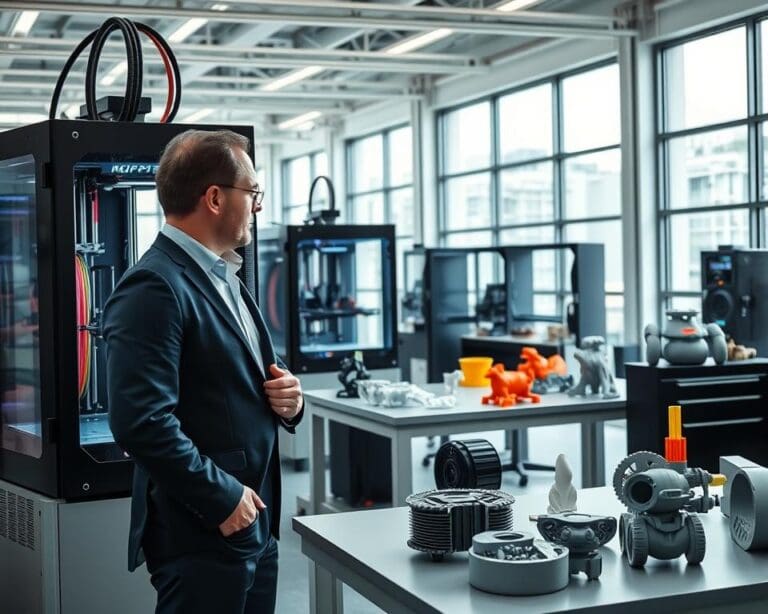
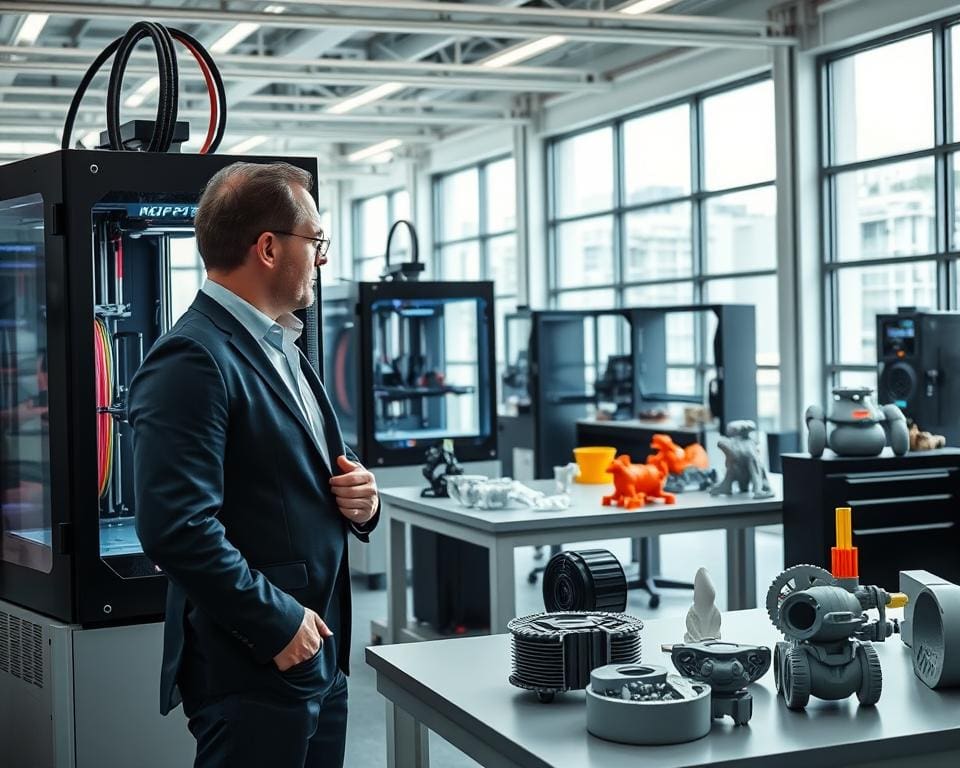
You are witnessing a shift in product development where additive manufacturing and 3D printing move ideas from concept to reality faster than traditional routes. These layer‑by‑layer processes—fused deposition modelling (FDM), selective laser sintering (SLS), stereolithography (SLA) and metal methods such as direct metal laser sintering (DMLS) and selective laser melting (SLM)—let you fabricate parts directly from digital files.
For UK businesses in automotive, aerospace, medical devices and consumer goods, this is more than a novelty. Additive manufacturing changes lengthy, capital‑heavy cycles into agile, iterative workflows that support rapid prototyping and shorter development times. That practical flexibility gives manufacturers a competitive edge in product development trends and manufacturing innovation.
At a glance, AM offers faster prototyping, lower iteration costs for complex geometries, improved supply‑chain resilience and the potential for decentralised production. It also enables design freedom through topology optimisation and design for additive manufacturing (DfAM), which can reduce material use and improve performance, lowering time‑to‑market and total cost of ownership for development.
The wider ecosystem matters. Innovate UK funding, partnerships between Rolls‑Royce, BAE Systems and GKN Additive, and university centres such as the University of Sheffield AMRC and the University of Nottingham are driving skills, standards and adoption. Regulatory oversight remains important in safety‑critical sectors, especially aerospace and medical devices where certification and traceability are essential.
This article is written for product managers, design engineers and business decision makers who want practical insight into how AM can reshape your development processes. You will find sections on how 3D printing accelerates iteration, supply‑chain impacts, and the design, material and commercial benefits that follow from integrating virtual tools and rapid tooling. For a closer look at tools that support engineers in design work, see this practical resource on workflow tools and simulation-driven approaches: supporting engineering design.
How additive manufacturing accelerates design iteration and prototyping
Additive manufacturing shortens the gap between idea and test by letting you produce physical parts from CAD files in hours or days rather than weeks. This shift transforms your workflow, so testing, validation and user trials can run in parallel instead of in strict sequence. You can try multiple concepts quickly, reduce prototyping costs and move from a digital sketch to a tangible proof-of-concept with far less delay.
Rapid prototyping in AM covers a range of technologies. SLA and SLS deliver detailed plastic parts for visual and functional checks. DMLS and SLM make metal prototypes for load tests. Desktop FDM gives low-cost, fast proof-of-concept models for early ergonomic trials. These options let you show stakeholders a working item rather than a render, speeding decisions and shortening project timelines.
Lower cost of iteration for complex geometries
When you iterate with additive manufacturing, tooling costs disappear. Traditional routes like CNC or injection moulding require setup that raises prototyping costs per cycle. AM keeps per-iteration spend low, especially for single items or small batches. Complex internal features that would demand assembly or expensive machining are often produced in one build, saving labour and post‑assembly expense.
Complexity no longer carries a heavy penalty. You can create conformal cooling inserts for injection moulds, topology-optimised aerospace brackets and heat exchangers with internal channels without prohibitive extra cost. These designs can reduce weight and improve performance while cutting assembly steps.
Enabling user-centred design through quick feedback loops
Short turnaround enables genuine user-centred design. You can print functional prototypes, run usability tests or clinical evaluations, gather feedback and refine ergonomics within days. Medical device teams and consumer product groups use iterative design cycles to validate fit, comfort and function before committing to final materials or certification paths.
To rely on these fast cycles, select the right AM process and material for each test. Mechanical properties from AM can differ from injection-moulded or wrought parts. Post‑processing, heat treatment and parameter control influence results. Integrate AM-specific testing and simulation into your development to ensure each iteration yields meaningful data.
Impacts of additive manufacturing on supply chains and manufacturing strategy
Additive manufacturing changes the way you think about production and logistics. Digital designs replace stacks of physical stock, so you can respond quickly to demand and bolster supply chain resilience.
Reduced lead times and on-demand production
With on-demand production you print parts when they are needed, not months before. That swaps long procurement cycles for hours or days, cutting delays for critical items.
Airlines and rail operators use spare parts printed at local hubs to avoid long waits for shipped components. You reduce downtime and improve fleet availability.
Decentralised manufacturing and nearshoring advantages
Decentralised manufacturing moves capacity from a few mega-factories into a network of local sites. Nearshoring to the UK or nearby EU partners lowers shipping costs and shields you from global logistics shocks seen during the COVID‑19 pandemic.
Service bureaux and digital manufacturing platforms let you scale production across locations while keeping consistent quality control and delivery performance.
Inventory reduction and customisation at scale
Digital inventory means part files sit in a server, not a warehouse. You achieve significant inventory reduction and cut warehousing costs by printing on demand.
Mass customisation becomes practical because you avoid expensive tooling. This suits spare parts, low-volume specialised components and high-value personalised goods.
New business models include pay-per-print, subscription fulfilment and controlled distribution of CAD files. These create aftermarket revenue from upgrades and bespoke retrofits.
Quality assurance and standards
When you decentralise, you must keep traceability and in-process monitoring tight. Certification matters most in regulated sectors, so align processes with standards from ASTM International and the British Standards Institution (BSI).
Sustainability and trade-offs
Reduced transport and leaner stock can lower emissions, yet some additive processes use more energy. Conduct life‑cycle assessment to weigh benefits against material recyclability and energy use.
Design freedom, material advances and business benefits
You gain significant design freedom with additive manufacturing. Removing traditional tooling limits lets you apply topology optimisation and embed lattice structures to cut weight and part count. That shift enables examples such as aerospace brackets redesigned for minimal mass, medical implants with porous surfaces that aid osseointegration, and heat exchangers with integrated fluid channels for improved thermal performance.
Materials for additive manufacturing have advanced rapidly across polymers, composites and metals. Common choices include PA12 and PEEK for engineering polymer parts, photopolymer resins for functional prototypes, aluminium alloys and Ti‑6Al‑4V for aerospace and medical components. Emerging high‑performance alloys, metal matrix composites, multi‑material printing and conductive or ceramic feedstocks expand functional applications and push performance boundaries.
When you build the business case for AM, quantify the savings from reduced part count, lower assembly costs and weight reduction that drives fuel or energy savings. Factor in faster product iterations, reduced lead times and tooling avoidance to calculate additive manufacturing ROI. Compare total cost of ownership across expected volumes and include inventory, logistics and potential revenue uplift from customisation and enhanced product performance.
To adopt additive manufacturing effectively, invest in Design for Additive Manufacturing skills, integrate AM into your development lifecycle and set up quality and certification pathways. Partner with specialist service bureaux or research centres and run pilot projects with clear KPIs. Acknowledge limits—surface finish, tolerances, process repeatability and production speed—and mitigate them with hybrid manufacturing, post‑processing, batch strategies and robust testing. Continued material breakthroughs, better automation and broader digital manufacturing networks mean AM will play a growing role; assess where it can deliver strategic advantage in your product roadmap and supply‑chain strategy.