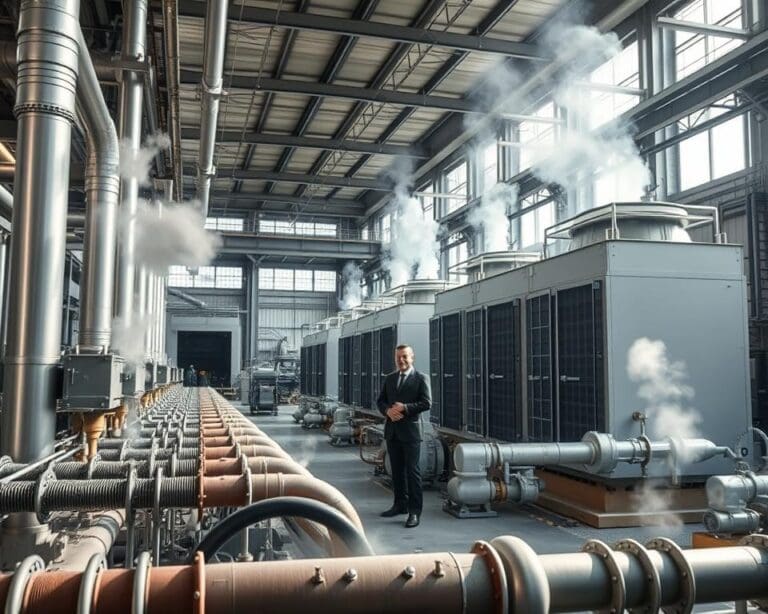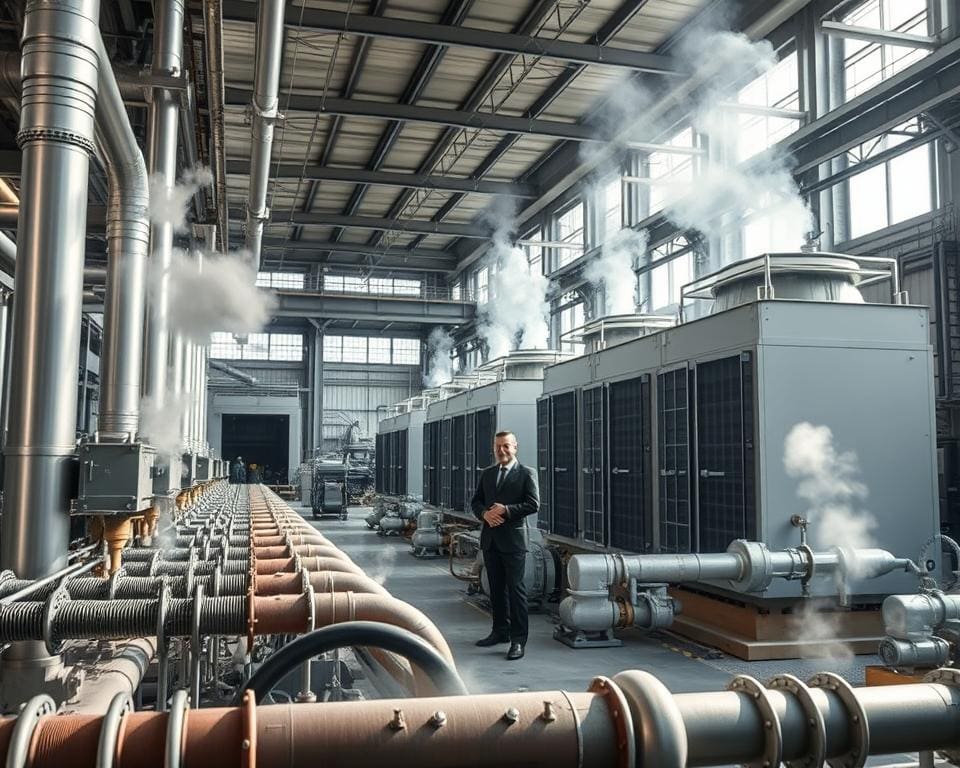
You rely on industrial cooling systems to keep plant temperatures within safe, repeatable limits. These engineered solutions — chillers, cooling towers, heat exchangers and packaged air-cooled units — remove heat from equipment, processes and buildings so your operations run smoothly.
When you judge cooling system performance, focus on clear metrics: equipment uptime, product quality consistency, process throughput, energy consumption per unit of output, maintenance intervals and lifecycle costs. Improvements in these areas translate directly into measurable industrial cooling benefits for your site.
In the UK, seasonal temperature swings and ambient limits for outdoor equipment affect design and operation. You must also meet regulatory expectations, including Environment Agency guidance on cooling water discharge and Health and Safety Executive considerations for plant safety. Good thermal management reduces compliance risk while protecting staff and assets.
This article first explores how industrial cooling systems boost operational efficiency, then reviews key system types and components, and follows with design, maintenance and monitoring best practice. It concludes by quantifying business outcomes such as productivity gains, cost savings and sustainability benefits.
If you work in food and beverage, pharmaceutical manufacture, data centres, steel or chemical plants, you will recognise suppliers like Carrier, Trane, Johnson Controls, Sulzer and SPX Flow on tender documents or service lists. Read on to learn practical steps to improve your cooling performance, indicators to watch, and how investment in process cooling UK can deliver real returns.
How industrial cooling systems boost operational efficiency
Effective thermal management strategies are central to reliable production. Your cooling system keeps equipment within safe limits, reduces unplanned stops and supports stable process control. Use this section to check how cooling downtime reduction, process temperature control and energy-efficient chillers deliver measurable benefits for your plant.
Reducing thermal-induced downtime
Overheating forces immediate shutdowns, spoils product batches and cuts throughput. Motors suffer insulation breakdown, bearings show wear from high temperatures and compressors can fail from thermal stress. You will see spikes in bearing vibration and motor temperature before a fault.
Correctly sized and maintained cooling equipment keeps components inside manufacturer temperature ranges. That raises mean time between failures and cuts unplanned stoppages, improving overall equipment effectiveness and delivering cooling downtime reduction you can measure.
Maintaining optimal process temperatures for consistent output
Tight process temperature control matters in polymer extrusion, chemical synthesis, fermentation and food processing. In pharmaceutical manufacture, active ingredient crystallisation takes place only within narrow bands. In food lines, pasteurisation depends on exact heat removal.
Closed-loop chillers, plate heat exchangers and control valves let you hold setpoints with precision. Use cascade control loops, tuned PID algorithms and PLC or SCADA integration to automate regulation, reduce variability and cut rework through better process temperature control.
Energy efficiency gains and reduced utility costs
Modern plant upgrades deliver utility cost savings while lowering carbon. Variable-speed drives on pumps and fans match output to demand. Free-cooling economisers, high-efficiency compressors and heat reclaim reduce electricity and water draw. Target metrics such as kWh per tonne of cooling, chiller COP and cooling water specific consumption to track progress.
Apply staging and sequencing of chillers and fit plate heat exchangers for more efficient transfer. These moves make energy-efficient chillers work harder for you and support compliance with UK reporting requirements such as Streamlined Energy and Carbon Reporting, helping with Scope 1 and Scope 2 reduction and clear utility cost savings.
Key components and types of industrial cooling systems
Understanding the main components helps you choose the right cooling plant for your site. This overview explains how different systems work, what parts they include and the trade-offs you should weigh when specifying equipment for factories, laboratories or data centres.
Closed-loop chillers are recirculating units that cool a secondary fluid, typically water-glycol, using refrigerant-driven compressors or magnetic-bearing technology. You will find them in precise processes such as injection moulding, laser cooling and pharmaceutical production where tight control matters.
Key components include screw, centrifugal or scroll compressors, condensers, evaporators, expansion devices and a secondary pump circuit. These elements work together to deliver stable outlet temperatures, often within ±0.1–1.0°C, and they keep the process fluid sealed to reduce contamination risk.
When you select closed-loop chillers, check coefficient of performance (COP) variation with load and ambient conditions. Also verify compliance with UK and EU F-gas rules by choosing low-global-warming-potential refrigerants to meet environmental obligations.
Evaporative cooling towers reject heat by evaporating a fraction of circulating water to the atmosphere. They suit large heat-rejection needs in power stations, chemical sites and central HVAC plants where bulk cooling is required.
Operational metrics you should monitor include approach temperature, drift, blowdown and cycles of concentration. These influence efficiency and water use.
Water management is critical. You must apply treatment to control scale and corrosion, and to reduce biological risk such as Legionella. Follow guidance from the Health and Safety Executive and Public Health England when you operate evaporative cooling towers.
Environmental and regulatory issues extend to effluent disposal and make-up water sourcing. You can lower consumption with drift eliminators and high-efficiency fill materials to optimise water use.
Air-cooled systems send heat to ambient air via fans and finned condensers. They need no cooling tower and use little or no process water, making them a good option where water is scarce or tightly regulated.
Advantages include simpler installation and reduced Legionella risk. Drawbacks include lower efficiency when ambient temperatures are high and higher acoustic emissions near the plant.
Water-cooled systems rely on cooling towers, or on river and sea water, to remove heat. They usually offer better thermal performance and a smaller footprint for the same capacity.
Expect higher heat-transfer efficiency and often lower power use compared with air-cooled systems. You must budget for water treatment, additional plumbing and more complex operation.
To decide between air-cooled systems and water-cooled systems, consider local water availability, noise restrictions, ambient temperature patterns across the UK and the balance between capital and operating costs. Also assess lifecycle environmental impact and the role of key pieces such as industrial heat exchangers in your selected configuration.
Design, maintenance and monitoring practices that improve performance
Good cooling system design begins with accurate load assessment. You should calculate sensible and latent loads, consider worst‑case ambient conditions and allow for seasonal diversity. Use heat balance methods for process lines and consult CIBSE guides and manufacturer performance curves when you size equipment.
Plan for future growth by choosing modular plant that allows staged expansion. Correct system sizing avoids wasted capital from oversizing and prevents frequent overloads from undersizing. Redundancy for critical processes reduces risk of downtime while keeping operating efficiency.
Begin with detailed measurements and worst‑case scenarios. Apply heat balance calculations and validate against chiller and tower curves. Factor in diversity, control margins and spare capacity so your plant meets present demand and future changes.
Preventative maintenance schedules to extend equipment lifespan
Create a simple, repeatable maintenance plan. Daily visual checks and alarm responses catch obvious faults early. Weekly inspections should cover belts, pump seals and basic housekeeping.
Monthly tasks include water chemistry checks and refrigerant pressure readings. Quarterly performance tests spot efficiency drift. Annual major servicing should address compressors, fan motors and heat‑exchanger integrity.
Keep detailed maintenance logs and a spares strategy for items such as compressors, bearings and gaskets. Proper preventative maintenance lowers unscheduled downtime, improves energy use and helps maintain warranty terms.
Using sensors and IoT for real‑time monitoring and predictive maintenance
Deploy temperature, pressure, flow, vibration, motor current and water conductivity sensors to capture key variables. Send telemetry to a central SCADA or a cloud platform for trend analysis and alerts.
Platforms such as Siemens MindSphere, Schneider Electric EcoStruxure and ABB Ability are common in the UK for industrial monitoring. Machine‑learning models can identify anomalies before they fail, allowing targeted, cost‑effective interventions.
Water treatment and corrosion control to preserve components
Unchecked scale, biofouling and corrosion reduce heat transfer and damage equipment. Use chemical dosing—biocides, scale and corrosion inhibitors—alongside filtration and side‑stream treatment to protect surfaces.
Manage closed‑loop glycol systems carefully and monitor residuals. Compliance with safe handling and accurate dosing is essential for audits. Consider contracts with specialists such as Pentair, SUEZ or Veolia for expert water treatment for cooling systems and regulatory peace of mind.
Business benefits: productivity, cost savings and sustainability
Your plant can see clear productivity improvements when cooling systems run reliably. Reduced thermal-related downtime often delivers single- to double-digit percentage gains in productive hours, depending on the sector. Stable temperatures cut scrap and improve yield, while faster ramp-up after maintenance means you regain capacity sooner and keep customer deliveries on schedule.
Investing in efficient equipment yields measurable operational cost savings. High-efficiency chillers, variable-speed drives and heat-recovery modules lower energy use and maintenance needs, shortening the cooling system ROI window. Typical payback for targeted retrofits ranges from two to five years, and you can track KPIs such as kWh per unit produced, water consumption per tonne and reduced emergency repair costs to demonstrate value.
Choosing sustainable cooling solutions supports carbon reduction industrial cooling goals across Scope 1, 2 and 3. Low‑GWP refrigerants and compliance with the UK F‑gas regime cut direct emissions, while heat reuse—feeding space heating or pre-heating process water, or linking to CHP—boosts overall plant efficiency. These steps help meet investor and customer expectations and align your business with UK net‑zero targets.
To secure benefits, you should assess current performance with an energy and water audit, prioritise high-impact upgrades and adopt continuous monitoring. Use accredited consultants and reputable suppliers to ensure compliance and to maximise lifecycle value. This approach makes cooling upgrades a strategic lever for productivity improvements, improved cooling system ROI and long-term sustainability.