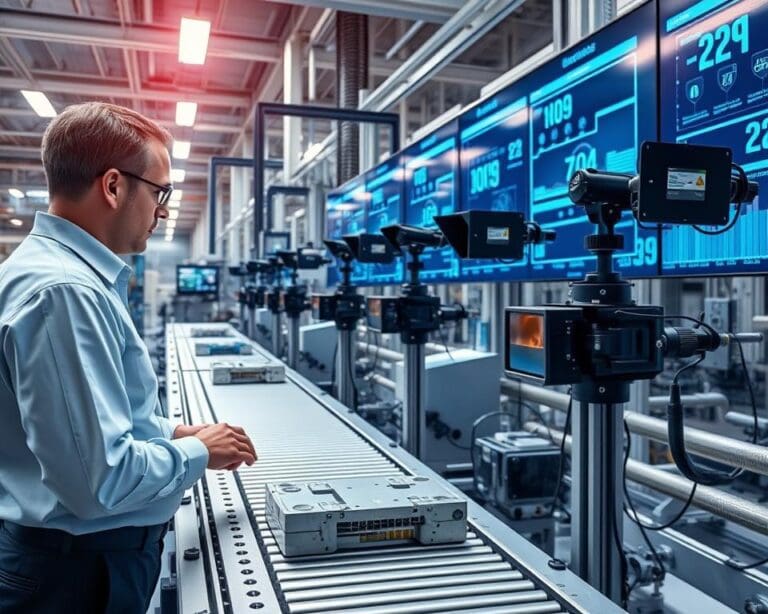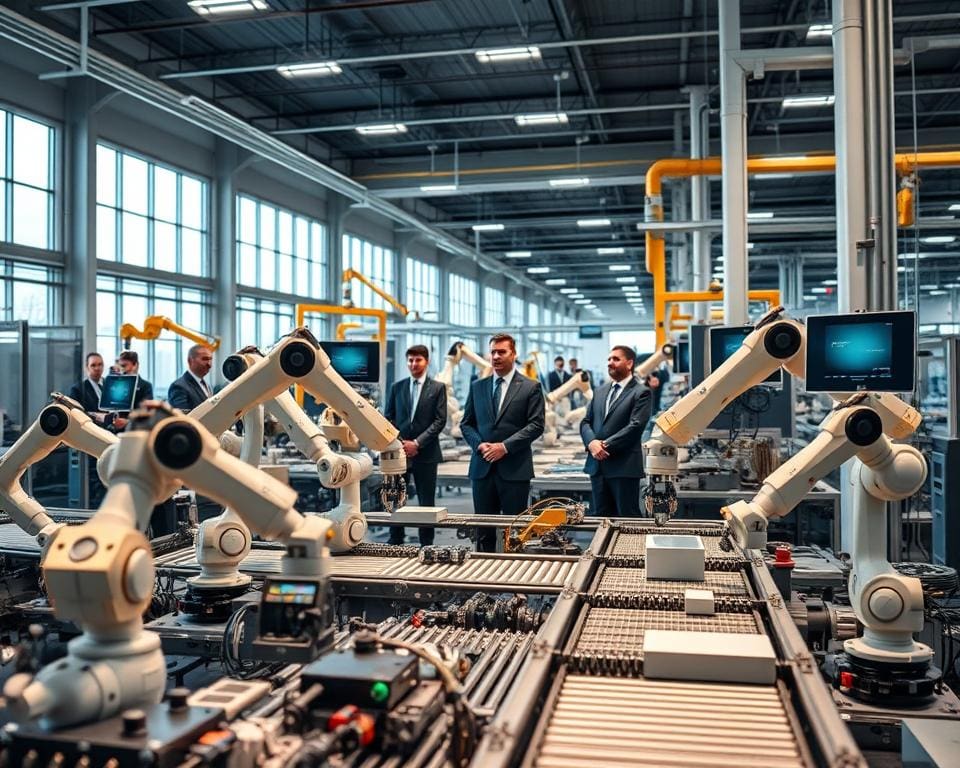
You are reading this because you want clear, practical insight on automation in manufacturing and how it will affect your business in the UK. Industrial automation is no longer optional: it is reshaping production, supply chains and competitiveness as firms respond to global pressure and evolving customer demands.
Manufacturing transformation is driven by several forces you recognise every day: global competition, labour shortages, rising energy costs, tighter emissions rules and a growing appetite for mass customisation. These pressures make factory automation UK projects a strategic priority for many boardrooms and plant managers.
To grasp the scale, remember that manufacturing contributes around 10% of UK GDP and employs over two million people. Government support such as the Made Smarter and Innovate UK programmes also helps firms access grants and advisory support to speed up manufacturing digitalisation.
In this guide you will learn what industrial automation means in practice, which technologies to prioritise, and the measurable benefits you can expect in throughput, quality, cost and sustainability. You will also find advice on managing workforce change and implementation risks.
Section 2 will examine how factory floors change when you adopt automation in manufacturing. Section 3 looks at the core technologies to consider. Section 4 quantifies benefits for UK manufacturers with case examples, and Section 5 outlines workforce implications and practical steps to prepare your business for successful manufacturing digitalisation.
How ndustrial automation is reshaping factory operations
Industrial automation brings together control systems, data analytics and mechanised processes so your factory can run with far less manual intervention. You move from single‑task machines to flexible cells and lines that cope with quick product changeovers and small batch runs.
What ndustrial automation means for your production line
On the shop floor your roles shift from hands‑on operation to supervision, system tuning and maintenance. Production line automation reduces cycle times and helps you stick to takt time more reliably.
You can expect greater flexibility for batch size one and customised production. Staff focus on exceptions and continuous improvement rather than repetitive tasks.
Types of automation systems used in modern factories
- Programmable Logic Controllers and Distributed Control Systems form the core of process control. Look to Siemens, Rockwell Automation and Schneider Electric for proven industrial control systems.
- Supervisory platforms such as SCADA and Manufacturing Execution Systems manage monitoring and scheduling. Examples include Siemens Opcenter, GE Digital and Rockwell FactoryTalk.
- Flexible manufacturing includes Automated Guided Vehicles and Autonomous Mobile Robots from vendors like MiR for intra‑plant logistics, plus robotic arms and cobots for assembly, welding and inspection.
- Integration layers use standards such as OPC UA, PROFINET and EtherCAT to keep devices and enterprise systems interoperable.
Impact on throughput, quality and defect reduction
When you retrofit lines, typical throughput improvement ranges from 20–50%. Automating inspection and closed‑loop control can halve defect rates in many cases.
Closed‑loop feedback and in‑line machine vision reduce rework and scrap, lifting first‑pass yield. Real‑time traceability speeds recall investigations through automated capture of serial numbers, batch IDs and process parameters.
To sustain gains you must adopt robust maintenance plans, manage spare parts effectively and secure connected control systems. Compliance with machinery directives, CE/UKCA marking and functional safety standards such as IEC 61508 and ISO 13849 is essential when deploying automated equipment.
Key technologies driving modern manufacturing transformation
You will find a tight set of technologies shaping how factories operate today. Each plays a distinct role in cutting downtime, lifting quality and giving you clearer control over production. The next parts break down robotics, connected equipment, AI and sensing so you can see practical paths to adoption.
Robotics and collaborative robots
Traditional industrial robots from ABB, KUKA and Fanuc run high‑speed tasks inside fenced cells. They excel at heavy payloads and continuous, repetitive work such as palletising and surface finishing.
Collaborative robots from Universal Robots and Doosan Robotics are built to work beside people. You can use cobots UK for machine tending, pick‑and‑place and hazardous tasks where safety and flexibility matter.
Return on investment is often rapid for repetitive operations. You should weigh end‑of‑arm tooling, programming ease like lead‑through teaching, safety systems and floor‑space planning when planning integration.
Internet of Things and connected equipment
IoT manufacturing links machine data to enterprise systems so you can monitor condition and run remote diagnostics. Platforms such as Siemens MindSphere, PTC ThingWorx and Microsoft Azure IoT make data accessible for asset tracking and digital twins.
Connectivity standards like MQTT and OPC UA and edge computing cut latency and reduce bandwidth use. These elements let you push actionable alerts to control rooms and mobile teams without delay.
Artificial intelligence and machine learning for predictive control
AI in manufacturing helps predict failures, tune process setpoints and spot anomalies before they escalate. Predictive maintenance driven by AI models can cut unplanned downtime by up to half in many deployments.
You will need quality data, strong feature engineering and governance to avoid model drift and to keep explainability for regulated work. Typical models include supervised learning for fault classification, time‑series forecasting for remaining useful life and reinforcement learning for adaptive control.
Advanced sensors and real‑time analytics
Industrial sensors cover vibration, acoustic emission, thermal imaging, laser distance, force/torque and chemical sensing. High‑frequency, multi‑modal sensor fusion feeds real‑time analytics for faster root‑cause detection.
Deploy with careful calibration, correct placement and edge analytics so alerts tie into MES and ERP systems. That setup enables automated corrective actions and closed‑loop control driven by timely, local decisioning.
- Practical tip: Combine cobots UK with industrial sensors and real‑time analytics to speed commissioning and reduce changeover time.
- Practical tip: Use IoT manufacturing platforms and AI in manufacturing to scale predictive maintenance across multiple sites.
Benefits for UK manufacturers: efficiency, cost savings and sustainability
The move to automation delivers clear gains for manufacturers in the United Kingdom. You will see shorter cycle times, higher on‑time delivery and better capacity utilisation when you adopt modular tooling and digital work instructions. Continuous operation and faster changeovers help you serve fast‑moving markets and bespoke orders without sacrificing quality.
How automation increases efficiency and reduces lead times
Automation reduces manual handoffs and speeds throughput by reclaiming administrative time and standardising processes. Typical simple automations can free 10–30% of admin effort, letting staff focus on value tasks such as optimisation and maintenance. You will notice improved cycle times and a measurable uptick in units per operator.
Design digital work instructions and use modular fixturing to cut changeover time. Combine those with analytics platforms like Power BI or Tableau to prioritise work and improve resource allocation. For practical guidance on digital productivity tools, see this productivity resource.
Cost reduction through labour optimisation and waste minimisation
Automation shifts people away from repetitive tasks and lowers overtime and absenteeism costs. By redeploying staff to higher‑value roles you improve labour productivity and reduce total cost of ownership compared with manual operations.
Process monitoring and automation reduce scrap and rework, cutting material handling and disposal costs. When you track metrics such as cycle time, lead time and tasks completed per period, you can set thresholds and alerts to contain defects quickly and protect margins. These measures deliver tangible cost savings automation can justify to finance teams.
Energy efficiency and lower environmental footprint
Energy management features in automated plants drive measurable energy savings industrial automation. Variable‑speed drives, demand response and optimised heating and cooling schedules lower consumption. Predictive maintenance prevents energy‑inefficient operation and extends asset life.
Automation also supports sustainable manufacturing by improving material efficiency and enabling recycling or remanufacturing workflows. These steps help you meet Scope 1 and 2 reporting needs and satisfy sustainable procurement demands from major buyers while reducing operating costs.
Case examples from UK industry to illustrate gains
Well‑documented examples show real benefits. BMW’s Mini Plant in Oxford uses advanced automation in its body shop and logistics to raise throughput and consistency. Rolls‑Royce applies automated machining and metrology to improve yield in aerospace parts. Jaguar Land Rover employs robotics and digital systems across assembly and testing to shorten lead times.
SMEs have seen strong returns under programmes such as Made Smarter and Innovate UK, where retrofits delivered faster throughput and better quality with payback periods often in weeks to months. For comparative context, consult manufacturing case studies UK that detail metrics like reduced cycle time and energy savings following automation.
When you assess investments, include lifecycle costs for maintenance, training and cyber security. Consider grant schemes and financing options to lower initial barriers so you can realise manufacturing efficiency UK, cost savings automation and long‑term sustainable manufacturing benefits.
Challenges, workforce implications and how to prepare your business
Adopting automation brings real automation challenges you must face: integrating legacy plant, overcoming data silos and managing interoperability between suppliers and protocols. Upfront capital expenditure can be large and ROI uncertain unless you set clear KPIs. Supply chain delays and vendor dependence add further risk, while industrial cybersecurity becomes essential as connected devices widen the attack surface. Follow National Cyber Security Centre guidance for industrial control systems and adopt network segmentation, regular patching and functional safety checks to reduce exposure.
Your workforce will change as roles shift from manual tasks to programming, maintenance and systems analysis. Workforce reskilling is not optional; plan structured routes such as apprenticeships, T‑levels and courses from City & Guilds, SEMTA or IMechE, alongside vendor training from Siemens, Rockwell or ABB. Effective manufacturing change management needs transparent communication, phased rollouts and early involvement of unions or works councils to secure buy‑in and reduce disruption.
Prepare your business with a clear assessment and strategy: perform a digital maturity review, map assets and connectivity, and define measurable objectives like OEE gains, lead time cuts and energy targets. Begin with targeted pilots that solve specific pain points, measure KPIs, then scale using standardised architectures and repeatable playbooks. Establish data governance, ownership and quality controls to underpin analytics and AI, and seek partners—local Catapult centres, technology vendors—and funding such as Made Smarter or Innovate UK to share risk during automation implementation UK projects.
Use a practical checklist to move forward: define objectives and KPIs, map assets, pick a pilot with measurable ROI, secure funding and partner support, plan workforce transition and training, implement industrial cybersecurity and safety measures, then monitor, iterate and scale based on data. Addressing these points will help you meet automation challenges while creating a resilient, skilled workforce and a controlled route to automation implementation UK‑wide.