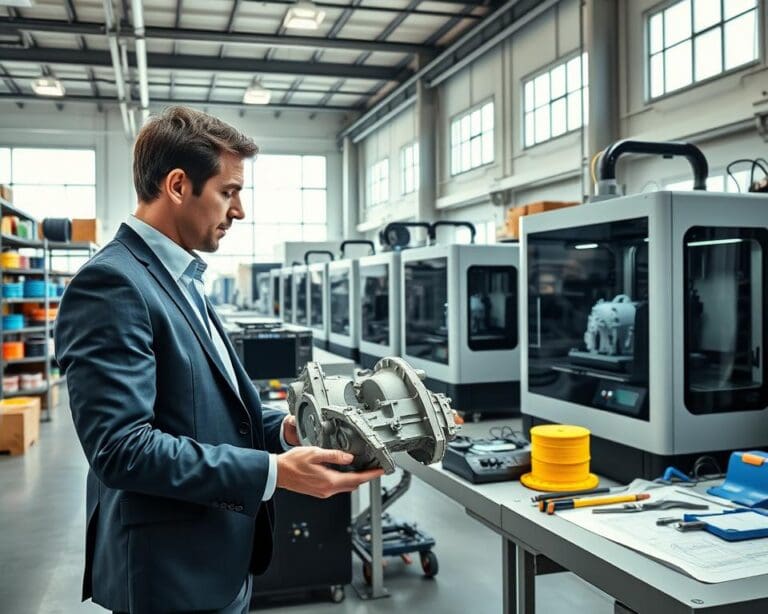
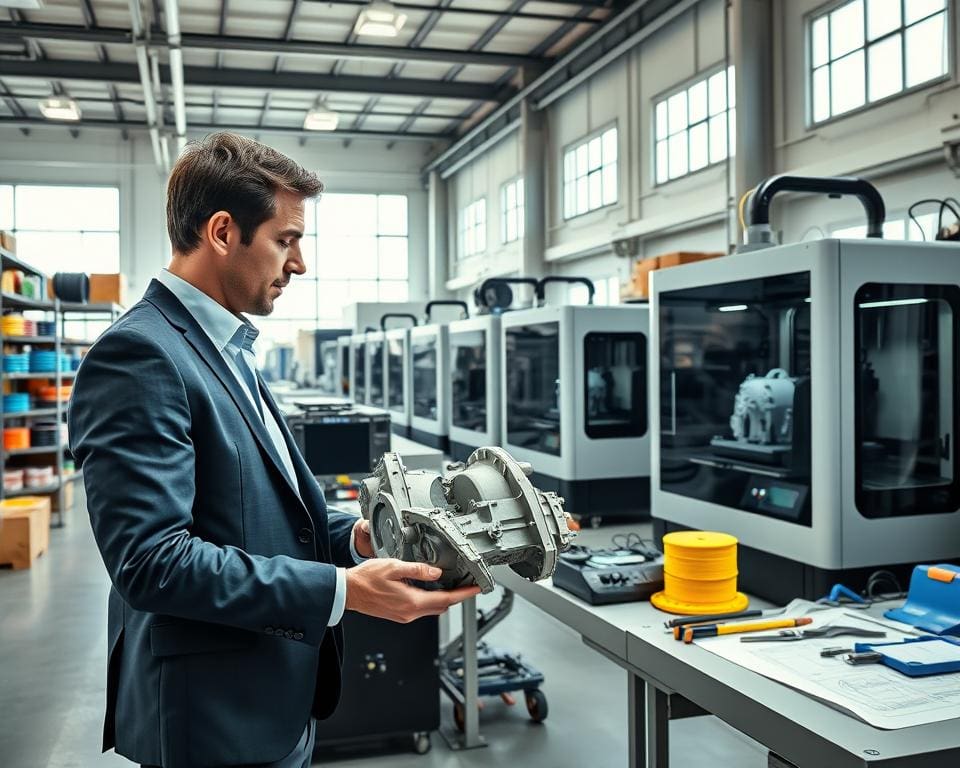
You are likely exploring how industrial 3D printing can strengthen your production. Also called additive manufacturing for manufacturers, this approach builds parts layer by layer from digital designs. Common processes include selective laser sintering (SLS), fused deposition modelling (FDM), stereolithography (SLA) and metal powder bed fusion (PBF).
When we say industrial, we mean production-scale capability: higher throughput, industrial-grade materials, repeatability and integration with existing lines. Major suppliers and research centres such as Stratasys, 3D Systems, Renishaw, EOS and the Manufacturing Technology Centre are helping UK manufacturers adopt these systems and secure training and certification.
Market drivers are clear. Supply chain disruption and reshoring trends in the UK push you to shorten lead times, lower inventory and produce custom or low-volume parts on demand. Sustainability goals also favour additive routes because they cut material waste and enable more efficient designs.
Strategic benefits you can expect include faster prototyping-to-production, cost and waste reduction, design freedom for complex geometries, part consolidation to reduce assembly steps, on-demand spare parts and enhanced performance through engineering polymers, composites, titanium and high-strength alloys.
This article is for operations managers, production engineers, procurement leads and business owners in the United Kingdom who want to assess 3D printing ROI and embed UK manufacturing innovation into their roadmap. Later sections will expand on concrete advantages, cost considerations, quality and regulatory pathways and practical steps to implementation.
industrial 3D printing: transformative advantages for your production line
You can reshape product development and manufacturing by adding industrial 3D printing to your workflow. Small changes early on speed decisions, cut lead times and reduce risk. This approach supports rapid prototyping that moves a CAD file to a tactile prototype in hours or days rather than weeks.
The speed to market gains come from using SLA and SLS for realistic prototypes and metal PBF for low-volume functional parts. Rapid prototyping helps your teams run concurrent engineering, validate fit and function early and accelerate time-to-revenue for launches.
Custom production no longer needs expensive tooling or long runs. Digital files drive manufacturing, so you can scale economical customisation across batches. On-demand manufacturing lets you print spare parts or variants as needed, limit obsolescence and serve UK customers faster from local sites.
You benefit in medical device production, bespoke jigs and fixtures, and limited-run aerospace components where tailored parts matter. On-demand manufacturing reduces inventory and lets you respond to orders without long waits.
Design freedom is a core strength of additive processes. You can create internal channels, lattice structures and topology-optimised forms that traditional methods cannot match. This freedom supports complex part consolidation, where multiple components are printed as one assembly.
Complex part consolidation reduces assembly steps, joints and fasteners. You get lighter, stronger parts with fewer failure points. Practical outcomes include weight savings in aerospace and automotive parts and simpler logistics on the production line.
Material choice defines what you can achieve. Industrial printers work with high-performance thermoplastics such as PEEK and Ultem, engineering-grade nylons like PA12 and PA11, composites and metals including aluminium, titanium, stainless steel and Inconel. Using engineering 3D printing materials lets you meet chemical resistance, heat stability and strength targets.
Performance improves further when you integrate post-processing. Heat treatments, surface finishing, machining and coatings bring parts to required functional and aesthetic standards. Thoughtful design for additive manufacturing ensures you gain the full benefits of materials and geometry in use.
Cost savings and efficiency gains for manufacturers
Adopting industrial 3D printing can change how you budget, store and produce parts. You will see immediate impacts on lead times and capital outlay when you move from traditional moulds to additive workflows. These shifts drive measurable cost savings 3D printing brings to modern manufacturing.
Reduction in tooling and setup costs
With additive manufacturing you often avoid bespoke tooling such as injection-mould cavities and complex jigs for low- to medium-volume runs. Traditional injection-mould tooling can cost tens of thousands of pounds and take weeks to produce. By contrast, 3D-printed fixtures or part-specific tooling require far less upfront capital and can be produced in days.
In practice you might use 3D printing for time-critical or limited-run parts while reserving steel moulds for high-volume production. This hybrid approach helps you reduce tooling costs without sacrificing unit economics on large orders.
When assessing costs, compare amortisation of your 3D-print equipment against per-part tooling amortisation. Shorter lead times translate into opportunity cost savings and less capital tied up in work-in-progress.
Lower inventory and warehousing requirements
On-demand production lets you shift from stocked finished goods to digital inventory. You keep CAD files and print as required, freeing warehousing space and cutting storage costs. This inventory reduction lowers the risk of obsolescence and improves cash flow.
A practical use-case is spare-part support for industrial equipment. You can create regional print hubs in the UK to supply parts locally, shortening delivery times for customers and reducing long supply chains.
Optimised material usage and waste reduction
Additive processes deposit material only where needed, so you use far less raw material than with many subtractive methods. Some metal powder systems let you reclaim unused powder for reuse. Polymer printing often produces fewer offcuts, which adds to both cost and environmental benefits.
Reduced scrap rates and lighter parts can lower life-cycle energy use, especially in transport applications where weight saves fuel. Be aware that post-processing and support removal create waste streams that must be managed. Good design for additive manufacturing (DfAM) reduces supports, enhances additive manufacturing efficiency and limits waste reduction in manufacturing.
Quality, reliability and regulatory considerations
When you scale industrial 3D printing into production, quality and regulatory demands become central to your operation. Clear process control, rigorous inspection routines and recognised certification pathways protect you from costly rework. These steps also support long-term trust with customers in aerospace, medical and defence sectors.
Your equipment choice affects repeatability. Machines from Renishaw, EOS and Stratasys include closed-loop controls and validated build recipes that improve repeatability in additive manufacturing. You should set firm process parameters, keep machines calibrated and manage temperature and humidity to reduce variation between batches.
Use statistical process control (SPC) and in-line monitoring such as thermal and optical sensors to flag drift during a build. Track build history and part traceability in software so you can show each component’s production record for audits and customer queries.
Material lot traceability and standardised post-processing are vital to preserve mechanical properties. Document your supplier lots, heat treatments and finishing steps so you can reproduce parts when needed and satisfy procurement teams.
Consistent repeatability and process control
- Define machine parameter windows and maintain calibration logs.
- Apply SPC charts and alarm thresholds to detect process shift early.
- Record environmental conditions and material batch numbers for traceability.
Inspection, testing and certification pathways
Inspection of 3D printed parts should combine non-destructive and destructive methods to validate internal and external quality. Use CT scanning or ultrasonic inspection to reveal internal defects. Employ coordinate measuring machines and optical scanners for dimensional checks.
Mechanical testing such as tensile and fatigue tests proves performance under load. Pair test data with documentation for material qualification and process validation to support 3D printing certification for regulated markets.
Follow ISO/ASTM 52900 series guidance and industry-specific standards. Work with accredited labs and bodies like the British Standards Institution and Aerospace Growth Partnership to navigate NADCAP requirements and Medical Device Regulation obligations.
Maintaining supply chain resilience in the UK
Localised, distributed additive manufacturing reduces lead times and helps you respond to demand spikes. Set up regional hubs or partner with service bureaus to create redundancy across sites and technologies.
Programs run by Innovate UK and the Advanced Manufacturing Research Centre support capability building and resilience projects. Plan for risks such as machine downtime, staff skills gaps, material shortages and cybersecurity of digital part files.
- Map critical parts and identify candidates for local production.
- Build supplier diversity and cross-train operators to reduce single points of failure.
- Secure digital workflows and maintain spare parts for key machines to protect UK supply chain resilience.
Implementing industrial 3D printing in your business strategy
To implement 3D printing successfully, begin with a strategic assessment that identifies clear use-cases such as prototyping, jigs, end‑use parts and spare parts. Quantify savings in tooling, inventory and lead time, estimate throughput needs and model return on investment for both equipment and outsourcing. A focused pilot project on a high‑impact part gives you evidence of technical feasibility and helps justify wider industrial 3D printing adoption.
Choose technology and partners with care. Evaluate machines for build volume, resolution and material compatibility, and compare total cost of ownership, service and software ecosystems for build preparation and quality control. Work with established OEMs and service providers such as Stratasys, EOS or Renishaw, and consider local UK service bureaus and research centres to support training and validation during 3D printing UK implementation.
Upskilling your team is essential. Train designers and engineers in DfAM, build preparation and post‑processing, and use certified courses from recognised training providers. Integrate additive workflows with your ERP and PLM systems, set quality management procedures, and assign clear responsibilities for digital file governance and cybersecurity to protect IP and ensure traceability.
Operationalise and scale in phases. Standardise validated build recipes, implement data capture and inspection stations, and schedule preventative maintenance. Start with pilot cells, then add machines or print farms and explore hybrid lines where additive complements machining. Monitor KPIs—lead time, cost per part, scrap rate, utilisation and quality—and use that data to refine your additive manufacturing strategy. A short checklist—identify target parts, select technology or partner, run a pilot, set up quality procedures, train staff, integrate with the supply chain and plan scale‑up—will help you move from pilot to production while reducing risk and unlocking the benefits of industrial 3D printing adoption in the UK.