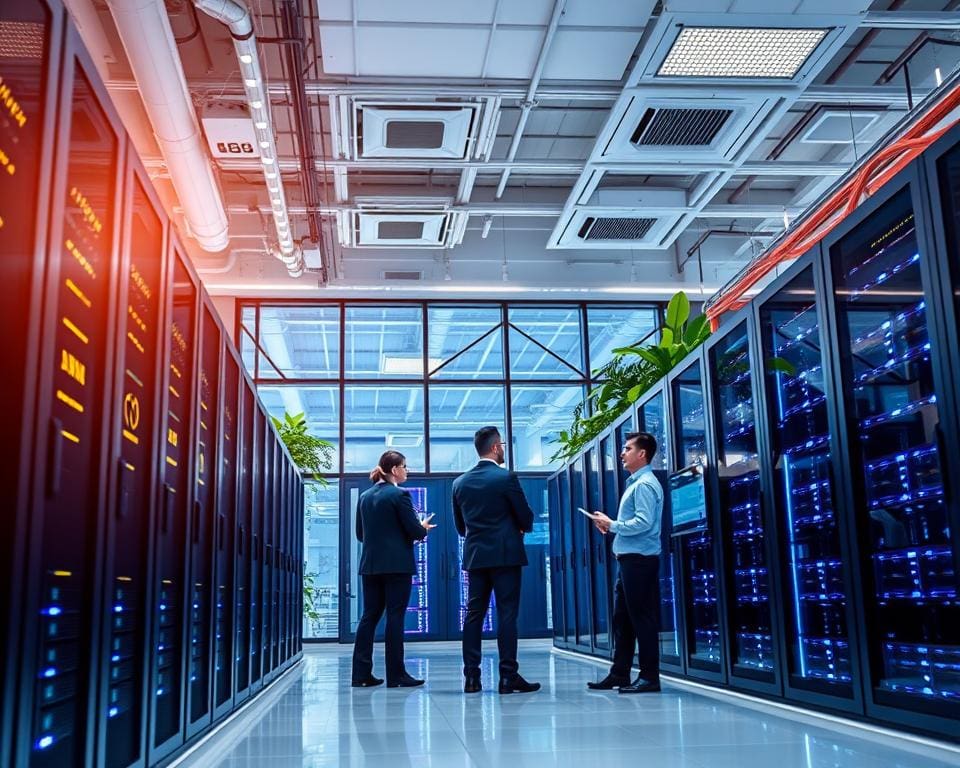
Demand for cloud services and digital platforms is rising across the UK and Europe. That growth puts data centres under pressure to deliver capacity while cutting costs and carbon. Modern data centre efficiency is now central to business resilience and reputation.
Industry baselines show the scale of the challenge. Legacy sites often record PUE values of 1.7–2.0, while modern efficient facilities target 1.1–1.3. Cooling, power distribution and IT equipment together dominate energy profiles, and server utilisation typically remains below optimal levels.
Improving data centre energy efficiency reduces operating expenditure and carbon emissions. It also strengthens reliability and supports corporate goals such as Science Based Targets and net zero commitments. Investors and large cloud customers increasingly favour operators who demonstrate PUE improvement and renewable procurement.
Efficiency is not just technical. Workforce performance and staff wellbeing affect operational continuity. On-site services, including nutrition and rest facilities, help keep engineers and operators alert during critical tasks.
This article links efficient data centre design, advanced low‑power technologies and human factors. Subsequent sections explore design principles, nutrition and workforce wellbeing, technology choices that lower power consumption, and operational sustainability aligned with UK data centre best practices.
Design principles for energy-efficient data centres
Good design sets the baseline for energy use and future growth. Thoughtful choices at the planning stage reduce mechanical cooling, simplify operations and make it easier to expand capacity without large disruptions.
Optimised airflow and containment strategies
A hot aisle cold aisle layout remains a core tactic to separate supply and return air. Cold-aisle containment and in-row cooling stop mixing of hot and cold streams, which raises heat-transfer efficiency and allows IT inlet temperatures to move closer to ASHRAE guidance.
Simple measures such as aisle shuttering, blanking panels and tidy cable management cut bypass losses. Choose between raised-floor and slab designs based on cooling distribution needs. Use Computational Fluid Dynamics (CFD) modelling to identify recirculation and hotspots before building or when retrofitting.
Brands like Schneider Electric and Vertiv supply containment systems and in-row modules that integrate with building controls. Follow ASHRAE thermal guidelines to set safe, efficient operating envelopes.
Modular and scalable infrastructure
Modular data centres and prefabricated pods let operators add capacity in stages. Containerised data halls speed deployment and match power and cooling to demand, lowering the risk of stranded capacity.
- Standardised racks and PDUs create predictable performance.
- Scalable infrastructure simplifies moves to the edge and hybrid cloud models.
- Right-sizing modules can reduce idle energy draw while keeping resilience options such as N, N+1 or 2N available.
Vendors such as Huawei and Dell Technologies offer modular solutions that support rapid scale-up and consistent performance across sites.
Site selection and ambient cooling opportunities
Where you build determines which ambient cooling methods are viable. Cooler regions in Scotland and northern UK give more hours of free cooling through air or water-side economisers.
Coastal sites can consider seawater cooling where planning and environmental rules allow. Urban heat islands, grid stability, fibre connectivity and water availability all shape site selection for data centres.
Ambient cooling UK options include air economisers, adiabatic systems and hybrid arrangements that blend mechanical chillers with outdoor air when conditions permit. Plan water use carefully in areas with limits on abstraction or discharge to meet permitting and sustainability objectives.
What foods support a healthy lifestyle?
Good nutrition is a strategic asset for operational reliability in data centres. Choosing what foods support a healthy lifestyle goes beyond individual wellbeing. Smart choices boost concentration, aid decision-making, improve shift resilience and reduce absenteeism among engineers and operators.
Relevance of nutrition to workforce performance and alertness
Balanced meals rich in low glycaemic-index carbohydrates, such as whole grains and oats, provide steady energy. Pair these with lean proteins like poultry, fish or legumes and healthy fats from olive oil, nuts or oily fish to support cognitive tasks.
Vitamins B and D, iron and magnesium help sustain focus. Hydration and regular meal timing preserve alertness. A protein-rich breakfast with complex carbs improves concentration during morning shifts.
On-site catering choices that boost staff wellbeing
Practical catering options lift morale and nutrition and performance. Offer salad bars, hot meals with lean proteins and wholegrain sides, fruit stations, unsalted nuts and plain yoghurt. Hydration stations with water and unsweetened herbal teas deter sugary drinks.
Vending machines can be upgraded to healthier snacks. Partner with local caterers who supply seasonal, locally sourced menus to support sustainability. Label menus with calorie and macro information and nudge healthy choices by placing them prominently.
For guidance on selecting antioxidant-rich ingredients and simple recipes that fit workplace nutrition, consult this useful resource: antioxidant-rich foods for wellness.
How employee health programmes reduce downtime and errors
Nutrition tied to employee wellbeing programmes UK can lower absenteeism and reduce error rates. Well-structured programmes speed cognitive recovery after incidents and raise morale across shifts.
Integrate nutrition into broader health offers: screenings, dietitian consultations, weight management and mental health services. Customise interventions for night teams with timed meals and protein-rich light snacks to limit post-meal drowsiness.
- KPIs to monitor: staff sickness days, incident rates, satisfaction scores and participation rates.
- Pilot programmes help measure ROI in reduced downtime and staffing costs.
Advanced technologies that reduce power consumption
Operators can cut energy use and carbon intensity by pairing smarter IT with better facility controls. This section highlights hardware, monitoring and local generation options that together drive measurable gains in data centre energy management.
High-efficiency server hardware and silicon
Modern server designs deliver large drops in idle and peak power draw. ARM-based processors and power-tuned Intel and AMD chips use efficient silicon that scales consumption with workload. Right-sized compute through virtualisation and containerisation keeps utilisation high and allows low-power servers to shine.
Storage trends also cut waste. NVMe and tiered storage reduce I/O overhead. Disaggregation and hyperconverged infrastructure remove duplicate resources, trimming both energy and space. Procurement of ENERGY STAR-rated equipment, firmware optimisation and clear decommissioning policies cut embodied carbon across hardware lifecycles.
Power usage effectiveness (PUE) monitoring and optimisation
PUE remains the industry metric for overall efficiency, calculated as total facility energy divided by IT equipment energy. PUE has limits, so teams track IT Power Usage Effectiveness and carbon intensity alongside workload efficiency. These additional measures give a fuller picture of energy performance.
Continuous PUE monitoring with real-time dashboards helps spot inefficiencies and detect drift in cooling performance. Machine-learning analytics can trigger automated adjustments such as variable-speed fans and altered chilled-water setpoints. ISO 50001 energy management systems provide a formal framework for continual improvement.
Use of renewable energy and on-site generation
Procurement choices range from power purchase agreements and corporate renewable energy certificates to green tariffs from suppliers. Renewable energy for data centres reduces operational carbon, though intermittency affects reliability planning and risk assessments.
On-site generation options include photovoltaic arrays, combined heat and power units and fuel cells. Energy storage systems such as lithium-ion and flow batteries smooth peaks and offer short-term backup. CHP and battery storage UK solutions can support demand-side response and participation in flexibility markets to monetise load-shifting.
Grid connection costs and national regulation in the UK shape feasibility for on-site generation. Whole-life carbon accounting must include battery production and infrastructure impacts to ensure true sustainability gains for data centre energy management.
Operational practices and sustainability strategies
Efficient data centre operations depend on disciplined routines and clear accountability. Preventative maintenance regimes for cooling plants, UPS systems and generators keep equipment running at peak efficiency. Regular cleaning of filters and heat-exchanging surfaces prevents gradual performance loss and reduces emergency repairs, aligning maintenance best practices with lower energy use.
Capacity planning and demand forecasting help avoid over-provisioning. Scheduling non‑urgent compute to run during periods of low grid carbon intensity cuts emissions and costs. Standardised change control, incident management and runbooks reduce human error, while staff training and cross-training—through recognised programmes such as BICSI and vendor courses—ensures operators can manage both IT and facility systems safely and swiftly.
Sustainability strategies should cover carbon reporting UK requirements alongside broader corporate reporting and compliance. Transparent carbon accounting for scope 1, 2 and 3 emissions, third‑party verification and alignment with UK frameworks build investor confidence. Procurement that embraces the circular economy, including refurbishment, buy‑back programmes and responsible e‑waste recycling, extends asset life and lowers embodied carbon.
Financial levers and employee‑centred measures complete the picture. Leveraging UK energy efficiency incentives and green finance supports upgrades guided by life‑cycle cost analysis rather than upfront price alone. Embedding staff wellbeing and better on‑site food into sustainability narratives yields measurable wins: reduced sickness absence, improved retention and a culture that links operational resilience with human performance. Together, design, low‑power technologies and disciplined operations form a practical path to resilient, low‑carbon facilities.