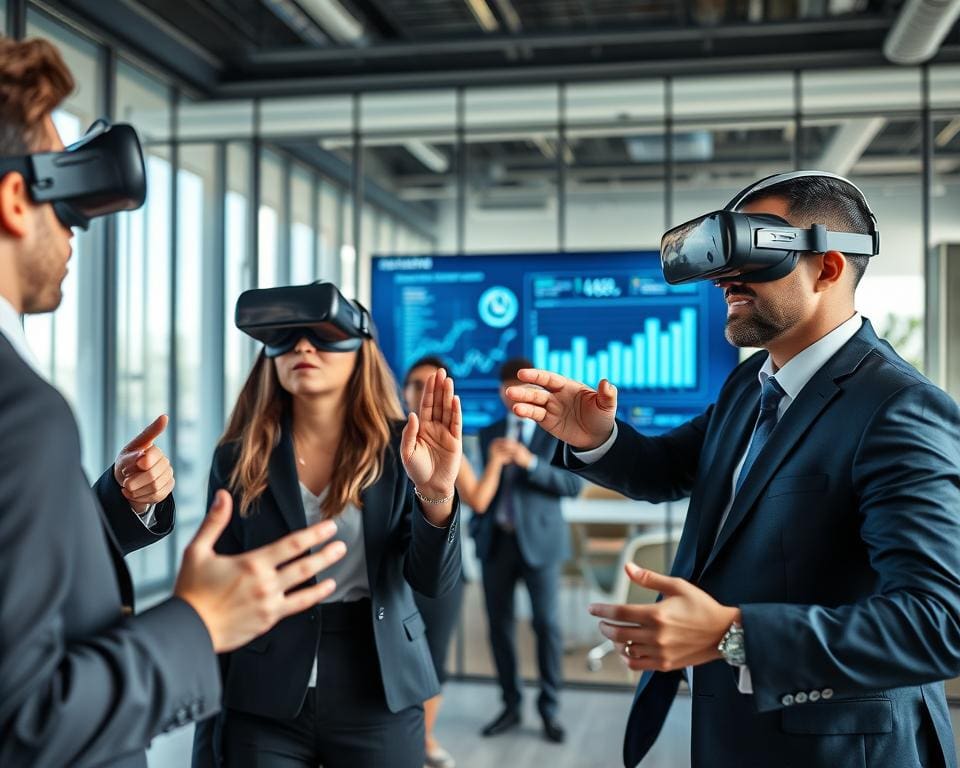
Virtual reality in business creates immersive, computer-generated environments that teams and customers access through headsets such as Meta Quest, HTC Vive and Pico.
This immersive technology for business is moving companies from observation to experience. Retailers let shoppers try products in virtual showrooms. Manufacturers rehearse complex assembly lines. Hospitals train clinicians in lifelike simulations without risk.
Enterprise VR advantages extend beyond training. Platforms like Microsoft Mesh enable mixed-reality collaboration, while Unity and Unreal Engine power realistic content. Specialist vendors such as STRIVR and Talespin provide focused business VR applications for learning and assessment.
Market signals in the UK and globally show rising enterprise investment, falling hardware costs and richer content libraries. These trends make pilots feasible for both SMEs and large firms seeking measurable returns.
Companies report clear business outcomes: reduced training time, fewer on-the-job errors, higher sales conversion and a stronger employer brand for talent attraction. When integrated with cloud services, analytics and LMS platforms, virtual reality in business becomes a strategic enabler.
For British organisations, VR benefits UK firms by offering a toolkit for innovation—reimagining customer journeys, upskilling workforces and designing resilient hybrid working models that support long-term competitive advantage.
How virtual reality transforms training and employee development
Organisations in the United Kingdom are turning to immersive programmes that change how staff learn and apply skills. VR training benefits reach beyond novelty. Learners gain engagement, practice in context and measurable progress that classroom sessions rarely deliver.
Immersive learning experiences that increase retention
Immersive learning UK uses multi-sensory cues and scenario-based tasks to boost attention and memory. Trainees who repeat scenarios in a virtual setting show faster competency gains than those who rely on videos or lectures.
Modules use spaced repetition, immediate feedback and analytics to track improvement. Platforms such as Coursera integrate with enterprise LMSs so managers can see outcomes, progress and areas needing refresh.
Safe simulated environments for high-risk skills
Simulated training lets staff rehearse hazardous procedures without danger. Teams can practise heavy machinery operation, emergency-response drills and clinical procedures in a controlled setting.
UK-relevant examples include construction site inductions, National Health Service simulation pilots and airline crew rehearsals for rare emergencies. Safety training VR reduces incidents, supports HSE compliance and lowers insurance exposure.
Scalable and repeatable training across locations
Cloud-delivered content and central management create consistent learning across shops, offices and sites. Franchises and dispersed teams benefit from uniform standards and shared performance benchmarks.
Scalable VR training cuts travel and venue costs, speeds onboarding for remote hires and reduces instructor time. Upfront development and hardware spend are offset by long-term savings in downtime, better productivity and clearer ROI.
What are the benefits of outdoor sports?
Outdoor sport brings clear gains for body and mind. Regular activity improves cardiovascular fitness, lowers stress and boosts mood through endorphin release. Public Health England and NHS guidance support using physical activity to raise workplace wellbeing.
Activities can be adapted for all levels. Walking groups, gentle cycling and orienteering suit mixed-fitness teams. Low-impact team sports help build social bonds without excluding less active colleagues.
Both outdoor play and virtual sessions teach teamwork and leadership. Outdoor team tasks demand physical collaboration and trust. VR scenarios recreate high-pressure decision-making in a safe, repeatable way. These parallels make blended approaches powerful for development.
- Route planning in orienteering mirrors strategic planning in simulations.
- Relay races sharpen handovers and coordination for collaborative workflows.
- Small-sided games improve communication under time pressure.
Combining real exercise with virtual problem-solving enhances creativity. Evidence shows physical movement sparks divergent thinking, useful when teams move to immersive ideation in VR. A morning walk can prime the brain for a focused workshop later in the day.
Practical formats work best. Start with light outdoor activity to energise participants, follow with VR workshops for focused tasks, then alternate formats to keep engagement high. This mix highlights wellbeing and outdoor exercise while delivering cognitive challenge.
Designing corporate retreats in the UK needs local knowledge and care. Choose venues with accessible green space, such as Lake District day centres or New Forest activity hubs. Partner with reliable VR providers who offer mobile setups and clear risk management.
- Plan balanced agendas that alternate intensity and rest.
- Complete risk assessments, ensure First Aid cover and confirm equipment insurance.
- Prepare contingency plans for UK weather and transport delays.
Measure outcomes to show value. Simple team cohesion surveys, wellbeing metrics and follow-up productivity checks demonstrate impact. Event organisers like Inspire Me Events can work with VR specialists to craft memorable, brand-aligned experiences that mix outdoor team-building UK with blended VR and outdoor activities for lasting results.
Enhancing customer experience and sales with virtual reality
Virtual reality is reshaping how customers discover, try and buy products. Retailers and manufacturers can use immersive tools to create clearer expectations, faster decisions and richer engagement. These changes drive conversion while keeping the shopping experience memorable and convenient for UK shoppers.
Virtual product demos and configurators for better purchasing decisions
VR product demos let buyers inspect, interact with and customise items at scale. Furniture can be placed to scale in a virtual living room much like IKEA Place, while automotive brands such as Jaguar and Land Rover deploy configurators that show finishes and options in lifelike detail. Business customers can examine complex B2B equipment through guided walkthroughs that reveal internal components and settings.
These experiences build buyer confidence, shorten sales cycles and produce analytics on interactions. Teams use that data to refine offers, predict preferences and personalise follow-ups in ecommerce VR environments.
Creating memorable brand experiences and virtual showrooms
Immersive marketing lets brands stage interactive launches and virtual events that reach remote audiences. Retail pop-ups and in-store VR suites increase dwell time and provoke social sharing. Automotive virtual showrooms offer curated tours that mirror flagship displays, while mobile VR activations bring those experiences to shopping centres.
UK retailers can pilot phased rollouts in flagship stores and link VR visits to loyalty programmes. That approach supports tracking of engagement metrics and helps convert interest into repeat custom.
Reducing return rates through virtual try-before-you-buy
Virtual try-ons and room visualisers reduce mismatches between expectation and reality. Shoppers can fit clothing, eyewear and footwear or preview sofas in a room to check scale, colour and texture. Accurate renders and correct sizing lower disappointment and cut reverse logistics.
When retailers integrate high-fidelity rendering, calibrated lighting and returns analytics with their ecommerce VR systems, they can measure the impact on margins and sustainability. Fewer returns mean lower transport and packaging waste and stronger consumer trust in the brand.
- Faster buyer confidence via interactive demos
- Enhanced conversion from immersive brand moments
- Lower return rates where virtual try-before-you-buy is reliable
Operational efficiency, cost savings and innovation driven by VR
Virtual reality is proving to be a practical lever for operational efficiency VR across UK businesses. By replacing frequent site visits with virtual factory walk‑throughs and remote inspections using VR and 360° video, companies cut travel time and reduce downtime. For manufacturers, virtual prototyping shortens design cycles and lowers the number of physical prototypes needed, delivering clear VR cost savings while speeding time‑to‑market.
When weighing costs, it is important to balance upfront investment in headsets and content production against recurring savings. A simple cost‑benefit analysis will compare hardware and development costs with lower travel budgets, fewer prototype builds and faster decision points. Real examples from architecture and automotive sectors show how tools such as Unity Reflect, Unreal Engine and CAD‑to‑VR pipelines enable rapid iteration and tangible VR innovation UK.
Remote collaboration VR creates presence‑like meetings where distributed teams review 3D models, rehearse processes and run user testing in shared spaces. These immersive sessions improve meeting effectiveness, boost engagement for hybrid staff and help reduce travel emissions in line with corporate sustainability plans. Use of virtual prototyping to test ergonomics and spatial layouts also reduces rework and supports faster product development.
Start with a clear implementation roadmap: set objectives, pilot a focused use case, select hardware and platform partners, and measure KPIs such as training completion rates, sales conversions and travel cost reduction. Address change management through staff upskilling, IT security, content governance and UK data‑protection compliance. With a measured approach, VR cost savings and VR innovation UK combine to make operations more resilient, creative and future‑ready.