Digital simulation importance has become central to modern engineering as companies seek faster, safer and more cost-effective ways to develop machines. For UK engineers and design managers, the question — why are digital simulations essential in machine design — opens a door to simulation-led design UK practices that sharpen creativity and improve precision.
Thirty years ago, physical prototyping dominated product development. Advances in computational power and methods such as finite element analysis and computational fluid dynamics shifted that balance. Today, multi-physics solvers make complex system-level studies practical, turning virtual prototyping into a routine step in the design cycle.
At a strategic level, machine design simulation reduces time-to-market and lowers development cost by validating performance before manufacture. Automotive, aerospace and advanced manufacturing firms across the UK use engineering simulation benefits to meet strict safety and regulatory standards while accelerating innovation.
Typical users include design engineers, simulation analysts, product managers and R&D directors, supported by systems integrators and vendors such as ANSYS, Siemens Digital Industries Software and Dassault Systèmes. These partnerships scale capability and embed simulation into wider PLM workflows.
Organisations measure value in clear terms: fewer physical prototypes, reduced warranty claims and recalls, improved energy efficiency and shorter development cycles. Many teams report multi-fold reductions in prototype iterations and shave several months from schedules through targeted virtual prototyping.
View simulation as a strategic investment rather than a tactical tool. Embracing machine design simulation positions UK businesses to protect quality, cut cost and remain competitive in global markets.
Why are digital simulations essential in machine design?
Digital simulation is reshaping engineering practice by letting teams test ideas long before the first prototype is made. The opening paragraphs below set the scene for practical definitions, workflow links, measurable benefits and real UK examples.
Defining digital simulation in contemporary engineering
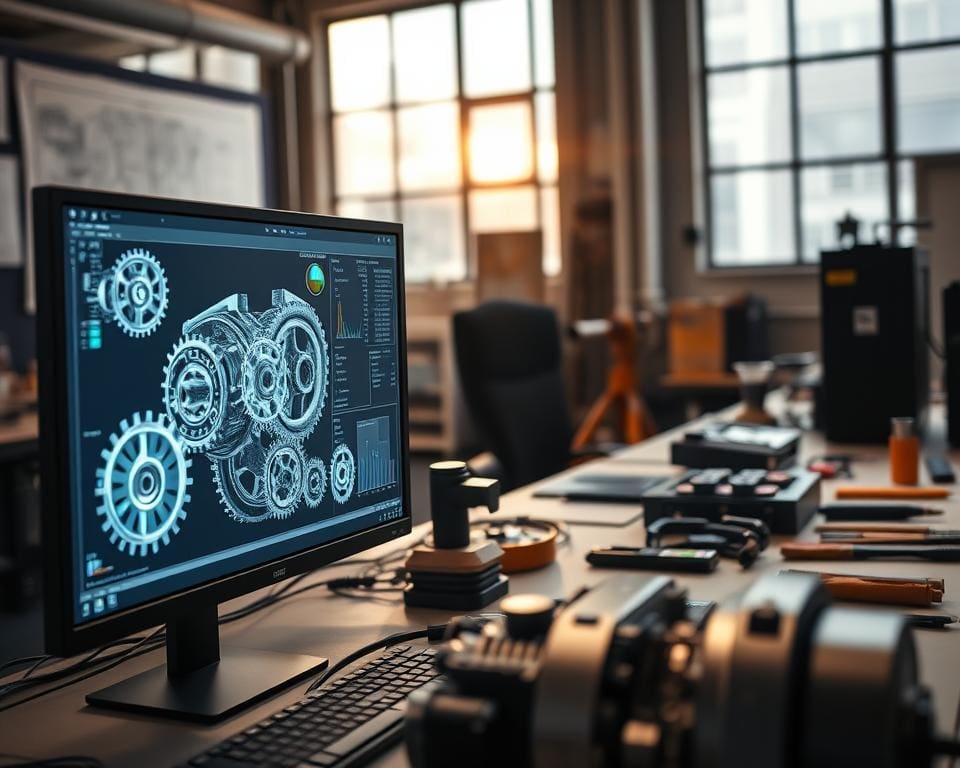
At its core the digital simulation definition covers virtual experiments that use numerical methods such as FEA, CFD, multi-body dynamics and thermal solvers to predict how parts and systems behave. It spans component-level checks for stress, fatigue and heat transfer, through system-level multiphysics interactions and control-system tests, to operational uses like digital twins and predictive maintenance.
Industry software underpins this work. Tools such as ANSYS, Abaqus from Dassault, Siemens NX with Simcenter and COMSOL Multiphysics form the technical stack. Standard formats like STEP and JT keep geometry interoperable as models move between teams.
How simulation integrates with CAD, CAE and PLM workflows
Integration starts in CAD. Designers create geometry, then prepare and simplify it for meshing. CAE solvers run analyses and return results that drive design changes in CAD. PLM then records versions, traceability and regulatory evidence across the lifecycle.
Modern platforms such as Siemens Teamcenter with Simcenter and Dassault Systèmes’ 3DEXPERIENCE enable CAD CAE PLM integration so teams collaborate with a single source of truth. Scripting, parameterisation and optimisation automate many steps in the simulation workflow and let engineers explore many variants quickly.
PLM is essential for governance in regulated sectors. It preserves model provenance, supports certification and helps multidisciplinary teams work in parallel without losing control.
Key benefits: risk reduction, cost savings and accelerated development
Simulations reveal likely failure modes, stress concentrations and thermal hotspots before manufacture. This risk reduction avoids expensive late-stage redesigns and improves safety.
There are clear cost benefits. Fewer physical prototypes, less material waste and reduced test time shrink development budgets. Large vehicle and aircraft programmes report multi-million pound savings after simulation-led redesign and lightweighting.
Parallel virtual testing accelerates delivery. Engineers can assess many design variants at once, shortening cycles from months to weeks. The benefits of simulation extend to better quality, optimised material use and faster routes to certification under EASA and BSI standards.
Real-world examples in UK industries: automotive, aerospace and manufacturing
UK automotive simulation is widely used by manufacturers and suppliers to improve aerodynamics, cooling and crash performance. Firms such as Jaguar Land Rover apply CFD and crash modelling to cut fuel use and ensure occupant safety.
In aerospace simulation UK companies including Rolls-Royce and BAE Systems rely on high-fidelity methods to predict structural behaviour, engine thermal loads and aeroelastic effects. These studies reduce the need for costly full-scale trials.
Manufacturing simulation case studies show how digital twins and virtual commissioning verify plant layouts, robot cells and process settings. Innovate UK and the catapult centres support projects that bring simulation tools into SMEs, improving throughput and shrinking downtime.
- University partnerships with Imperial College London and the University of Cambridge drive new methods and practical adoption.
- Cross-sector projects deliver transferable workflows and raise engineering capability across the UK supply chain.
Boosting design accuracy and performance with virtual testing
Virtual testing uses simulation to check a design under realistic operating conditions. Engineers use performance simulation and virtual prototyping to replace some physical tests and speed up development. This approach raises design accuracy early in the process and reduces expensive late-stage changes.
FEA tackles structural and fatigue questions. It predicts stress, strain and life under static and dynamic loads. CFD examines fluid flow, heat transfer and aerodynamics to refine cooling and efficiency. Teams combine these methods with multibody dynamics and electromagnetic simulation for a full picture.
Model fidelity matters for trustworthy results. Mesh resolution, advanced material models and realistic boundary conditions all improve predictions. Calibration through simulation validation against strain gauges, wind-tunnel runs or bench tests makes models more reliable.
Engineers use probabilistic methods and sensitivity analysis to quantify uncertainty. These techniques reveal confidence ranges and help design for variability. That leads to more robust products and clearer risk assessment.
Performance optimisation thrives on iteration. Parametric studies, surrogate models and optimisation algorithms such as topology optimisation and genetic algorithms push stiffness-to-weight ratios and energy efficiency. Real projects show gains like higher payload, lower fuel use and quieter operation.
UK teams must balance fidelity with compute cost. Cloud HPC from Amazon Web Services or Microsoft Azure scales heavy workloads, while local HPC centres offer alternative capacity. Smart allocation keeps simulation efforts sustainable.
Building in-house simulation skills improves outcomes. The Institution of Mechanical Engineers and university MSc or CPD courses offer relevant training. Ongoing education helps teams apply FEA, CFD and virtual prototyping with confidence.
Embed virtual testing early and adopt a culture of routine simulation validation. Regular physical checks keep models honest and maintain design accuracy as products evolve.
Driving innovation and sustainability through predictive modelling
Predictive modelling combines simulation and data analytics to forecast how machines behave over time, while a digital twin provides a live virtual replica of an asset for real‑time monitoring and predictive maintenance. By fusing IoT sensor feeds, machine learning and physics‑based models, engineers gain clearer, earlier insight into failures, performance trends and optimisation opportunities.
Simulation fuels innovation in engineering by enabling rapid concept exploration and cross‑disciplinary design. Teams can test bold topologies and additive‑manufacturing ready parts quickly, and co‑design control systems with physical models to deliver advanced mechatronics and robotics solutions. Surrogate and reduced‑order models accelerate R&D by allowing vast design spaces to be explored with lower computational cost.
Sustainability through simulation is a practical route to lower emissions and smarter material use. Reduced emissions simulation helps engineers refine aerodynamics, drivetrains and thermal systems to cut energy use and support UK net‑zero targets. Topology optimisation and process simulation reduce waste and improve recyclability, while lifecycle assessment quantifies cradle‑to‑grave impacts to guide greener choices.
Organisations should start small: pilot a digital twin on a critical asset, set clear KPIs such as uptime improvement and energy savings, then scale. A robust data strategy and collaboration between IT and engineering are essential, as are partnerships with software vendors, Innovate UK programmes and Catapult centres to build capability. Embracing predictive modelling delivers competitive advantage—machines that last longer, use less and innovate faster for a cleaner future.