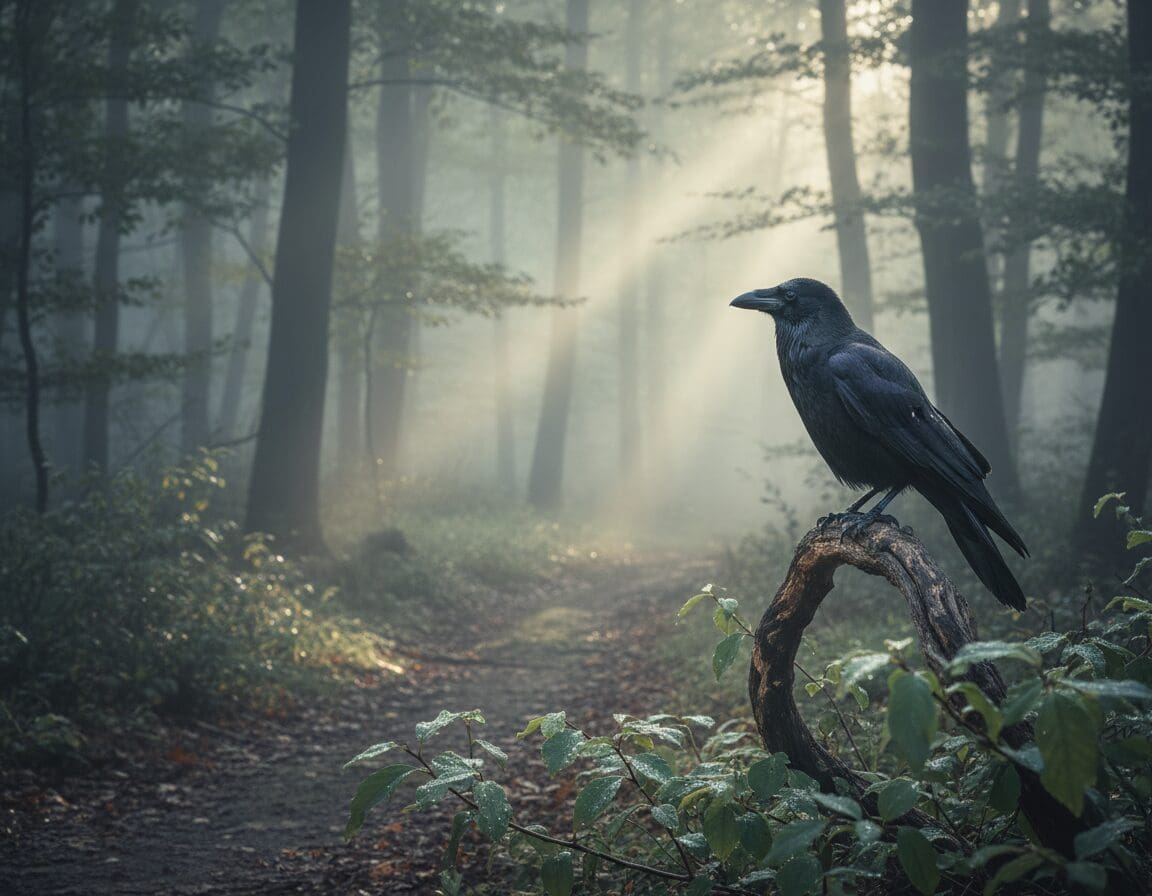
When you notice a crow nearby, the question what does seeing a crow mean often springs to mind. In the UK, members of the Corvus genus — including the carrion crow and hooded crow — are familiar sights. Ornithologists at the British Trust for Ornithology and studies in journals such as Animal Behaviour show these birds are highly intelligent, recognise faces, use tools and hold strong family ties.
Those natural behaviours shape many interpretations of crow sighting meaning. Crows communicate with varied calls, engage in collective mobbing and cache food, so a persistent bird may simply be responding to its environment. Observations like these remind us that not every crow encounter is a crow omen meaning from beyond; often it is rooted in clear, measurable behaviour.
At the same time, crow symbolism UK is rich and varied. Across cultures, crows have been seen as messengers, guides of souls, tricksters and tokens of wisdom. Some traditions link crows with death or misfortune, while others regard them as symbols of transformation and protection. Modern readers tend to blend folklore, psychology and personal experience when weighing what a sighting might signify.
Your reaction to seeing a crow will depend on where you live, recent events in your life and whether you see a single bird or a murder. Holding both scientific insight and symbolic meaning in mind offers a balanced way to reflect on any crow sighting meaning you encounter.
what does seeing a crow mean
Seeing a crow can prompt curiosity and reflection. This short guide outlines how people across cultures and in daily life read those moments, and how to notice patterns without leaping to rigid answers.
Symbolism in different cultures
Crows carry varied significance around the world. In Norse lore, Odin’s ravens Huginn and Muninn represent thought and memory, watching battlefields and journeys. Irish and Welsh tales link the crow to the Morrígan, a goddess tied to sovereignty and war, where the bird signals presence at contested places.
Across East Asia, the crow sometimes takes on solar or guiding roles, as in Japan’s Yatagarasu, which guides and unites. In many African and Indigenous traditions the bird may appear as a clever trickster or an ancestral messenger. These cultural meanings of crow differ widely, so care is needed before applying one story to every sighting.
Common interpretations in dreams and waking life
Modern readers tend to treat crows as messengers. They can suggest change, prompt attention to a problem, or point to insight. In dreams a crow might represent shadow aspects, unresolved grief, intelligence or transformation depending on the scene and emotions involved.
Psychological views, like Jungian analysis, place the crow among archetypes of the unconscious. Cognitive perspectives show how the brain assigns meaning to a striking animal, making a crow appear significant when it stands out. A lone crow can feel like a personal nudge; a murder of crows may highlight social dynamics or broader change.
Personal reflection: noticing patterns and timing
To turn sightings into useful prompts, keep a brief notebook. Jot down date, place, number of birds, behaviour, weather and what you felt. This practice sharpens awareness of crow appearance timing and personal associations.
Compare notes with life events. Do sightings cluster during transitions, grief or big choices? Balance symbolic reading with natural explanations such as food, season or breeding. Use a crow omen as an invitation to reflect rather than a fixed decree.
- Record where and when you saw the bird.
- Note behaviour: calling, circling, scavenging.
- Reflect on feelings and concurrent life events.
Crows in mythology, folklore and spiritual belief
Across cultures, corvids carry layered meanings. Rituals, tales and archaeological finds show how humans have long read messages in their flight and cry. This section sketches three strands: northern European legend, Indigenous perspectives, and modern spiritual practice.
Celtic and Norse traditions
In Norse myth, Odin kept two ravens, Huginn and Muninn, whose names mean thought and memory. Sagas record them flying the world and returning with news for the All-Father. That link to knowledge and prophecy appears in runic inscriptions and medieval prose, where corvids act as messengers between realms.
Irish literature gives equally vivid examples. The Mabinogion and early Irish annals record the Morrígan as a figure who appears as a crow or raven at battle. She is tied to fate, sovereignty and prophetic speech. Archaeological finds, such as carved stones and metalwork bearing crow imagery, support how common these motifs were in daily belief.
Native and Indigenous perspectives
Indigenous corvid stories vary widely by place and nation. In Pacific Northwest traditions, Raven often appears as creator and transformer, shaping landscapes and teaching people. Other nations tell of crow figures as ancestral teachers or tricksters who teach caution and cleverness.
Respect matters when exploring indigenous crow meanings. Readers should avoid generalising across tribes. Seek primary Indigenous voices, listen to community elders and cite culturally specific sources. That approach helps prevent appropriation and preserves the integrity of lived belief.
Modern spiritual and New Age meanings
In contemporary practice, crows appear as totems, spirit animals and guides. New Age crow symbolism often frames them as aides for shadow work, intuition and transformation. Practices include meditative visualisation, symbolism in tarot-like systems and divinatory alerts when a crow appears at a threshold.
Critics point out that such reinterpretations sometimes blend unrelated traditions. Critical thinking helps here. Combine personal reflection with reputable scholarship and voices from the cultures you reference. Distinguish folklore and spiritual use from ecological fact about corvid behaviour.
- Tip: If you feel drawn to a crow as a symbol, keep a journal of encounters and dreams. That record helps reveal whether the sign has personal resonance or is part of wider mythic patterns.
Practical and observational perspectives on crow sightings
Field studies from organisations such as the British Trust for Ornithology and guides like RSPB and the Collins Bird Guide show why do crows appear where they do: food sources, seasonal roosting and breeding cycles shape crow ecology across the UK. You will often see them around urban food waste, roadkill and agricultural fields. In autumn and winter many towns host large communal roosts, while spring brings territorial calls and nesting activity and summer sees juvenile dispersal.
To observe crows safely and ethically, keep your distance and use binoculars rather than approaching nests. Note plumage differences between carrion crow and hooded crow, listen for calls, and record behaviours such as tool use, caching and mobbing. Understanding crow behaviour UK helps you interpret sightings: scavenging points to opportunism, mobbing signals nearby predators and persistent following usually reflects habituation to food, not mystical intent.
Make a simple crow sighting guide for your own use: log date, time, number, location, behaviour and your response. Regular notes reveal patterns and strengthen interpretation. Use sightings as prompts for mindful practice—brief breathwork, journalling or setting intentions—and combine scientific knowledge with personal meaning to deepen appreciation of these birds.
Whether you view crows as omen, teacher or neighbour, learning about crow ecology and how to observe crows respectfully enriches everyday life. Their intelligence, social bonds and resilience invite attention to seasonal cycles and to the small natural wonders that share our towns and countryside.