
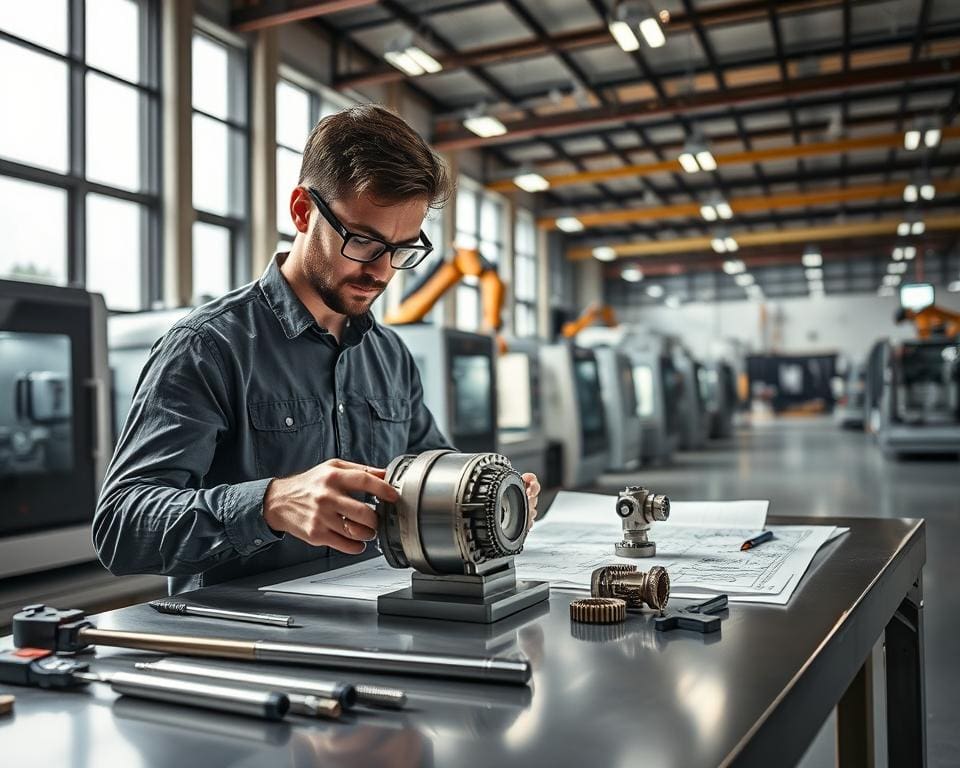
You rely on precision engineering to turn complex designs into reliable products. In practical terms, it covers the design, development and manufacture of components to extremely tight dimensional and performance tolerances. That work uses specialised machine tools, metrology and strict process control to deliver improved product reliability, reduced waste and lower life-cycle costs.
The future of manufacturing will see these capabilities underpinning sectors from aerospace and defence to automotive, medical devices and semiconductor equipment. In the UK manufacturing landscape, strengths lie in high-value, low-volume production and in advanced research centres such as the Manufacturing Technology Centre and the Advanced Manufacturing Research Centre.
Clusters across the Midlands and North West support aerospace supply chains, while the South West hosts skilled medical-device producers and a network of precision sub-suppliers. Ongoing policy moves and industry initiatives target manufacturing innovation and R&D investment to keep UK manufacturing competitive.
This article sets out to map emerging technological trends, explain how digital transformation and data-driven quality control will change workflows, and describe the skills and supply-chain strategies you should adopt. Global supply-chain shifts, onshoring, demand for customisation, stricter regulatory requirements and sustainability imperatives are economic drivers that increase the value of precision machining and advanced manufacturing across the sector.
precision engineering: emerging trends and technological advances
You need clear direction on how new tools reshape precision work. Emerging trends span machine design, materials and inline measurement. These advances let you push tolerances lower and cut lead times for small batches.
Additive manufacturing and micro-manufacturing integration
Metal powder-bed fusion, directed energy deposition and micro-scale stereolithography now create geometries that were once impossible with subtractive methods. You can consolidate multi-part assemblies into single precision components, reducing tolerance stack-up and assembly error.
Hybrid manufacturing platforms combine additive and subtractive operations in one set-up. A five‑axis CNC with laser deposition, for example, delivers fine surface finish and tight dimensional control that suits aerospace fuel systems and medical implants.
Micro-manufacturing and microfabrication techniques produce sub-millimetre parts for sensors and miniature actuators. These methods speed prototyping, enable bespoke 3D printing precision parts and cut material waste while supporting localised production.
For practical guidance on device support and metrology, consult this industry overview: precision engineering devices and metrology.
Automation, robotics and cobots in precision tasks
Robotic machining and cobots are now programmed for high-precision duties such as automated inspection, repeatable fixturing, micro-assembly and polishing. You gain better repeatability, shorter cycle times and improved operator safety.
Vision-guided robotics and force/torque control let robots handle delicate operations in electronics assembly and medical-device manufacture. This technology supports accurate pick-and-place, inspection and closed-loop correction during processing.
Cobots free skilled technicians to focus on complex decision-making while machines manage repetitive precision assembly. Integration with MES and vision platforms ensures traceability and consistent throughput.
Materials innovation and surface engineering
Advances in advanced materials such as high-performance alloys, ceramics and composites target fatigue resistance, thermal stability and biocompatibility. These choices demand refined tooling like diamond coatings and micro-endmills for reliable machining.
Surface engineering techniques—PVD, CVD, laser surface texturing and specialised coatings—raise wear resistance and cut friction, which helps you hold tighter tolerances in service. Coatings also change inspection needs and process parameters.
When you select materials and finishes, plan metrology and process flows accordingly. Inline measurement, environmental control and regular calibration keep measurement uncertainty low and parts within spec.
Digital transformation and data-driven quality control
Digital transformation manufacturing reshapes how you manage precision. Sensors and connected machines feed continual telemetry so you can monitor spindle load, vibration and temperature across the shop floor. These feeds support traceability and part conformity, helping you meet regulatory demand and just-in-time schedules.
Smart factories and the Industrial Internet of Things (IIoT)
The IIoT links CNC, vision systems and environmental sensors to edge nodes and central platforms. Edge computing runs local analytics for video classification and vibration checks so you can act fast and keep data local for privacy. Real-time dashboards and manufacturing execution systems let you see production flow, reject rates and workstation traceability at a glance.
Secure device management and clear data governance matter when suppliers and machines connect. Apply UK best practice and standards to protect intellectual property and ensure compliance. For practical deployment guidance, see a hands-on primer at how engineers work with IoT devices.
Machine learning, AI and predictive maintenance
Machine learning metrology turns large sensor and inspection datasets into early warnings. Models spot spindle imbalance, tool wear and drift before you see out-of-tolerance parts. Anomaly detection, remaining useful life estimates and optimisation routines cut scrap and inspection bottlenecks.
Predictive maintenance lowers unplanned downtime and extends tool life. Closed-loop feedback from analytics to control systems lets you tune process parameters in near real time, improving yield and supporting continuous improvement.
Metrology, digital twins and in-process inspection
Advanced metrology tools such as coordinate measuring machines, optical profilers and CT scanners give high-resolution verification. You should tie calibration to national standards, for example the National Physical Laboratory, to maintain measurement traceability.
A digital twin mirrors components and processes with live data. Use virtual replicas to run what-if scenarios and validate changes without risking production parts. In-process inspection — on-machine probing and in-line optical checks — enables immediate correction and reduces post-process rework.
- Data platforms: MQTT messaging, time-series databases and cloud IoT services provide scalable storage and central analytics.
- Cost control: edge filtering, event-driven reporting and efficient encodings reduce airtime and cloud costs.
- Operational KPIs: track MTBF, throughput, packet success rate and latency budgets to link telemetry with quality control.
Skills, supply chain resilience and strategy for UK manufacturers
You need to prioritise investment in manufacturing skills to build a resilient precision engineering workforce. Focus on advanced machining, metrology, CAD/CAM, CNC programming, robotics integration and data-analytics competencies. Routes such as higher apprenticeships, T‑levels, university‑industry partnerships and specialist training centres like the Manufacturing Technology Centre offer clear pathways for upskilling and practical experience.
Blend traditional hands‑on machining expertise with digital literacy. Encourage staff to gain PLC programming, basic machine‑learning awareness and data interpretation skills so your teams can support smart factories and in‑process inspection. Industry bodies such as Make UK and the Institution of Mechanical Engineers provide guidance and funding programmes that you can tap into to support training and workforce development.
Strengthen supply chain resilience through dual sourcing, nearshoring or reshoring of critical capabilities and forming strategic partnerships with specialist suppliers. Mitigate materials risks for high‑value alloys or semiconductor‑grade inputs by developing local supplier networks or vertical integration. Use certification and quality management systems such as ISO 9001 and AS9100 plus robust supplier audits to ensure precision across tiers.
Adopt a pragmatic UK manufacturing strategy that targets digitisation of high‑value processes, upgrades metrology capability, implements predictive maintenance and pilots hybrid additive–subtractive equipment. Measure ROI by tracking scrap reduction, first‑pass yield improvement, shorter lead times and customer satisfaction in high‑reliability sectors. By combining technological adoption, upskilling, and supply chain resilience, you can secure a stronger manufacturing export strategy and a competitive position in high‑value precision engineering markets.