You are reading this because you want practical answers about digital twin technology and how it can change your factory or plant. The UK is accelerating its move towards Industry 4.0 through programmes like Made Smarter, and many manufacturers and utilities are already trialling industrial digital twin solutions from Siemens, GE Digital, ABB, PTC and Microsoft Azure Digital Twins.
This article explains how a digital twin can cut costs, boost uptime and speed decision-making. You will see the clear digital twin benefits that matter to smart manufacturing UK: predictive maintenance, process optimisation and better resource use. These outcomes help meet priorities such as decarbonisation and supply-chain resilience.
Expect a concise guide to what a digital twin is, where it delivers measurable ROI and which operational areas will benefit most. You will also get a practical sense of how to approach implementation in your own operations and how a factory digital twin can drive innovation across your site.
What a digital twin is and why it matters for industry
You may have heard the phrase what is a digital twin and wondered how it applies on the factory floor. At its core the digital twin definition is simple: a virtual representation of a physical asset, process or system that mirrors real‑time state using data from IoT sensors, control systems and enterprise software.
This short primer explains the digital twin components you will encounter and why they matter for your operations. Knowing these pieces helps you judge vendors and plan pilots that deliver measurable outcomes such as operational savings and improved digital twin ROI.
Definition and core components
An asset twin models a single machine or device to monitor condition and predict failure. Data flows from IoT sensors, PLCs and SCADA into time‑series databases or cloud platforms such as Microsoft Azure, AWS or Google Cloud.
Analytical and simulation models combine physics‑based logic with machine learning. These simulation models forecast behaviour and run what‑if scenarios to test fixes before you touch equipment. Dashboards, 3D visualisation and AR overlays give engineers a clear interface for action.
Integration with ERP, MES and CMMS links the twin to workflows. Open protocols like OPC UA and MQTT promote interoperability. Security, access controls and data governance protect intellectual property and plant safety.
Types of digital twins used in industry
An asset twin focuses on a motor, pump or turbine. A process twin models a production line or chemical process to raise throughput and cut defects.
A system twin, sometimes called a plant twin, gives you a holistic view of interactions across assets and processes. A fleet digital twin aggregates performance across sites so you can scale best practice and compare KPIs.
The product lifecycle twin tracks a product from design to operation. This feedback loop speeds R&D, supports warranty claims and improves after‑sales service.
Business value and strategic benefits
Business benefits digital twin projects often show up as reduced unplanned downtime, lower maintenance spend and longer asset life. Predictive maintenance ROI can be significant when condition‑based servicing replaces calendar‑based schedules.
Digital twins drive productivity gains by revealing bottlenecks and enabling virtual trials of process changes. They support quality, compliance and energy optimisation so you can hit sustainability targets.
Use cases from GE Digital, Siemens and Microsoft show varied vendor approaches. You can measure success with MTBF, MTTR, OEE and maintenance spend reductions to build a clear business case.
How digital twin technology improves operational efficiency
Digital twins give you a consolidated view of plant performance so you can act fast. By unifying sensor feeds, historian records and maintenance logs, the twin turns raw inputs into operational analytics that operators and managers can trust.
Real-time monitoring lets you see health and environmental trends as they happen. With condition monitoring on bearings, motors and electrical panels, you detect drift before it becomes a fault. Edge filtering keeps bandwidth lean while preserving the events you need for robust anomaly detection.
Predictive maintenance uses machine learning on vibration, temperature and pressure signals to predict failures. You schedule interventions at convenient times, lower spare-parts inventory and raise asset availability. Siemens, SKF and Rolls-Royce have reported marked drops in unplanned downtime after rolling out such programmes.
Process simulation helps you test what-if scenarios without stopping the line. Run alternatives for line layout, control logic or setpoints and measure outcomes for throughput, yield and emissions. This type of digital twin process improvement supports process optimisation across food, chemical and automotive operations.
Resource allocation becomes simpler when you combine production schedules with twin outputs. Simulate batch sequencing to improve labour use, reduce raw-material waste and enhance resource efficiency. Integrating the twin with MES and ERP gives you a single pane for planning and execution.
Energy optimisation is another tangible gain. Model energy flows to find high-consumption equipment and trial fixes such as variable-speed drives or heat recovery. Small adjustments to setpoints often drive big savings in utilities and carbon footprint.
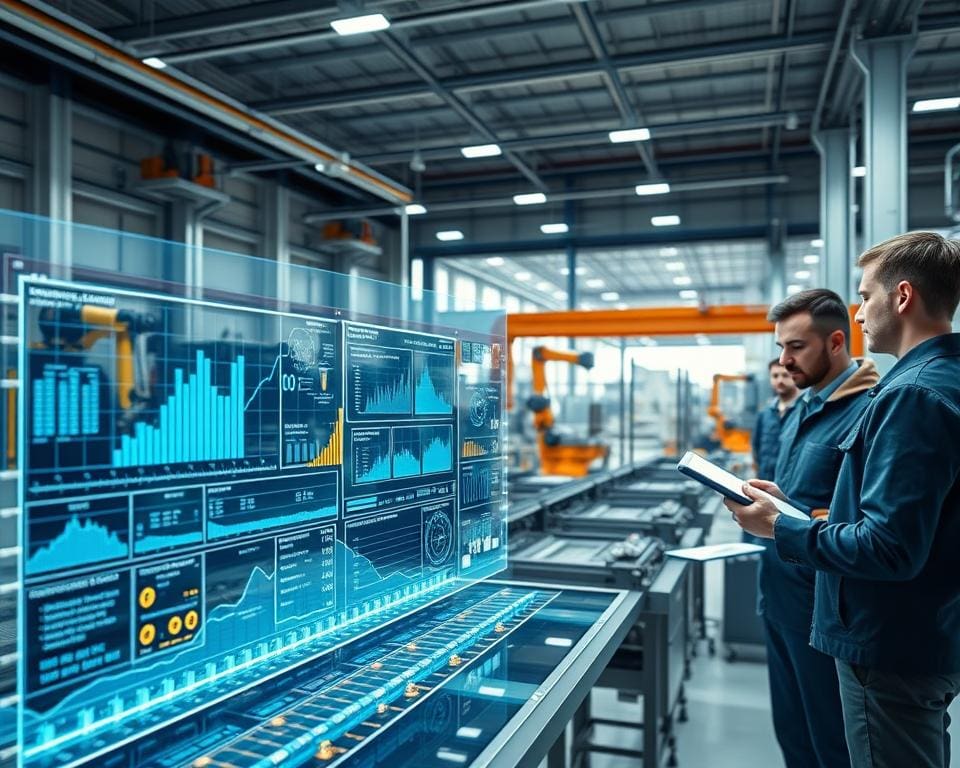
Your dashboards should offer prescriptive recommendations, not raw tables. Visual heatmaps, 3D models and alert cards speed root-cause analysis and offer real-time decision support. That clarity cuts handover times and empowers frontline staff to act with confidence.
Operational analytics and digital twin insights together support data-driven decisions at every level. Scenario planning exposes trade-offs in throughput, cost and emissions so you choose options that match commercial and sustainability goals.
Governance functions benefit from automated logging of actions and outcomes. Audit trails reinforce accountability, feed continuous improvement cycles and ensure you keep a record of changes that affect compliance and performance.
Implementing digital twin solutions in your industrial operations
Begin by assessing readiness across your OT and IT layers. Check sensor coverage, data quality, network capacity and staff skills. Scope a pilot that targets a high-impact asset or process so you can demonstrate value quickly and refine requirements before wider digital twin deployment.
Set clear, measurable objectives such as reducing downtime by a specific percentage, improving OEE or cutting energy use. Choose KPIs that map to those goals and to cost categories like sensors, connectivity and software licences. This makes it easier to track ROI and justify further industrial digital twin implementation.
Decide on the architecture that suits your estate: edge, cloud or hybrid. Prioritise platforms that support standards such as OPC UA and MQTT and that integrate with MES, ERP and CMMS systems. Assess vendors like Siemens, GE Digital, Microsoft Azure and PTC, and work with systems integrators who understand industrial OT for a smoother digital transformation UK journey.
Establish robust data governance and cybersecurity from day one. Implement secure pipelines, role-based access, retention policies and network segmentation to meet UK data protection rules. Build models using both physics-based and machine-learning approaches, validate them against historical and live data, and schedule retraining and data quality checks to maintain accuracy as you scale.
Embed the twin into your operational workflows so outputs trigger maintenance work orders, control adjustments or procurement actions. Invest in change management: train engineers and operators, form cross-functional teams and align incentives. Start small with a pilot, measure results, refine models and processes, then scale across sites when you have proven impact and a clear roadmap for continuous improvement.