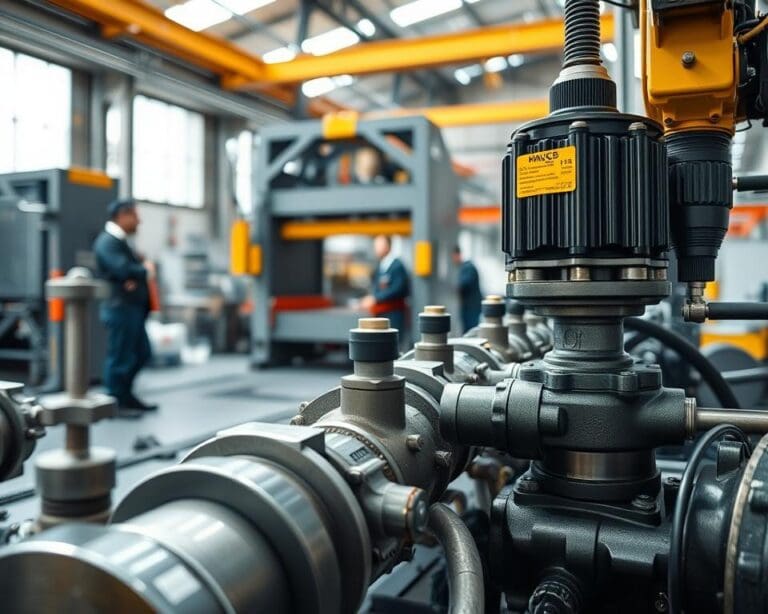
Modular production organises your factory into standardised, self-contained modules or cells. Each module can be combined, reconfigured and scaled independently, so you gain production scalability without a full layout overhaul.
This systems-level approach touches layout, equipment selection, process control and supply chain interfaces. By treating production as linked modules, you unlock manufacturing flexibility that supports shorter product lifecycles and rising customisation demands.
Key advantages you will see include improved efficiency and flexibility, lower and more predictable costs, and clear real-world use cases across sectors such as automotive and electronics. Later sections expand on these modular manufacturing benefits in detail.
For UK manufacturers, modular production aligns with Industry 4.0 adoption and initiatives from the Advanced Manufacturing Research Centre and government programmes promoting resilience and digital manufacturing. It also helps meet regulatory and sustainability pressures.
You should read this if you are an operations manager, plant director, manufacturing engineer, supply chain lead or senior executive in a UK manufacturing business seeking efficiency and resilience improvements.
The article proceeds in five parts: the efficiency and flexibility benefits, cost advantages, industry case studies, practical implementation guidance and a concluding roadmap for your business.
Why modular production improves efficiency and flexibility
Modular production decouples complex processes into repeatable units you can build, test and transport offsite. This approach lets your team run parallel workstreams, shorten commissioning and move faster from pilot to full-scale output. You gain both agility and predictability when modular cells arrive ready to integrate on the shop floor.
Faster ramp-up and reconfiguration
Prefabricated modules cut commissioning time. You can install, connect and validate a module far quicker than constructing bespoke lines in situ. That reduces time-to-volume when you launch a new model or variant.
You can scale capacity incrementally to match demand spikes without redesigning a whole line. Digital twin and simulation tools such as Siemens NX and Dassault Systèmes’ DELMIA speed virtual commissioning and smooth the ramp-up process.
Reduced downtime through standardised modules
Standardisation of interfaces, parts and control logic simplifies maintenance and spare-parts management. Fault isolation becomes faster, cutting mean time to repair when problems arise.
Swap-out of a faulty module is straightforward. Use of standard protocols like OPC UA and EtherCAT and modular automation from Rockwell Automation or Beckhoff supports plug-and-play replacement and helps drive reduced downtime across your plant.
Improved workflow and space utilisation
Modular cells let you arrange equipment to optimise material flow and reduce internal transport. That lowers energy use and emissions, supporting sustainability targets and regulatory compliance in UK facilities.
Small-footprint modules work well in floor-space-constrained plants. You can reconfigure layouts quickly to add product lines, improving overall manufacturing layout optimisation and boosting operational flexibility.
Cost advantages of adopting modular production in manufacturing
Modular production changes how you spend on plant and operations. Upfront capital can be lower when you offset large, single purchases with staged plans that match demand. This approach supports modular production cost savings while keeping disruption to a minimum.
You can pursue phased investment manufacturing to add lines or stations as order books grow. Leasing or rental options from suppliers, and turnkey modular lines offered by firms such as Siemens or Bosch Rexroth, let you scale without a single heavy outlay.
Lower capital expenditure and phased investment
Investing in modules incrementally reduces financial risk and smooths cashflow. You buy or lease discrete units, expand capacity in steps, and avoid idle assets.
Automotive suppliers and contract manufacturers often deploy modular stations to expand capacity quickly. This model fits businesses that expect demand swings or frequent product updates.
Reduced operational costs and waste
Standardised modules cut changeover times and raise repeatability. You gain operational cost reduction through fewer rejects, shorter cycles and simplified maintenance.
Smaller WIP levels and pull-based flows lower inventory carrying costs. Optimised floor plans and modular machinery let you power down zones, generating energy savings that feed into ongoing operational cost reduction.
Off-site fabrication and controlled assembly reduce manufacturing waste reduction by improving accuracy and quality control. This lowers disposal and rework expenses while improving throughput.
Predictable lifecycle and resale value
Standard modules offer clearer depreciation paths and often retain value because they work across lines and sites. You benefit from asset lifecycle value when equipment can be repurposed or sold on the secondary market.
Major OEMs and equipment makers provide refurbishment and buy-back programmes that improve total cost of ownership predictability. That makes long-term planning easier and supports investment cases for modular adoption.
For guidance on designing adaptable spaces and planning staged implementation, see this practical overview on modular design and lifestyle adaptability: modular design guidance.
modular production: practical applications and industry case studies
You will find clear examples of modular production across major sectors. These case studies show how modular systems speed up changeovers, control quality and scale capacity without large rebuilds. The practical lessons that follow are relevant to your UK business planning.
Automotive and electric vehicle manufacturing
Original equipment manufacturers and tier suppliers use modular manufacturing automotive approaches to handle model variety and electrification. Major carmakers deploy modular battery pack assembly lines that let teams retool quickly for different pack sizes. Jaguar Land Rover and BMW have reported shorter lead times for new variants after shifting to modular cells.
These systems simplify quality control, make it easier to add robotic pick-and-place and testing modules, and support faster introduction of EV variants to market.
Electronics and consumer goods
Contract manufacturers such as Flex and Jabil use modular electronics assembly cells for PCB mounting, final assembly and test stations. Small, standard modules support high-mix, low-to-medium volume runs while remaining simple to reconfigure.
The benefit is rapid product changeovers, scalable capacity during holiday peaks or launches, and improved first-pass yield through dedicated test modules that can be swapped without halting the whole line.
Food and pharmaceuticals
Hygiene and regulatory demands make modular pharmaceutical production attractive in the UK. Modular cleanroom modules and mobile filling lines allow CMOs to scale quickly while meeting MHRA expectations and BRCGS food standards.
Pharmaceutical firms use aseptic filling modules to reduce validation time, maintain controlled environments and lower cross-contamination risk. Food producers adopt portable processing units to respond to seasonal demand without lengthy factory modifications.
Cross-sector lessons and pitfalls
- Establish standard interfaces to ensure modules plug in and out without redesign.
- Choose suppliers with proven integration experience to reduce implementation risk.
- Invest in digital standards for interoperability so your control systems communicate across modules.
- Avoid over-customisation of modules; bespoke parts can block reuse and increase cost.
- Plan change-management early to train staff and update maintenance routines.
Implementing modular production successfully in your business
Start with a clear modular production roadmap that suits your plant and product mix. Begin by assessing capability and need: map volumes, changeover frequency, regulatory limits and available floor space. Use value-stream mapping and digital simulation to identify the processes that will benefit most from modular automation implementation.
Run a pilot or proof of concept on a product family with high variability. Use the pilot to validate assumptions and measure KPIs such as ramp-up time, uptime, MTTR, first-pass yield, energy use and total cost of ownership. Treat results as the foundation for phased scaling and a repeatable manufacturing change management plan.
Choose suppliers and integrators that support open standards like OPC UA and Ethernet/IP to avoid vendor lock-in. Work with systems integrators experienced in digital twin and virtual commissioning to cut on-site commissioning time. Update spare-parts strategies and deploy a CMMS for rapid module swap-out and remote diagnostics.
Prepare your workforce with targeted training so operators become multi-skilled and maintenance teams master swap-out procedures. Roll out in stages: replicate successful pilots across sites, standardise module designs and keep configuration management up to date. Integrate IoT sensors with cloud platforms such as Microsoft Azure or AWS IoT for centralised monitoring, predictive maintenance and continuous improvement. Address regulatory validation early, ensure cybersecurity for connected modules, and set contractual terms that cover warranties, upgrades and end-of-life refurbishment or resale. With careful planning, the right partners and adherence to digital standards, you can implement modular production to add agility, reduce costs and strengthen resilience.