You are about to explore the warehouse automation trends that are reshaping distribution centres across the UK and Europe. This opening outlines what matters for your operation: the key technologies, the business drivers behind adoption, and the practical checks you should make before investing in automated fulfilment.
Rapid growth in online retail and omnichannel fulfilment has pushed demand for faster, more accurate order processing. Labour shortages and seasonal peaks increase pressure on teams, while rising customer expectations force shorter delivery windows. These forces, together with the need to cut operational costs and errors, are the main drivers of supply chain automation today.
The article follows a five-part roadmap so you can find the right information quickly: core automation hardware developments; intelligent software and data-driven optimisation; connectivity, sensing and safety; and finally sustainability, labour trends and implementation strategies. Each section links trends to outcomes you can expect in your business.
Effective warehouse automation delivers measurable gains: higher throughput, improved pick accuracy, reduced order cycle times, better space utilisation and enhanced worker safety. It also makes costs more predictable and helps you scale for peaks without excessive temporary labour.
Choosing the right approach means aligning automation with your business model, SKU profile and seasonal variability. You should test ROI calculations, check compatibility with your current warehouse management systems, and confirm local service and maintenance from established vendors familiar with warehouse technology UK and European regulations.
Warehouse automation: core developments shaping modern fulfilment
The shift to automated fulfilment touches every part of a distribution centre. You will see systems that speed picking, raise storage density and cut handling errors. These developments help retailers, grocers and manufacturers meet tighter delivery windows and lower operating costs.
Rise of autonomous mobile robots (AMRs)
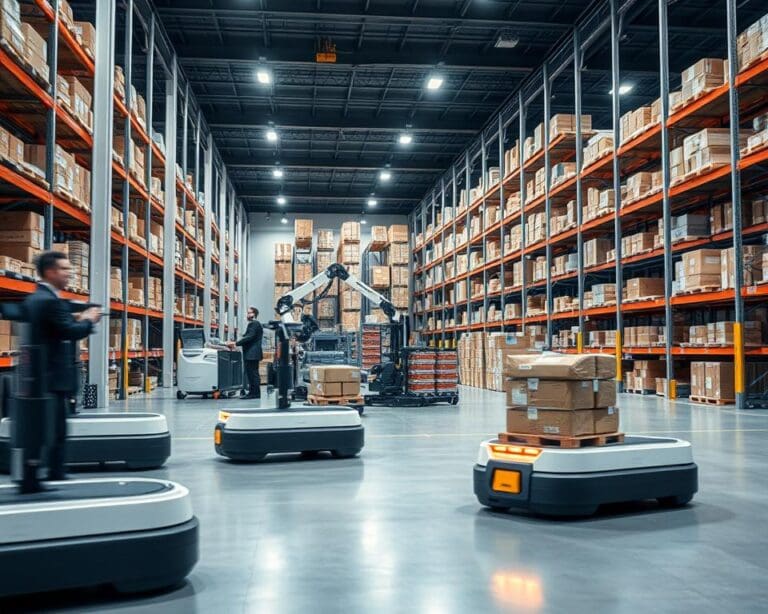
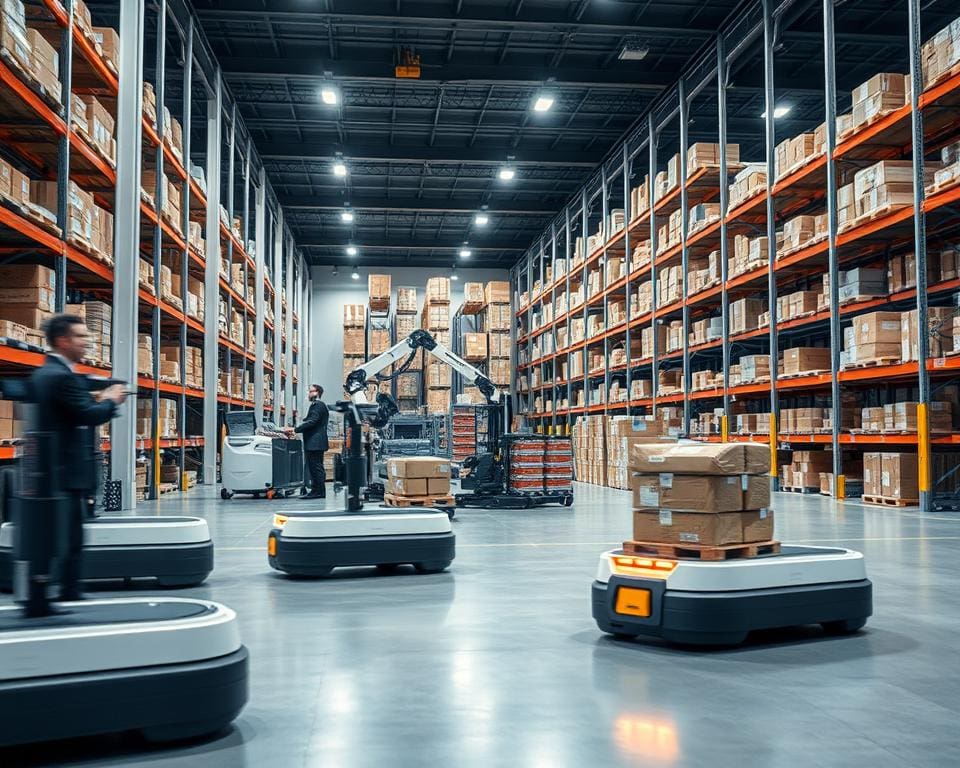
AMRs are self‑navigating vehicles that move goods without fixed rails or tape. They use LIDAR, SLAM and vision to map space and avoid obstacles, unlike traditional AGVs that follow fixed paths. Typical uses include piece picking support, tote transport between workstations and replenishment runs.
You can find AMRs from vendors such as Fetch Robotics (now part of Zebra Technologies), MiR and Amazon Robotics operating in the UK and worldwide. Benefits include rapid deployment, scalable fleets and lower capital outlay than conveyor-heavy installs. Constraints to plan for include battery charging, fleet orchestration complexity and limits in ultra high‑throughput, linear conveyor scenarios.
Integration of automated storage and retrieval systems (AS/RS)
Automated storage and retrieval systems come in many forms: shuttle systems, unit‑load cranes, mini‑load units and vertical lift modules. These solutions maximise vertical space and reduce travel time for pickers and machines.
Suppliers such as Kardex Remstar, SSI Schaefer and Dematic deliver AS/RS to grocery, retail and manufacturing sites across the UK. Key ROI drivers are improved storage density, better inventory accuracy and reduced pallet handling labour. You must consider WMS/WCS integration, building constraints and upfront capital as part of planning.
Role of collaborative robots (cobots) in augmenting human labour
Cobots are designed to work alongside people with built‑in safety features and simple programming. They excel at light pick‑and‑place, packing, labelling and inspection tasks that reduce ergonomic strain and speed mixed‑SKU lines.
Manufacturers such as Universal Robots and FANUC offer collaborative models suitable for warehouse environments. Cobots lower injury risk and boost throughput but may not match heavy industrial cycle times. You should address safeguarding, certification to UK and EU standards and training for staff who will program or supervise these machines.
Advances in conveyor and sortation technologies
Modern conveyor systems are more modular and flexible than older fixed lines. Innovations include motorised rollers, flexible conveyors and high‑speed tilt‑tray or cross‑belt sorters for parcel and e‑commerce flows.
Operators often combine conveyors with AMRs to cover peaks and improve flexibility. Vendors like BEUMER Group, Vanderlande and Intelligrated supply sortation technology to UK distribution networks. Conveyors deliver very high throughput and consistent handling for large operations, though they carry higher capital and demand more fixed layout planning.
Intelligent software and data-driven optimisation for warehouses
You need software that turns raw telemetry into clear actions. A modern warehouse management system gives real-time inventory visibility, task orchestration and labour management. WMS analytics feed KPI dashboards so you can track throughput, pick accuracy, fill rates and equipment utilisation without guesswork.
Top WMS vendors in the UK market include Manhattan Associates, Blue Yonder and Tecsys. These platforms use APIs to link robotics fleets, AS/RS controllers and ERP systems. Robust event streams let your automation controllers receive and act on live updates from the WMS.
Warehouse management systems with real-time analytics
Start by mapping data flows from PLCs, conveyors and AMR fleets into your WMS. Real-time dashboards surface exceptions quickly and support dynamic slotting and replenishment decisions. Use WMS analytics for root-cause analysis when throughput dips and to measure cost per pick against targets.
Integrate using standard interfaces such as REST and OPC UA. You should pilot integration with defined KPIs for throughput, accuracy and cost per pick before scaling across sites.
Use of machine learning for demand forecasting and inventory optimisation
Machine learning forecasting models ingest historical sales, promotions, seasonality and external signals like weather. Better forecasts reduce stockouts and excess stock. You can apply ML to safety stock tuning, multiechelon optimisation and dynamic slotting to match storage layouts to demand.
Governance matters. Set retraining cadences, monitor model drift and require explainability so planners trust automated recommendations. Treat ML as an augmentation to experienced planners, not a black box replacement.
Digital twins and simulation for layout and process testing
A digital twin warehouse is a virtual replica of your facility and workflows. Use it to stress-test seasonal surges, assess new AS/RS layouts and validate ROI before committing capital. Accurate input from your WMS and equipment telemetry is essential for credible simulation outputs.
Simulation lowers disruption by proving changes in a safe environment. UK operators commonly use discrete-event simulation and physics-based models to fine-tune pick paths and equipment mixes before physical rollout.
Edge computing versus cloud processing in warehouse operations
An edge computing warehouse approach keeps latency-sensitive tasks local. Vision systems, AMR controllers and safety interlocks benefit from low-latency processing at the edge. Use cloud platforms for heavy ML training, cross-site analytics and long-term storage.
A hybrid architecture often works best: edge for device control and safety, cloud WMS UK for central analytics and historical trend analysis. Design for resilient connectivity, strong encryption and GDPR-compliant data handling when you select cloud vendors.
For practical guidance on integrating automation, consult specialist resources and vendor case studies to shape a phased rollout that ties WMS analytics, machine learning forecasting and digital twin warehouse testing into your automation roadmap. Explore practical applications.
Connectivity, sensing and safety innovations
You will find connectivity, sensing and safety form the backbone of modern fulfilment centres. Systems that link devices, capture environmental data and protect people and machines let you scale automation with confidence. Practical deployments in the UK tie together networks, sensors and compliance to support operations from cold-chain storage to high-density picking.
Internet of Things (IoT) sensors deliver continuous readings from temperature and humidity probes, vibration sensors for equipment health and BLE beacons for indoor location. These devices feed real-time asset and environmental data into your warehouse management system or CMMS. Use cases include cold-chain monitoring for pharmaceuticals, predictive maintenance for conveyors and forklifts, and RTLS for high-value pallets and containers.
Vendors such as Zebra Technologies, Honeywell and Impinj support UK deployments and provide middleware to integrate sensor streams with WMS platforms. You should plan for secure data ingestion, timestamp synchronisation and scalable storage when you roll out IoT sensors warehouse projects.
Private 5G and robust Wi‑Fi 6 change how devices perform at scale. A 5G warehouse benefits from lower latency, greater device density and smoother handover for autonomous mobile robots. Site surveys, network segmentation for operational technology and partnerships with telecom providers or specialist integrators prove essential for success.
Design for resilience by adding local edge processing for critical controls and fallback strategies for network outages. Edge nodes can keep pick logic and safety interlocks running even when the wider network degrades.
Computer vision picking systems now combine 2D and 3D cameras with deep-learning object recognition to boost piece-picking accuracy. Multi-camera rigs and on-device inference reduce reliance on human scanning and speed up order fulfilment. Barcode scanning remains vital for many flows, while RFID tracking accelerates throughput where line-of-sight slows processes.
Standards such as EPC Gen2 and solutions from Zebra Technologies, Honeywell and Impinj make RFID a practical choice for apparel and pallet-level tracking. Benefits include faster picking, fewer mispicks and clearer inventory insights that improve returns handling and stock reconciliation.
Warehouse safety systems must meet UK and EU regulatory frameworks through thorough risk assessments and machinery directives. You will need CE or UKCA marking, adherence to ISO 13849 and IEC 61508 where functional safety is required, and safe system design for collaborative robot deployments.
Engineering controls like light curtains, safety mats and area scanners should tie into certified safety controllers. Regular audits, staff training and robust incident response planning keep compliance current and maintain a safe working environment as automation grows.
Sustainability, labour trends and implementation strategies
You should view a sustainable warehouse as a long-term asset, not just a compliance tick-box. Automation can reduce your warehousing footprint through denser layouts and smarter routing, while energy-efficient AS/RS, conveyors with regenerative braking and LED lighting cut operational emissions. In the UK market, corporate net-zero commitments and regulations are shaping design choices, so factor in HVAC controls, peak-demand management and options for on-site renewables or battery storage when planning upgrades.
Think about lifecycle impacts when you procure equipment. Choose systems with repairable components and clear upgrade paths to avoid premature disposal, and assess embodied carbon for major purchases. These choices influence total cost of ownership and improve your return on investment automation by extending service life and reducing waste-related costs.
Automation also reshapes your workforce. Warehouse labour trends in the UK show a move from manual picking to roles such as robotics technicians, automation operators and data analysts. You will benefit from fewer repetitive injuries and better resilience against labour shortages, but that depends on investment in training, apprenticeships and engagement with trade bodies. Open dialogue with unions and phased roll-out will help preserve morale during change.
For automation implementation, adopt a staged, risk-managed approach. Start with pilot projects that use digital twins and simulation to validate KPIs, then scale while tracking throughput, accuracy and cost per order. For retrofit automation UK sites, favour modular AMRs and cobots to limit disruption; greenfield projects can justify fixed AS/RS and conveyors for peak throughput. Use total cost of ownership analyses that include capex, maintenance, spare parts, licences and integration, and choose vendors with strong UK references, local service networks and open APIs.
Before you commit, run ROI and sensitivity analyses for peak and steady-state scenarios, secure budgets for training and connectivity, and ensure clear contractual terms on software updates and cybersecurity. A pragmatic checklist—pilot, measure, train, secure and scale—will make your automation investments deliver both sustainability gains and lasting operational returns.