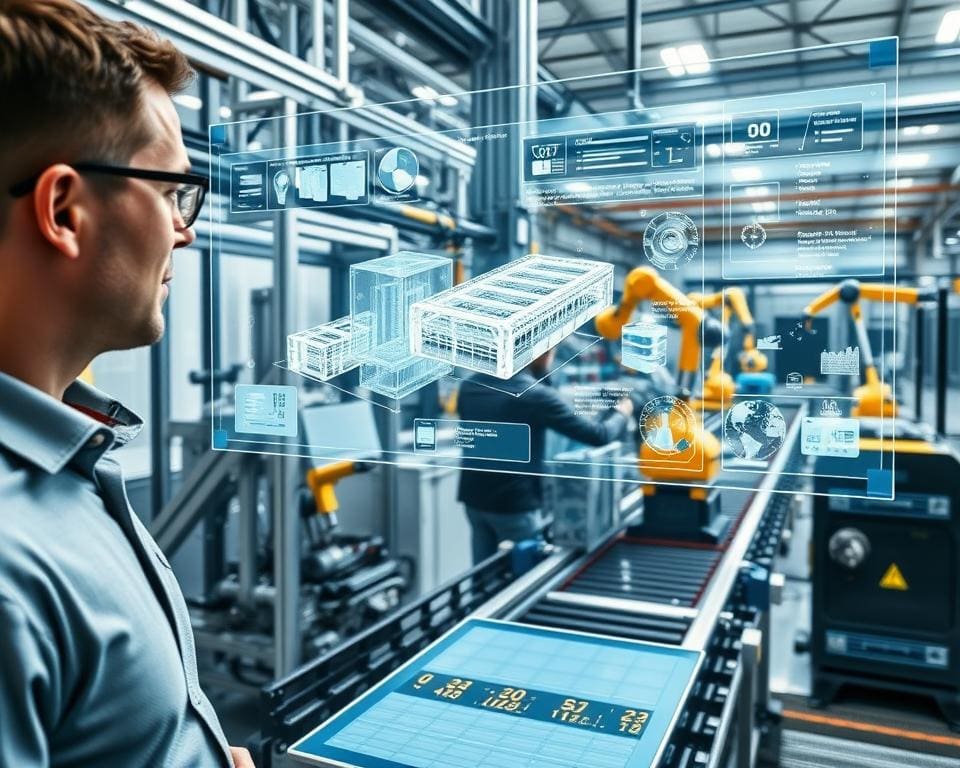
This article explains how digital twins help you streamline operations, cut costs and boost performance across your plant or supply chain. You will see how an industrial digital twin acts as a live, virtual replica of assets, processes and systems to enable real‑time monitoring, simulation and decision support.
Market adoption is rising. Analysts at Gartner and McKinsey note growing investment in manufacturing digital twins across manufacturing, energy and utilities, driven by Industry 4.0 and wider industrial IoT roll‑outs. In the UK, sectors such as automotive, aerospace, water and pharmaceuticals are already reaping benefits as firms respond to regulatory and sustainability pressures.
The core promise is simple: link sensor, PLC and SCADA data to a virtual model to run simulation-based optimisation, detect anomalies and predict failures before they happen. That combination of live data and virtual testing transforms how you approach process optimisation and operational resilience.
The rest of the article is structured to help you act. First, you will understand what digital twins are and their main components. Next, you will explore operational benefits for efficiency, maintenance, energy and quality. Finally, you will get practical guidance on implementation, common challenges and how to assess ROI for your business.
Understanding digital twins and their role in industry
You will find digital twins are live, data-driven replicas of physical assets, processes or whole systems that mirror state and behaviour over time. This concept helps you see current conditions, test scenarios and push decisions from the virtual model back to the shop floor. Vendors such as Siemens MindSphere, GE Digital Predix, PTC ThingWorx and Microsoft Azure Digital Twins are commonly used in UK plants and offer practical platforms for deployment.
What a digital twin is and how it works
At its core, a digital twin answers the question what is a digital twin by linking sensors and control systems like PLCs, SCADA and DCS to cloud or edge platforms. Telemetry streams into gateways where data is cleaned, normalised and fused with engineering models. That flow keeps the virtual representation aligned with reality so you can run analyses and produce actionable outputs.
The feedback loop sends simulation results or optimised setpoints back to controllers or maintenance teams. That loop closes the gap between insight and action, letting you reconfigure equipment, schedule repairs or adjust process parameters with confidence.
Key components: models, data, and simulation
Digital twin architecture rests on three pillars: accurate models, robust data pipelines and simulation models that explore what-if scenarios. Physics-based methods such as finite element and computational fluid dynamics sit alongside empirical techniques like machine learning. Hybrid models merge both to improve prediction quality.
Data sources include real-time telemetry, historical time-series, maintenance logs, BOMs and CAD or PLM records. You must manage latency, missing values and sensor drift with time synchronisation and resilient ETL pipelines to preserve trust in outputs.
Simulations run Monte Carlo tests, optimisation routines and predictive analytics to generate KPIs such as throughput, OEE and remaining useful life. Integration with MES, ERP and CMMS ensures insights from the twin translate into production planning and maintenance workflows.
Types of digital twins used in industrial settings
Industrial deployments use different forms of twin depending on scope and purpose. An asset digital twin represents a single device like a pump, motor or compressor for condition monitoring and predictive maintenance.
A system digital twin models assemblies such as production lines or turbines where interaction effects matter for throughput and reliability. A process digital twin covers entire flows—chemical reactors and batch processes—to optimise yield, safety and control settings.
Organisational or enterprise twins link assets and processes across sites to model supply chains and plant networks for strategic planning. In the UK, Rolls-Royce applies engine digital twins for condition-based maintenance while National Grid and Scottish Water run pilots for asset management and operational resilience.
Operational benefits of digital twins for process optimisation
Digital twins give you live insight into operations so you can act fast. Real‑time visibility and process simulations help you spot bottlenecks, balance production lines and improve sequencing. You can test changes in the model before touching the shop floor to improve throughput and overall equipment effectiveness.
How digital twins improve efficiency and throughput
By tuning setpoints in a virtual replica you avoid disruptive trial‑and‑error. Manufacturers have reported double‑digit gains in throughput and shorter cycle times after validating adjustments in the twin. Scenario planning lets you run multiple schedules and layout options to pick the least disruptive approach.
Predictive maintenance and downtime reduction
Condition monitoring inside a predictive maintenance digital twin shifts you from calendar‑based to condition‑based care. Remaining useful life models and sensors such as vibration and thermal imaging flag issues early so you can schedule maintenance at optimal times and reduce downtime.
Many industrial adopters report 20–50% lower unplanned outages and smaller spare parts stocks due to better forecasting. Integration with CMMS triggers work orders automatically and allocates parts when the model predicts an intervention.
Energy management and sustainability gains
Digital twins model energy flows across equipment and processes to support energy optimisation. You can optimise setpoints, share loads across assets and respond to demand signals to cut consumption and emissions.
Chemical plants and data centres use twin‑based optimisation to reduce energy per unit produced. Typical energy reductions range from 5–20%, helping firms meet UK net zero targets and sector sustainability goals.
Quality control and defect reduction through virtual testing
Quality assurance virtual testing lets you pre‑validate control logic, robot paths and line changes. Virtual commissioning finds defects before physical start‑up, lowering scrap and rework and speeding time‑to‑market for new variants.
Twins support root‑cause analysis by replaying events and inspecting virtual states to pinpoint defect origins. You can run HAZOP and safety scenarios in the model to protect people and assets while meeting regulatory needs.
Implementing digital twins: strategy, challenges and ROI
To start digital twin implementation, you should define a clear use case and measurable KPIs, for example reducing unplanned downtime by a set percentage or cutting energy intensity. Begin with a pilot focused on a high‑value asset or production line, using short sprints with operations, IT/OT, engineering and data science. Use the pilot to validate models, data pipelines and business processes before you move from pilot to scale.
Address data governance early: legacy PLCs, siloed MES/ERP information and time synchronisation issues create friction. Standardise data models and industrial protocols such as OPC UA and MQTT, and choose platforms that support multi‑asset twins and federation across sites. Hybrid modelling and continuous calibration will help you manage model accuracy and validation while keeping engineers engaged.
Cybersecurity for digital twins must be built in from day one. Implement network segmentation, role‑based access, encryption and align controls with UK NCSC guidance for industrial control systems. Expect cultural resistance and plan change management: involve operators early, use transparent analytics and explainable AI so users trust recommendations and embed twin outputs into shift routines and maintenance planning.
Measure the ROI of digital twins with a simple framework: record baseline time‑per‑task, error rates and costs, then re‑measure after deployment to calculate hours saved, error reduction and payback period. Typical pilots return value in weeks to months for targeted assets, and scaled programmes can deliver larger gains in throughput, quality and cost per process. Use pilot results, track operational and people‑centric metrics, and consider government support or partners such as Siemens, GE Digital, PTC, Microsoft or AVEVA to reduce vendor risk and accelerate adoption. For practical guidance on dashboards and reporting, see this resource on tool-driven productivity: digital tool dashboards.