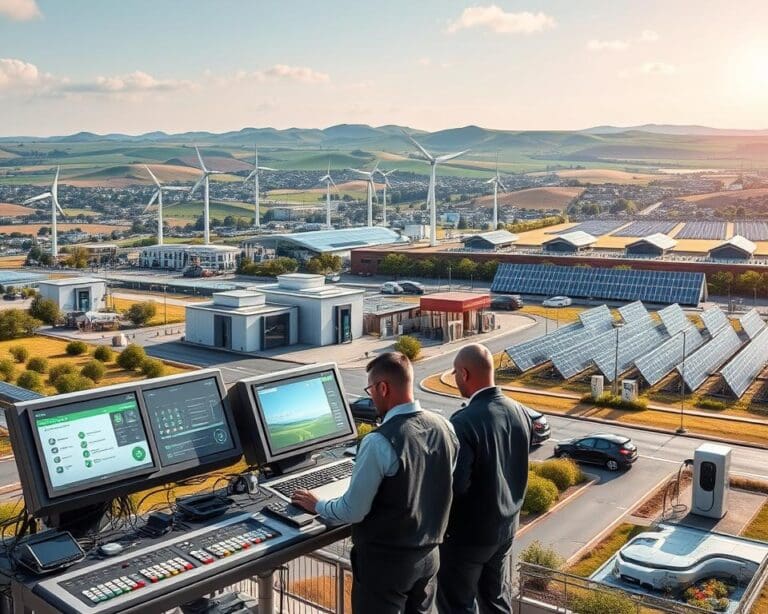
You are seeing a shift: smart factories are moving from pilots to everyday practice across UK industry. A smart factory is an integrated, data-driven production environment that uses automation, connectivity and analytics to optimise operations in real time.
Major manufacturers such as Siemens, Bosch, Rolls-Royce and Jaguar Land Rover are investing heavily in digital manufacturing and Industry 4.0 technologies. Their moves, alongside government initiatives like the Made Smarter programme and Industrial Strategy investment, signal clear momentum for smart manufacturing UK.
The business case is straightforward. You face pressure to cut unit costs, speed up product customisation and strengthen supply-chain resilience after Brexit and COVID-19. Sustainability targets and net-zero commitments add urgency to manufacturing transformation.
Measured gains are compelling. Companies report typical increases of 10–30% in overall equipment effectiveness (OEE), 20–50% reductions in unplanned downtime through predictive maintenance, and energy savings of 5–25% depending on process and retrofit choices.
This article is for you if you are a manufacturing executive, operations manager, production engineer or IT leader in the UK considering digitisation or scaling pilots into full production. Later sections will define the smart factory in detail, examine the drivers accelerating adoption and set out practical steps to implement smart manufacturing across your sites.
smart factory: what it is and why it matters for your business
A clear smart factory definition helps you see how digital tools change production. At its core a smart factory is a cyber-physical production system where machines, sensors, control systems and people link through networks and cloud services. This connected factory gives you real-time visibility and supports automated decision-making across the shopfloor.
Defining a smart factory
The architecture relies on IIoT sensors at the edge, local edge computing for latency-sensitive tasks and cloud platforms such as Microsoft Azure or AWS for historical analytics. Systems like Siemens Opcenter or Rockwell FactoryTalk integrate with ERP solutions such as SAP to provide a single source of truth. Cyber-physical systems and digital twins mirror processes so you can test changes before you apply them.
Key benefits you can expect
You will see measurable productivity improvement through shorter cycle times and optimised scheduling. Inline inspection with machine vision raises quality and cuts rework, while predictive maintenance models use sensor data to spot faults early and reduce unplanned stoppages by 20–50% in many adopters.
Energy efficiency improves when you monitor consumption and automate process optimisation. Unified data provides cost transparency and decision support that drive continuous improvement and smarter capital spending.
Who benefits most in the UK manufacturing landscape
UK manufacturing firms in automotive and aerospace gain from complex assembly control and traceability. Pharmaceuticals and medical devices benefit from strict quality records and batch traceability. Food and beverage firms improve throughput and hygiene compliance with automated checks.
SME digitalisation is viable through phased adoption. Start with energy monitoring or predictive maintenance and scale with vendor managed services and government grants such as those offered by Innovate UK. Tier‑1 and tier‑2 suppliers improve compliance with OEMs and strengthen just-in-time delivery.
Regional clusters in the West Midlands, North West and South Wales can attract investment as digital adoption shifts roles from manual tasks to higher-value activities. Your path to a smart factory makes supply chains more resilient and your business more competitive in the UK market.
Drivers accelerating adoption of smart factories
Smart factories scale because technology, policy and people are converging faster than before. Falling sensor prices and cloud compute make IIoT adoption more affordable. Pre-trained machine learning tools and platforms lower the barrier to AI in manufacturing. You will see this in practical tools from Siemens, Rockwell Automation, PTC and GE Digital that simplify integration and reduce upfront risk.
Technological advances making transformation feasible
Edge computing paired with 5G private networks cuts latency for real-time control and analytics. That improves reliability for robotics and automated guided vehicles on the shop floor. Open standards such as OPC UA and MQTT plus ecosystem platforms like Microsoft Azure Digital Twins enable vendor-neutral interoperability.
Robust cloud hosting on Azure, AWS or Google Cloud removes large capital expense for data storage and processing. AutoML and domain-specific models bring predictive maintenance and anomaly detection within reach of smaller teams. You can combine dashboards from Power BI or Tableau with robotic systems to speed decision-making.
Economic and regulatory pressures
The productivity challenge UK pushes manufacturers to raise output per worker, reduce defects and cut operating costs. Smart factories help by automating routine tasks and improving throughput. Supply chain resilience has become a board-level priority since Brexit and the pandemic, with digital traceability and flexible production helping to manage shocks.
Regulatory compliance around environmental reporting and safety favours digital process control. Net zero manufacturing commitments and obligations such as SECR encourage investment in monitoring and energy management. Public funds and incentives, including Made Smarter programmes and Innovate UK grants, make capital investment easier to justify.
Workforce and skills evolution
Smart factories demand digital skills in manufacturing, not just manual dexterity. You will need people who understand data analysis, automation maintenance and cybersecurity. Apprenticeships, T Levels and employer-led reskilling programmes supply practical pipelines into higher-skill roles.
Upskilling initiatives and on-the-job AR training help flatten learning curves and support human-machine collaboration. When you engage shop-floor teams early and use clear digital work instructions, adoption improves and resistance falls. Automation can reduce labour shortages and occupational risk while creating better-paid technical roles.
For practical examples of how these technologies change the workplace and support continuous learning, see how technology is changing the modern.
Practical steps to implement a smart factory in your organisation
Start with strategy and a clear business case. Define objectives such as reduced downtime, higher throughput or meeting sustainability targets. Identify measurable KPIs and calculate expected ROI. Benchmark against peers and vendor case studies from Siemens, ABB, Rockwell and Schneider Electric to validate assumptions and shape your digital transformation roadmap.
Assess your current state with an OT/IT audit: list machinery, network topology and data sources, and run a maturity assessment. Build a phased roadmap that prioritises high-impact, low-complexity use cases like predictive maintenance, energy monitoring and machine-vision quality control. This approach makes pilot projects manageable and quick to evaluate.
Choose interoperable platforms and partners with UK support presence. Consider managed services or systems integrators such as BAE Systems Applied Intelligence or Capgemini to fill gaps. Use small, measurable pilot projects, collect baseline data, validate models and workflows, then scale successes across lines or sites. Digital twin simulations can de-risk rollouts and speed up adoption.
Define a data strategy that standardises formats, secures telemetry and ties OT data into ERP and MES. Create real-time dashboards with Power BI or vendor analytics suites for operational decisions. Harden security with network segmentation, secure remote access and regular patching, following guidance from the National Cyber Security Centre. Embed change management through training, role redesign, incentives and apprenticeship links with local colleges. Explore funding via Made Smarter grants, Innovate UK competitions or leasing models to smooth capital outlay. Finally, set governance for regular KPI reviews, cross-functional steering groups and continuous improvement to protect long-term ROI.