
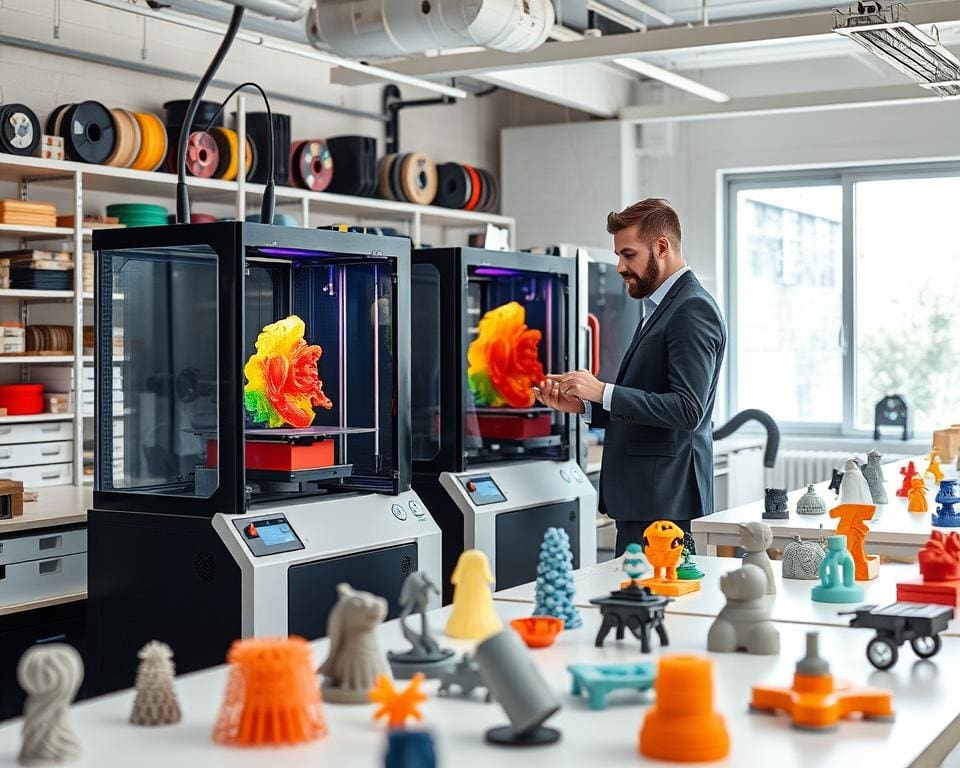
You work in product development and you need to know how 3D printing, or additive manufacturing, reshapes the way products reach market. This opening section explains how timelines, costs and design freedom change when you adopt rapid prototyping and DfAM practices.
Adopting additive manufacturing brings clear benefits. You can shorten iteration cycles through rapid prototyping, cut tooling costs, and explore complex geometries that reduce weight or consolidate parts. Siemens uses metal additive manufacturing for gas turbine components to trim lead times, and GE Aviation’s 3D printed fuel nozzles show how consolidation can boost performance.
That said, 3D printing complements rather than replaces established methods. For high‑volume consumer items, injection moulding and CNC machining often remain more economical. You should also bear in mind material limits, surface finish and regulatory hurdles that affect some sectors.
In the United Kingdom, the technology matters across aerospace, medical and consumer goods. Rolls‑Royce and BAE Systems are integrating additive parts, the NHS and private clinics use 3D printed implants and surgical guides, and startups exploit desktop and industrial printers for fast experiments. Government support and Catapult centres such as the National Manufacturing Institute Scotland help accelerate manufacturing innovation.
In the sections that follow you will see how 3D printing transforms prototyping and design iteration, how it scales into production, how customisation changes supply chains, and what material, quality and regulatory issues to watch when you adopt additive manufacturing.
How 3D printing transforms prototyping and design iteration
3D printing speeds the journey from idea to tested part, so you can move from CAD to physical items in hours or days rather than weeks. Rapid prototyping lets teams run more tests, collect user feedback and reduce risk early in development. You will find that faster loops change decision making and make agile, user‑centred design practical for both startups and established manufacturers.
Faster prototype cycles to speed up development
Fused Deposition Modelling, Stereolithography and Selective Laser Sintering each offer quick routes to form, fit and function models. Companies such as Ford and Airbus report prototype lead times cut from weeks to days when they use 3D printed prototypes for usability testing. You can schedule more frequent validation sessions with stakeholders and refine ergonomics or assembly while confidence builds in the concept.
Lower cost of iterating designs and testing multiple concepts
For low to medium complexity parts, additive processes avoid the expense of CNC set‑ups or injection‑mould tooling. Per‑part costs for one‑offs or small batches are often lower when you account for machine hourly rates, polymer and resin price per kilogramme and modest post‑processing. Use desktop printers for early concepts to keep costs down and outsource complex materials or metal parts to service bureaus such as Shapeways or 3T RPD when needed.
Enabling complex geometries that were previously impractical
Topology optimisation, lattice structures and part consolidation unlock weight savings and new performance gains. Automotive brackets with internal lattices and aerospace components that merge multiple fastened pieces into one print illustrate what is possible. Internal channels, organic forms and integrated mounting features now fit within the prototyping toolbox, opening routes to novel product architectures.
Design implications and workflows
Adopt design for additive manufacturing principles early. Orient parts for strength and surface quality, minimise support structures and account for anisotropy and tolerances. Tools such as Autodesk Netfabb, Siemens NX and Materialise integrate topology optimisation with CAD, so iterative design becomes part of your regular workflow. Balance prototype fidelity against final material properties when you plan concept validation tests.
Practical tips for rapid iteration
- Start pilot projects that prove rapid prototyping value on one product line.
- Use desktop printers for quick 3D printed prototypes and move to service bureaus for specialised materials or metal parts.
- Document print settings and post‑processing steps so iterative design changes remain reproducible.
3D printing and production scalability for modern manufacturing
You must judge whether additive methods can move from prototyping into serial production for your parts. Look at metal processes such as Selective Laser Melting (SLM) and Direct Metal Laser Sintering (DMLS) when strength and certification matter. Electron Beam Melting (EBM) suits high‑value aerospace alloys. For polymers, High Speed Sintering (HSS) and Continuous Liquid Interface Production (CLIP) give fast cycle times. Binder jetting works well for sand casting patterns and large batches of customised parts.
Cost drivers shape the case for production additive manufacturing. Consider machine utilisation, build volume efficiency and part packing. Account for material yield, post‑processing steps and labour. Use cost‑per‑part and total cost of ownership (TCO) to compare against machining or injection moulding. Additive becomes economic for complex geometry, low to medium volumes, high customisation or when it reduces assembly and material waste.
Scaling 3D printing calls for clear strategies. You can deploy a fleet of printers on site to raise capacity. Partner with service bureaus such as Xometry or Protolabs when demand fluctuates. You may adopt distributed manufacturing to place production closer to the point of need, cutting lead times and inventory.
Large manufacturers show what is possible with additive manufacturing production at scale. General Electric and Siemens have integrated metal printing into series workflows for fuel nozzles and gas‑turbine parts. Their examples highlight the need for process control, end‑to‑end qualification and design standardisation when moving to serial production.
Quality assurance becomes critical as you scale. Implement machine calibration and document processes from powder to finished part. Use statistical process control and in‑process monitoring such as melt pool surveillance on metal printers. Follow ISO and ASTM standards and insist on material traceability within qualified supply chains.
Distributed manufacturing changes supply chains and carbon footprints. On‑demand spare parts programmes in aerospace reduce inventories and shorten logistics. Near‑net‑shape production cuts material waste, though some metal processes carry higher energy intensity. Balance localised additive manufacturing production against energy and finishing trade‑offs when assessing sustainability.
- Assess tech fit: match SLM/DMLS/EBM/HSS/CLIP/binder jetting to part function and volume.
- Model costs: include machine hours, packing efficiency, post‑processing and TCO.
- Scale smart: choose fleet deployment, bureaus or distributed manufacturing networks.
- Control quality: apply calibration, monitoring and standards for repeatability.
Customisation and personalisation enabled by 3D printing
You can offer bespoke items at scale without the prohibitive tooling costs of traditional manufacturing. Additive processes let you move from one‑off prototypes to repeatable runs, so your product range can include truly personalised products alongside standard lines.
Mass customisation relies on parametric CAD, automated build preparation and digital inventories of configurable designs. These workflows let you change dimensions, material properties and surface finish per order. Variable data manufacturing turns a single master file into many unique outputs with minimal setup time.
For a practical example, dental laboratories use medical 3D printing to produce crowns, surgical guides and dentures that match a patient’s anatomy. Hospitals and clinics also manufacture patient‑specific implants and prosthetics. Companies such as Stryker and DePuy Synthes apply additive techniques for orthopaedic implants, following UK and EU device classification rules and traceability requirements.
Footwear brands have adopted similar methods. Adidas’ Futurecraft 4D and New Balance projects demonstrate how print‑based midsoles and customised insoles deliver fit optimisation. Start‑ups and established labels can use this approach to serve niche markets and direct‑to‑consumer channels with custom footwear options.
Design strategies should favour families of parts that share interfaces and allow configuration without redesigning the whole product. Use modular design and parametric rules to reduce SKUs and speed up order fulfilment. Lattice structures and variable stiffness regions can be tuned per user, giving a personalised comfort or performance profile.
Operationally, you need systems for digital file security, version control and production planning. Capture customer data through scanning or simple measurement inputs, then validate models before printing. Post‑processing and finishing are critical for consumer‑facing items; you must set clear expectations for surface quality and lead time when offering bespoke manufacturing.
Material, quality and regulatory considerations when using 3D printing
You should start material selection by mapping functional needs to 3D printing materials. Thermoplastics such as PLA, ABS, Nylon (PA), PEKK and PEEK suit many mechanical and thermal needs, while photopolymer resins are common for SLA/DLP parts that require fine detail. Metal powders — stainless steel, titanium Ti‑6Al‑4V, aluminium and Inconel — cover high‑performance aerospace and medical uses. Composite and filled materials add stiffness or conductivity. Check material certification from suppliers such as EOS, Renishaw and Stratasys to confirm grade, traceability and stated properties before you commit.
Quality control drives reliable outcomes in additive manufacturing quality. Implement material certification and batch traceability, incoming inspection, and build parameter validation as routine steps. Use non‑destructive testing — including CT scanning for internal defects in metal parts — alongside mechanical testing (tensile and fatigue) and surface finish measurement. Process validation should include first article inspection and process capability studies, aligned with ISO/ASTM for additive standards and the outputs of the ISO/ASTM F42 committee.
Regulatory compliance is essential if your product enters regulated markets. For medical devices, follow the EU Medical Device Regulation (MDR) and MHRA guidance in the UK for custom devices. Aerospace parts demand conformity with EASA or UK CAA pathways and industry certification. Maintain design history files, risk assessments, digital and material traceability, and collect clinical or performance data where required. Clear documentation eases audits and supports submissions.
Post‑processing affects both performance and approval. Heat treatment, stress relieving, machining, surface finishing and sterilisation reduce porosity and control surface roughness, which in turn influence mechanical strength and the acceptability of parts under regulatory review. Protect your intellectual property and digital assets by using encrypted transfers, secure cloud platforms and contractual safeguards when sharing CAD files with print bureaus. Finally, follow a practical checklist: define functional requirements, choose the right material and process, perform a DfAM review, validate with test builds and mechanical testing, verify supplier qualifications, and document traceability to support regulatory submissions and consistent additive manufacturing quality.