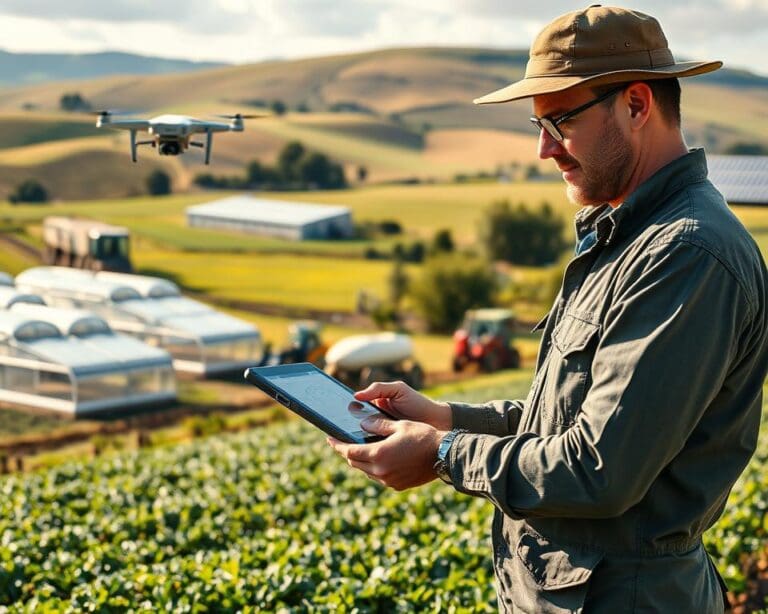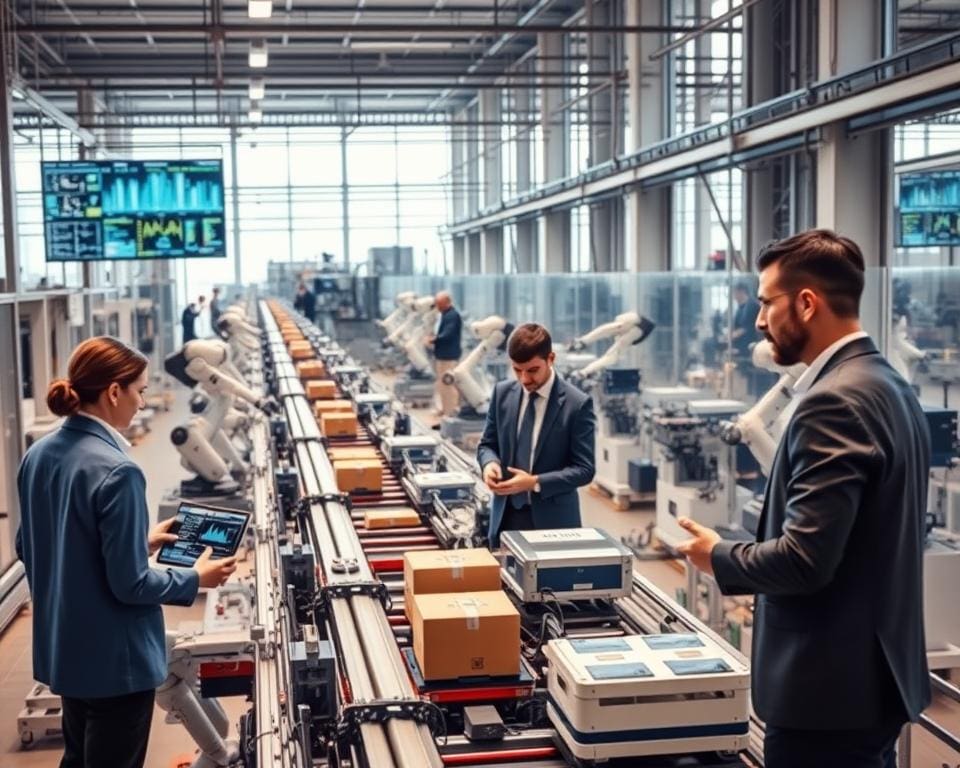
A smart factory brings digital technologies, connectivity and factory automation together to create a data-driven production environment. You will see machines, sensors and software work as one system that responds to demand, equipment status and supply-chain changes in near real time.
Your main goals are higher throughput, reduced cycle times and lower operating costs. With manufacturing optimisation, you can also expect better product quality and improved resource use for energy, materials and labour.
Measure progress with clear KPIs such as Overall Equipment Effectiveness (OEE), first-pass yield, mean time between failures (MTBF) and lead time reduction. These figures show whether your move to Industry 4.0 delivers the promised gains.
In the UK, initiatives like the Government’s Made Smarter Programme are driving adoption across automotive, aerospace, food & beverage and pharmaceuticals. British manufacturers focus on digital adoption, workforce upskilling and sustainability to stay competitive.
Smart factory projects touch operations, maintenance, quality, IT, supply-chain and senior management. You need cross-functional governance, a data strategy and clear ROI metrics before you start deployment.
Prerequisites include robust networks, cybersecurity, and clean, standardised data. Expect obstacles such as legacy equipment integration, workforce resistance and initial capital expenditure; mitigate risk with phased pilots.
Short-term wins often include downtime reduction and basic automation. Medium-term gains come from predictive maintenance and improved yield, while long-term transformation delivers flexible mass customisation and continuous optimisation.
How a smart factory transforms manufacturing processes
You will see change across shop floors when smart systems connect machines, people and data. Sensors and gateways feed live metrics into dashboards and manufacturing execution systems so you gain instant clarity on throughput, utilisation and bottlenecks. This visibility is the foundation for IoT in manufacturing and real-time production monitoring that drives faster decision-making.
Integration of IoT and real-time data
IIoT devices such as vibration, temperature and motor-current sensors collect machine and environmental readings continuously. Edge computing pre-processes data to cut latency and network load before sending summaries via OPC UA or MQTT to SCADA and MES platforms.
You can use those feeds for condition-based alarms, trend charts and automated reports. A common example is spotting bearing wear from rising vibration and current, then scheduling maintenance before a breakdown affects output.
Automation of repetitive and hazardous tasks
Robots and fixed automation now handle welding, palletising and heavy lifting with repeatable pace and accuracy. This reduces manual risk and raises throughput per shift while lowering incident-related downtime and insurance costs.
Collaborative robots let your staff work side-by-side with machines for assembly and inspection. You free skilled operators from repetitive tasks so they can focus on optimisation and quality activities that add more value.
Flexible production lines and rapid reconfiguration
Modular cells and plug-and-play equipment let you change product runs quickly. Standardised interfaces, quick-change tooling and digital work instructions support batch-size-one and agile responses to customer demand.
Flexible manufacturing gives your business faster time-to-market and cost-effective customisation. Practical steps include modular fixturing and SKU rationalisation to keep changeovers short and predictable.
Improved quality control through predictive analytics
Data from in-line vision systems and process sensors trains machine-learning models that predict defects before they occur. Closed-loop control can then tweak setpoints in real time to keep tolerances tight and reduce scrap.
Tools from Siemens, Rockwell Automation and Cognex can help you integrate inspection, analytics and action. The result is fewer defective parts, higher first-pass yield and lower warranty exposure thanks to predictive quality control.
Key technologies that drive production efficiency
You will find several core technologies that transform how factories run. Each one feeds real-time insight, reduces waste and speeds up decision-making. Together they form a toolkit for modern manufacturing.
Industrial Internet of Things (IIoT) sensors and connectivity
IIoT sensors such as temperature, vibration, pressure, current and vision devices give granular visibility into machine health and process variables. That visibility supports rapid responses to anomalies and helps you target inefficiencies.
You must choose the right network architecture for each site. Wired Ethernet offers deterministic traffic for critical control loops. Wireless options like Wi‑Fi 6, 5G and LoRaWAN provide flexibility for mobile assets and remote areas.
Legacy PLCs often need protocol gateways or edge retrofits to interoperate with modern devices. Protect your estate with network segmentation, device authentication, TLS encryption and a robust firmware update policy to reduce risk to industrial control systems.
Artificial intelligence and machine learning for optimisation
AI and machine learning manufacturing use cases include predictive maintenance models that forecast failures from vibration patterns, process optimisation that tunes parameters to maximise yield and demand forecasting for planning.
Supervised learning suits anomaly detection while reinforcement learning can handle dynamic scheduling. You must invest in quality labelled data, careful feature engineering and regular retraining to keep models accurate.
Practical platforms such as Microsoft Azure IoT, AWS IoT and Siemens MindSphere provide managed pipelines and deployment tools so you can operationalise models without building everything from scratch.
Robotics and collaborative robots (cobots)
Industrial robotics cover high-speed, high-precision arms for assembly and machining. Mobile robots, AGVs and AMRs move parts across the plant. Cobots work alongside operators to handle shared tasks safely.
Integration points include vision systems for part recognition and safety systems like light curtains and safety‑rated monitored stops. Programming can be done offline or by lead‑through teaching to reduce commissioning time.
Calculate ROI from cycle time gains, lower labour cost per unit and higher throughput, weighed against capital expenditure and ongoing maintenance. Clear metrics help justify investment to stakeholders.
Digital twins for simulation and what-if analysis
A digital twin simulation is a virtual replica of equipment, lines or entire plants that mirrors live data. It lets you run tests, verify reconfigurations and assess control changes without touching production.
Use cases range from capacity planning to predicting the throughput impact of equipment upgrades and estimating energy consumption under new schedules. Twins speed decision-making and cut the cost and risk of physical trials.
Vendors offer solutions that integrate with MES and ERP systems so simulations can feed execution. That closed‑loop approach ties planning directly to production results and shortens the feedback cycle.
If you want an overview of emerging technologies that complement these tools, read a concise summary on emerging tech trends for businesses to see how they fit into a broader strategy.
Business benefits and practical steps to implement smart factory strategies
You will see tangible business benefits from smart factory implementation: reduced downtime through predictive maintenance, lower material and energy use from optimised scheduling, and improved yield with fewer defects. These gains translate into production cost reduction and faster return on capital, so your ROI smart factory calculations often show payback in months for targeted pilots rather than years.
Start with a clear business case and prioritise high-impact, low-complexity pilots such as predictive maintenance on critical assets or a vision-based quality check for a high-defect SKU. Audit your systems, map workflows and ensure deterministic networking, edge compute and secure cloud connectivity before wider roll-out. Use measurable KPIs — OEE, MTTR, yield and energy per unit — to prove value and iterate quickly.
Invest in skills and change management manufacturing: train operators, engineers and data specialists, secure executive sponsorship and create cross‑functional teams. Work with established vendors like Siemens, ABB or Schneider Electric for core control, and partner with specialised suppliers for AI or vision solutions. Follow industrial cybersecurity frameworks (NIST, IEC 62443) and maintain governance, data residency and vendor risk reviews.
Measure continuously and scale fast once pilots validate outcomes. Maintain dashboards and alerts to track cycle time, lead time and cost per process, and embed improvement cycles so your manufacturing digital transformation keeps delivering competitive advantage. For practical tools and examples on boosting productivity across workflows, see this productivity resource how digital tools boost productivity.