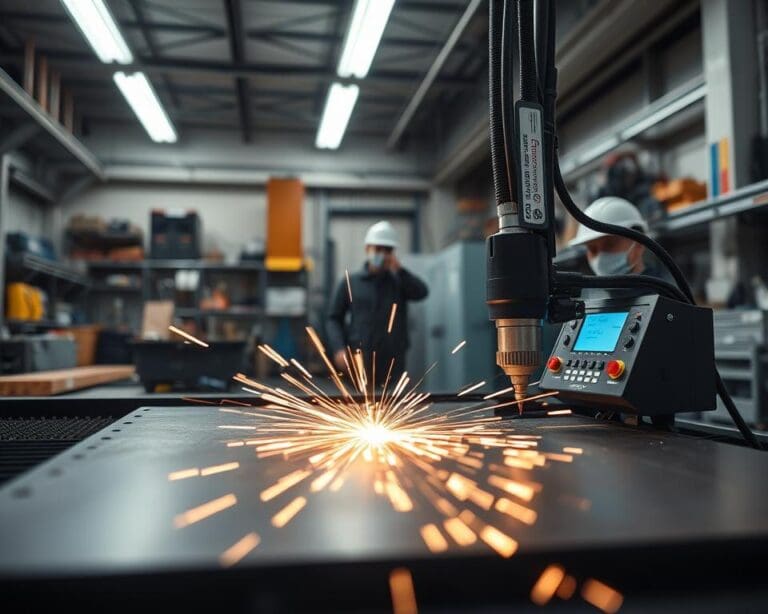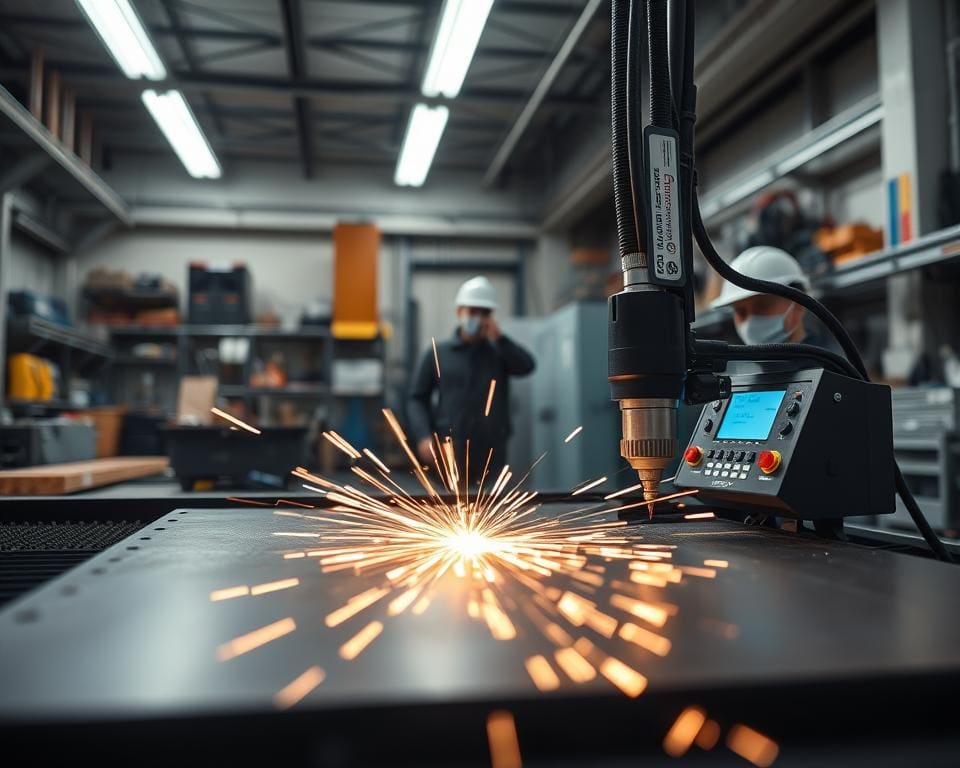
When you look to raise production quality in UK manufacturing, laser cutting is a practical route to faster, cleaner and more consistent parts. Laser fabrication uses a focused beam of light — typically CO2, fibre or diode-pumped lasers — to melt, vapourise or blow away material without contact, so you avoid mechanical distortion and tool wear that can undermine manufacturing precision.
The principal advantages for quality are clear: high repeatability, a narrow kerf and a reduced heat-affected zone when process control is applied correctly. These traits translate into improved edge integrity, minimal mechanical stress and fewer rejects, which lowers rework rates and improves assembly consistency across batches.
Different laser sources suit different tasks. CO2 lasers remain useful for non-metallics and some sheet work, while fibre lasers excel across thin-to-thick metals; diode-pumped systems offer compact, energy-efficient options. Understanding these differences helps you choose the right technology for your application and captures the main laser cutting benefits for your product mix.
This article will guide you through how laser cutting enhances dimensional accuracy, material compatibility and surface finish, and how it boosts throughput through automation and inline measurement. You will find practical takeaways for specifying laser cutting in production, selecting equipment or suppliers, and metrics to monitor such as tolerance, repeatability, scrap rate and cycle time.
For an overview of supporting devices and metrology that protect precision investments, see this resource on precision engineering tools and alignment techniques from TopVivo here. Applying the right measurement and thermal-stability practices will help you lock in manufacturing precision across your laser-cut workflows.
How laser cutting enhances precision and dimensional accuracy
When you need parts that fit first time, precision laser cutting gives you a clear advantage. Modern systems combine tight beam control with advanced motion axes to deliver remarkable dimensional accuracy across a wide range of materials and thicknesses.
Beam control and repeatability
You benefit from CNC-regulated lasers that use galvanometer scanners or linear motion systems with closed-loop encoders to reach sub-millimetre and micron-level positional accuracy. Fibre lasers commonly achieve positional accuracies around ±0.05 mm, with repeatability often within ±0.01–0.02 mm under stable conditions. Beam quality (M2), focus optics and the choice of assist gas, such as oxygen or nitrogen, all influence the consistency of cut profiles.
To keep repeatability reliable, you must manage machine calibration, thermal stability, work-holding and fixturing, plus routine maintenance of optics and filters. Galvanometer systems add very high-speed, repeatable cutting for intricate shapes while motion-axis machines handle larger format panels with the same repeatability goals.
Tighter tolerances compared with traditional cutting methods
Compared with shearing, sawing, plasma or waterjet, laser cutting produces a much narrower kerf and finer detail without the effect of tool wear. That allows you to hold tighter tolerances and create finer features straight from the machine, often reducing the need for post-machining.
Typical laser cutting tolerances commonly range from ±0.1 mm down to ±0.02 mm, depending on material, thickness and machine class. Mechanical methods usually show larger variances due to tool deflection and wear, which can force extra finishing work to meet the same dimensional accuracy.
Minimising part-to-part variation for consistent assemblies
Keeping beam parameters constant, using repeatable clamping and applying automated nesting delivers near-identical parts across a batch. This reduces fettling and helps you achieve consistent assemblies for welded frames, enclosures and consumer products.
Inspection-driven controls extend this reliability. You can apply statistical process control, in-line metrology like laser scanners or CCD cameras, and closed-loop feedback to adjust parameters and maintain dimensional consistency. Industries where tight part-to-part consistency matters include aerospace brackets, medical device components, precision sheet-metal assemblies and automotive parts.
laser cutting for material versatility and surface finish
Laser cutting gives you wide material compatibility and predictable surface finish across many applications. You can process metals, plastics, composites, wood and textiles with a single platform when you pick the right laser type and parameters for the job.
Common laser cutting materials include mild steel, stainless steel, aluminium, copper and brass for metalwork. On the plastics side, acrylics and polycarbonate respond well to CO2 and fibre systems when you set power and speed correctly. Composite cutting covers CFRP and GFRP, where extraction and fume control are essential to protect operators and equipment.
Reflective metals such as aluminium and copper may favour fibre lasers with higher peak power. Thermoplastics can soften or melt if you use excessive heat, so you must adjust focus and speed. For stainless steel, nitrogen assist gives oxide-free edges. For mild steel, oxygen boosts speed at the cost of a lightly oxidised edge.
Reduced need for secondary finishing and deburring
Well-tuned laser processes deliver small kerf widths and tight edge quality that cut down manual filing, grinding or tumbling. In many fabrications you will find finished-edge tolerance and cosmetic quality meet final assembly requirements without extra labour.
Thick sections, some plastics that reflow, and surfaces needing ultra-fine roughness still require secondary work. Process optimisation aims for deburring reduction rather than its complete removal in every case.
How heat input affects edge quality and strategies to control it
Edge quality and heat-affected zones depend on power density, cutting speed, focus position and assist gas choice. Excess heat can create dross, kerf taper or recast layers. Low heat may leave incomplete cuts or rough edges.
- Optimise focal position to concentrate energy where you need the cut.
- Use pulsed or modulated beams for heat-sensitive materials to limit thermal spread.
- Adjust cutting speed and power to balance penetration with minimal HAZ.
- Select assist gas and pressure to control oxidation and blowout of molten material.
- Employ active cooling, fixturing and good extraction for composite cutting to manage fumes and heat.
Advanced machines can tune parameters in real time and mix gases to maintain consistent surface finish and edge quality across varying thicknesses. Proper filtration and extraction remain vital, especially when you process plastics and composite materials.
Process efficiency and production throughput improvements
Laser cutting drives clear gains in manufacturing efficiency by compressing task times and cutting manual steps. On thin to medium gauge steels and aluminium, high cutting speeds and high‑power fibre lasers deliver faster cycle times than mechanical methods. That shortens lead times for prototypes and small batches, so you can respond to changing demand and improve delivery performance.
Automation lifts throughput further when machines talk to your factory systems. CNC control and robotic part loading reduce handling delays and human error. You can add pallet changers, automatic nozzle changers and conveyors to keep cells running across shifts with less supervision.
Nesting software plays a key role in reducing waste. Smart nesting arranges parts to maximise sheet use and to cut down on pierces and rapid moves, which boosts material yield and reduces cost per part. Typical sheet utilisation gains range from a few percent up to 10–20% depending on geometry and nesting sophistication.
Integrating laser automation with MES or ERP systems gives you live data for scheduling and traceability. Predictive maintenance and remote monitoring cut unplanned downtime and raise uptime. These features help you measure baseline performance and track improvements in OEE and labour hour savings.
Smaller run economics change in your favour because there are no dedicated tools to set up. Flexible nesting and cobots let you make customised parts without heavy tool investment, lowering scrap and rework. That improves first‑pass yield and shortens payback on automation projects.
You can learn more about how robotics and data-driven optimisation amplify these gains at manufacturing efficiency insights.
Quality assurance, inspection and cost-benefit of laser cutting
You should use a mix of metrology tools for laser cutting inspection to keep quality assurance robust. Coordinate measuring machines (CMMs), optical profile scanners and non-contact laser scanners each measure dimensions and hole locations with high accuracy. Vision systems can run in-line checks for edges and features, so you spot deviations without halting production.
Process control matters as much as inspection. Implement statistical process control (SPC), first-article inspection (FAI) and in-process sensors that monitor beam intensity, focus and assist-gas flow to maintain consistency. Embed job IDs from nesting software and keep digital records for traceability; these practices support audits and supplier approval under standards such as ISO 9001 and relevant sector regulations across the UK and EU.
When you carry out a cost–benefit analysis, compare capital expenditure for laser equipment against outsourcing to a specialist job shop. Include operating costs — electricity, assist gas, maintenance and consumables — plus labour savings from automation and lower secondary-processing spend. Typical manufacturing ROI drivers are high-mix, low-volume work, frequent design changes and parts needing fine features or tight tolerances; outsourcing can give immediate quality gains without capital outlay.
Track pragmatic metrics to measure impact: cost per part, scrap rate, throughput (parts per hour), first-pass yield and lead-time reductions. Establish KPIs before you invest, and run pilot batches or supplier trials to gather empirical data. If specified and controlled correctly, laser cutting improves precision, surface finish and yield, reducing waste and delivering a clear manufacturing ROI for UK producers.